
Groundwater open loop
Source yield, water quality, pumps and permitted return/discharge determine feasibility; a unit quote does not include wells by default.
 HVAC & REFRIGERATION
A system-concept publication rather than an exact machine schedule: establish the groundwater, buried-loop or surface-water source before selecting the heating/cooling duty.
From Shandong Hangli Air Conditioning Group Co., Ltd.
Individual product research · HVACDeck Editorial · Sources checked 2026-10-11
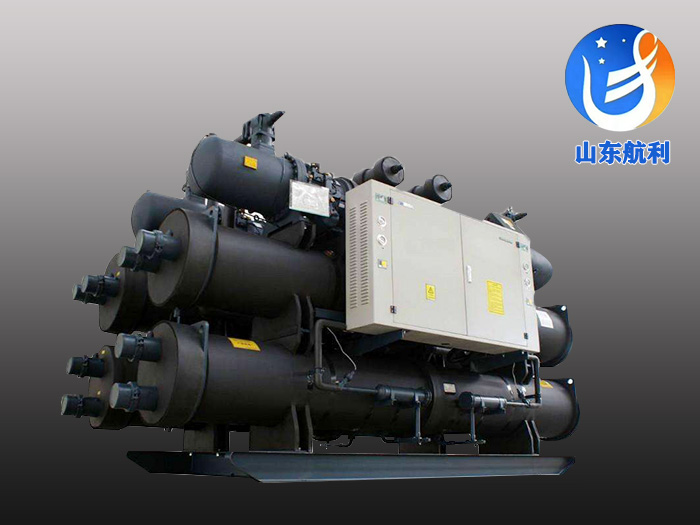
Hangli’s actual official publication, dated 15 November 2019, explains groundwater open-loop, soil closed-loop and surface-water heat-exchange arrangements. It is filed under an air-source navigation category, but its title and body concern water/ground-source heat pumps. That navigation label does not change the described source concept or establish a specific air-source model.
Two original photographs show large framed assemblies with cylindrical heat-exchanger shells, pipework and control cabinets. They provide no readable model plate or performance table. The page has no exact order code, capacity/input schedule, source/load flow or water pressure-loss data. Its historical energy and subsidy promotion is not adopted here as a current rating, financial promise or project approval.
This is an equipment family; its range does not identify one orderable configuration.
Swipe the table, or focus it and use arrow keys, to read the conditions and sources.
| Parameter | Published value | Conditions and evidence |
|---|---|---|
| Official item | 水地源热泵机组 · published 2019-11-15 | General system explanation, freshly read in this review; no named appliance model. Source |
| Described sources | Groundwater open loop · horizontal/vertical buried loop · surface-water exchange | Concepts, not proof of source availability or a complete selected installation. Source |
| Equipment images | Framed assemblies with exchanger shells, pipework and control cabinets | Actual photos viewed; no readable model/rating schedule. Source |
| Unpublished selection data | Heating/cooling capacity, input, source/load flow, pressure loss and operating limits | Must be obtained for an exact offered model and site conditions. Source |
For groundwater, obtain actual seasonal water temperature, sustainable flow and water analysis. Determine abstraction, return/discharge, pumping and treatment responsibility with the responsible local designer. The supplier’s general temperature statement is not a site measurement. If an isolation exchanger is needed, account for its temperature approach and pumping rather than select the machine at untreated well-water conditions.
For a buried loop, establish available land/borehole layout and the ground thermal data needed by the source designer. For a water-body exchanger, establish seasonal levels, temperature, volume/depth and access/protection. The DOE consumer guide similarly distinguishes loop types and site constraints; it does not certify Hangli equipment or provide the buyer’s source design.
Source yield, water quality, pumps and permitted return/discharge determine feasibility; a unit quote does not include wells by default.
Define ground conditions, drilling/trenching, loop design, antifreeze and flushing/testing scope.
Check seasonal water conditions and the selected exchanger location, protection, access and hydraulic connection.
State building/process heating and cooling loads, required load-side supply/return temperatures and source-side entering/leaving conditions for each mode. Ask for exact-model capacity and electrical input at those points, together with permitted flow, pressure loss and operating limits. A generic heat-pump category has no single kW or COP that covers these combinations.
The unit moves heat between the load and source. In heating, source extraction and compressor input contribute to delivered heat; in cooling, source rejection includes cooling and relevant input energy. Use the selected machine’s actual schedule when designing the source circuit. Do not size source works solely from the building’s peak cooling or heating number.
A source sized only around one peak does not establish long-term performance. Provide seasonal load profiles and operating hours, particularly where heating and cooling are strongly unbalanced. Ask the source designer how the chosen layout and controls address cumulative extraction/rejection and projected entering-water temperatures. This is project-design guidance, not a measured Hangli result.
Define backup or supplementary heat/rejection only through an actual system design. Check simultaneous demands and changeover requirements, and clarify whether domestic hot water or process heat belongs in the offered scope. The general statement that a heat pump can heat and cool does not prove simultaneous delivery or a particular hot-water temperature.
Hangli’s old page includes a general 4–5 output-to-input statement without a selected model or test conditions. It is not reproduced as the machine’s rated COP here. Request manufacturer capacity/input at the specified conditions and define whether that input includes auxiliary equipment.
For an operating comparison, include source and distribution pumps, controls and any backup/auxiliary heat within the agreed system boundary. Pumping head and runtime can materially alter total consumption; unit COP alone does not establish project savings. Any annual estimate needs actual loads, weather/source behaviour, control strategy and energy prices, rather than the dated webpage’s financial promotion.
Approve a hydraulic drawing showing both circuits, connections, valves, strainers, air/dirt removal, expansion/filling and flow proving as applicable. Identify antifreeze type/concentration where selected and the unit’s material/water-quality limits. The publication does not specify these for an exact appliance. Obtain isolation and service clearances for the heat exchangers and pumps.
Agree flow/freeze protection, temperature limits, mode changeover, pump sequencing and failure handling with the unit and plant controls suppliers. Check electrical supply, current/protection, communication and sensor positions on a current schedule. A cabinet photograph cannot prove the required controls or network compatibility.
No present price, MOQ, lead time or warranty is established by the reviewed publication. Assign source investigation/construction, unit delivery and commissioning to named parties, with separate evidence and acceptance milestones.
Approve source feasibility and seasonal conditions; issue load-side duties and the complete source/load hydraulic boundary.
Confirm full model, both-mode performance, operating limits, drawings, electrical/control schedule and relevant test evidence.
Verify source works, flow, temperature, protections and delivered heating/cooling at agreed conditions; record complete-system energy and hand over maintenance documents.
Compiled by HVACDeck Editorial. Source review identifies what the publication states; it is not an independent performance test or certification.
Editorial method and corrections · Report a detail with this page URL
Send the manufacturer your required duty, installation conditions and the unresolved items identified in this brief.