
Chiller quotations: full-load and part-load performance
Build a comparison that states the duty, rating basis and equipment boundary.
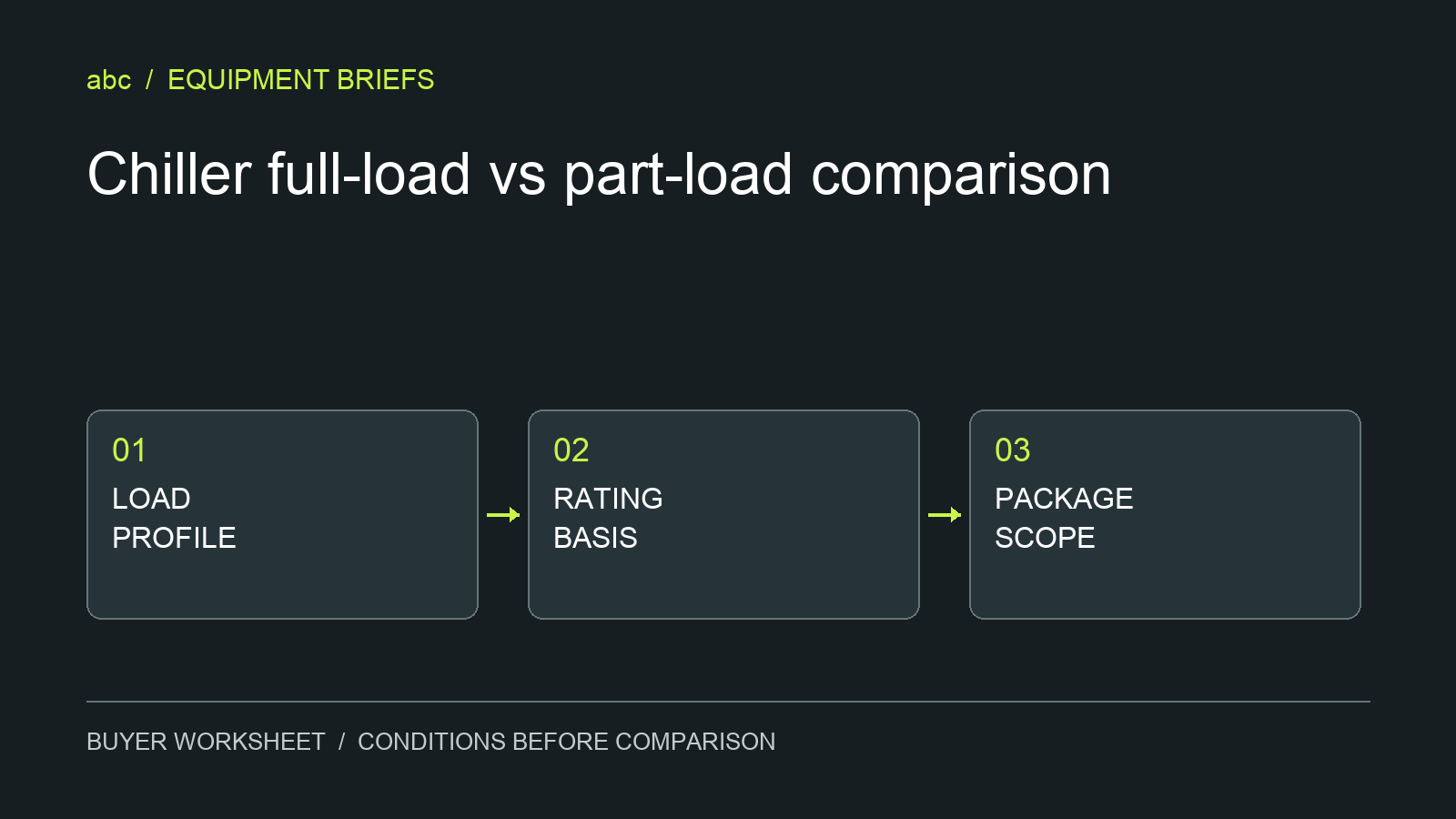
Two chiller quotations can show the same cooling capacity and still describe different equipment duties. Before ranking prices or efficiency figures, establish what each number measures. This guide proposes a document comparison workflow; it does not estimate energy savings or set a project efficiency threshold.
Separate the selection questions
U.S. Department of Energy FEMP purchasing guidance distinguishes air-cooled and water-cooled chillers and considers whether equipment is intended mainly for full-load or variable-load operation. It also pairs the main efficiency requirement with a complementary requirement at the other operating condition. This is useful context for asking suppliers about both duties, rather than selecting a unit on one headline number.
FEMP's procurement rules apply within their stated scope. They are not proof that a supplier in this directory has a certified or compliant model. Verify the applicable requirement for the actual project and the precise unit offered.
Create a rating-basis row
Ask each bidder for the selected model, cooling output, chilled-fluid temperatures, fluid composition, flow and condenser-side conditions. Request the test or rating basis for the efficiency figure. Keep full-load and part-load values in separate fields with their units and supporting document revision.
Draw the quotation boundary
An equipment offer may describe the chiller alone or a larger package. Use a scope column to identify included pumps, controls, heat rejection equipment, electrical accessories and commissioning. Ask the supplier to resolve ambiguous entries in writing. Do not silently treat an excluded accessory as included merely because another bidder supplies it.
Keep an exceptions register
For every proposed alternative, record the requirement, the supplier's offered value, the document page and the open question. Mark unknown values as unresolved. Retain the original quotation when a revised offer arrives, so the purchasing team can see which conditions or accessories changed with the price.
An example clarification is: please identify the exact rating conditions and whether the stated electrical input includes the auxiliary equipment in your scope. This is more actionable than asking only for the most efficient chiller.
Finish with an evidence-based shortlist
Compare commercial terms only after the duty and scope are aligned. A qualified project designer should resolve operating conditions and system selection; the buyer's role is to preserve those requirements in the enquiry and contract documents. No generic efficiency label substitutes for the selected model's documented performance.
By HVACDeck Editorial · Updated 2026-10-07
References and scope
Technical references support the points identified in this guide. They do not certify any directory supplier.
Download blank quotation worksheet (CSV) Buyer requirements, supplier response, document revision and clarification status. Blank fields are not product ratings.
Chiller quotation worksheet
Use this procurement workflow to turn a catalogue enquiry into a comparable supplier response. The blank worksheet below separates buyer requirements, supplier declarations and evidence still to obtain.
Separate the cooling duty from the heat-rejection duty
State whether the chiller serves comfort cooling or an industrial process. Record fluid type, concentration if applicable, required leaving and entering temperatures and the design cooling duty. Identify the heat-rejection arrangement separately: an air-cooled unit needs its outdoor condition; a water-cooled unit needs a condenser-water schedule and tower/system boundary. A chilled-water temperature range alone is not a selection.
Build a comparable operating schedule
Create a schedule of the load conditions the project expects to operate at and the corresponding temperatures. Ask each supplier to return a selection for that same schedule, identifying the exact model and the limits of its selection software or document. Keep full-load declarations separate from seasonal or part-load metrics and note the stated test/rating basis. Use the project schedule to expose different assumptions rather than treating one headline efficiency number as a complete operating-cost estimate.
Draw the included-energy boundary
List whether the reported input includes only the chiller package or also pumps, tower fans, external controls and auxiliaries. Put excluded equipment in its own schedule. Request minimum-flow provisions, allowable pressure loss, minimum stable load and staging/control behaviour. For a process application, identify the consequences of temperature excursions and shutdowns; ask what restart sequence and redundancy are included, without assuming standby capacity is part of every quote.
Review installation and service requirements
Obtain dimensions, lifting weight, service clearances, connection sizes and electrical protection requirements for the quoted unit. Request the refrigerant designation and charge for that configuration, access to replacement parts and the required commissioning procedure. For water-cooled proposals, ask which party specifies condenser-water quality and treatment. Record whether delivery, installation, start-up and warranty labour are included and where those responsibilities end.
Example return schedule
Editorial enquiry example: “Return exact model, fluid and temperature schedule, cooling duty, declared input and selection basis for each requested condition. Separate package input from external auxiliary loads. Provide pressure losses, minimum flow, minimum stable duty, controls, drawings and exclusions.” The downloadable sheet is blank for buyer and supplier completion; its fields are not performance results for a directory product.
Resolve conflicts before ranking
A quotation cannot be compared on efficiency if its temperature or input boundary is different. Ask for a revised return schedule instead of converting incompatible headline values into a ranking. The DOE reference explains a purchasing distinction between full- and part-load operation in US federal procurement. It does not establish that a listed Chinese series meets a project requirement or any US procurement threshold.
Sources and review scope
- DOE FEMP electric-chiller purchasing guidance · Source checked 2026-10-07 · US federal procurement guidance; its thresholds are not universal project requirements.
Compiled by HVACDeck Editorial · Page updated 2026-10-07. Source review establishes what the document states; it does not independently certify factory capacity or equipment performance.