
Heat pump quotations: compare capacity at the design temperature
Separate a catalogue nameplate value from the duty your project actually needs.
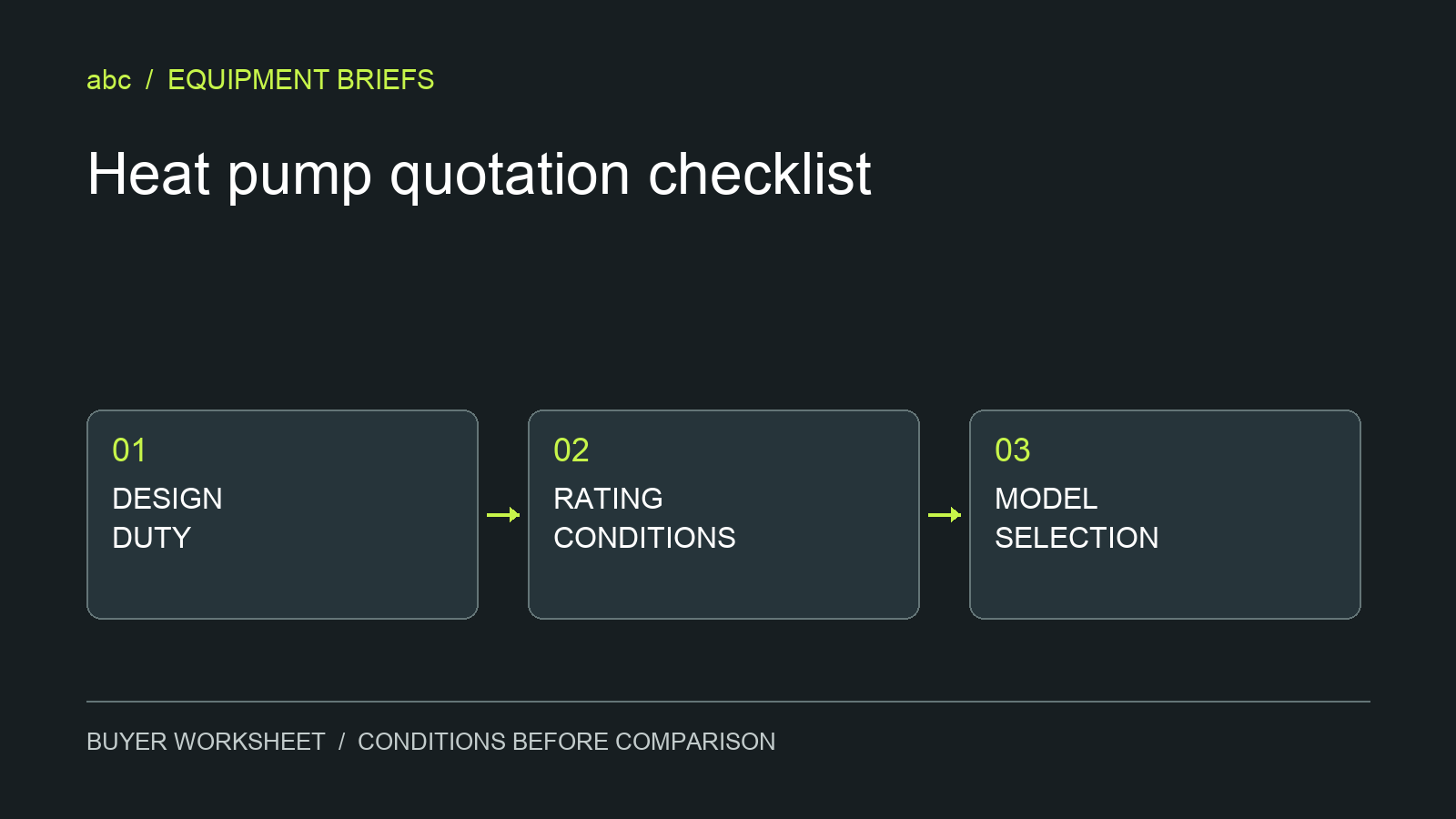
A heat-pump quotation is easier to compare when the operating conditions appear beside the capacity. A single kilowatt figure can refer to a catalogue rating rather than the cold-weather duty required by a building. This brief is a purchasing worksheet, not a sizing calculation or a claim that any listed unit meets a particular project load.
Start with a load and a system boundary
The NEEP sizing guidance hosted by the U.S. Department of Energy distinguishes replacement, displacement and other applications. That distinction matters: equipment serving the whole building has a different role from equipment supporting an existing heating system. Ask the project designer to state the required duty and the conditions at which it applies before requesting a unit selection.
Put the conditions on the same line
For an air-to-water enquiry, ask the supplier to return the selected model with outdoor air temperature, entering and leaving water temperatures, flow and declared heating output. Keep the rated power input beside that output. Record whether auxiliary heating is included. These are requests for supplier evidence; leaving a field blank is more useful than assuming that a headline capacity applies at every temperature.
A useful comparison sheet has separate columns for the buyer requirement, supplier response, document reference and unresolved question. Put the catalogue designation in its own column. Do not convert a family name into an orderable model code.
Ask for the operating envelope
Request the manufacturer's selection output or technical table for the proposed configuration. Ask what happens outside that envelope and how backup heat and controls are intended to operate. The NEEP material is focused on residential air-source applications; it does not establish the performance of an industrial air-to-water unit in this directory.
Send a quotation brief that can be answered
State the project location, application, quantity, design duty, available electrical supply and installation constraints. Attach the designer's conditions rather than asking each bidder to guess them. Ask suppliers to identify exclusions, accessories and the exact documents accompanying their response. Keep engineering selection separate from commercial terms such as delivery scope and warranty.
Before comparing price, highlight every row where the quotations use different conditions. Return those rows as clarification questions. A cheaper offer with an unresolved operating condition is not yet a like-for-like alternative.
By HVACDeck Editorial · Updated 2026-10-07
References and scope
Technical references support the points identified in this guide. They do not certify any directory supplier.
Download blank quotation worksheet (CSV) Buyer requirements, supplier response, document revision and clarification status. Blank fields are not product ratings.
Heat-pump quotation worksheet
Use this procurement workflow to turn a catalogue enquiry into a comparable supplier response. The blank worksheet below separates buyer requirements, supplier declarations and evidence still to obtain.
Start with the job the heat pump must do
Record the project location, required heating and cooling duties and the design calculation reference. State whether the system replaces all heating, serves a separate zone or operates beside an existing heat source. These are different procurement scopes. Identify who owns the load calculation and whether distribution equipment is included. A catalogue family name cannot close these decisions.
Make the quotation describe an operating point
For an air-source proposal, list outdoor dry-bulb temperature, relevant moisture conditions and required delivery temperature. For a water/ground-source proposal, add source-fluid composition, entering/leaving temperatures, available flow and the source-system boundary. Ask the supplier to name the exact unit, configuration and selection-document revision. Request declared output and input at that point, with the test basis identified; do not compare an unspecified nominal label with a project selection.
Check minimum output and system integration
Ask for the available modulation or staging range and the control sequence during light demand. Identify the buffer, circulation and minimum-flow provisions included in the proposal. Record how the existing or backup heat source is enabled, which controller owns that decision and the electrical demand of the complete agreed scope. For equipment with defrost operation, ask how the selection and controls account for it; do not assume the same answer applies to every heat-pump type.
Read the return documents before choosing a supplier
Match the selection sheet to the quoted model code, power supply and accessories. Keep the drawing revision, acoustic declaration and refrigerant documentation in the same quotation folder. Record whether reported sound is sound power or sound pressure, and any distance or operating condition. Ask for the commissioning checklist, service contacts and written warranty conditions. A website claim about efficiency is not a replacement for these documents.
Example request wording
Editorial enquiry example, not a supplied-equipment result: “Please select for the attached heating and cooling loads at the stated source and delivery conditions. Identify the exact model and controller, provide output/input and operating limits at each duty, state backup and minimum-flow requirements, and list exclusions. Mark unavailable data as pending rather than estimating it.” Attach the completed worksheet and a system schematic so all suppliers respond to the same scope.
When to pause the comparison
Keep the quotation pending if its source temperature, delivery temperature, exact model or included electrical loads are missing. Resolve different load assumptions before comparing efficiency or cost. The linked cold-climate guide concerns residential air-source selection; the water/ground-source family in this directory needs its own source-system design. No shortlisted factory is certified by this guide.
Sources and review scope
- NEEP cold-climate air-source heat-pump selection guide, hosted by DOE · Source checked 2026-10-07 · Residential air-source guidance; not a certification or design standard for every water/ground-source or commercial system.
Compiled by HVACDeck Editorial · Page updated 2026-10-07. Source review establishes what the document states; it does not independently certify factory capacity or equipment performance.