
Plate heat exchanger enquiries: the inputs to send
Describe both fluid circuits before asking a supplier to choose an exchanger.
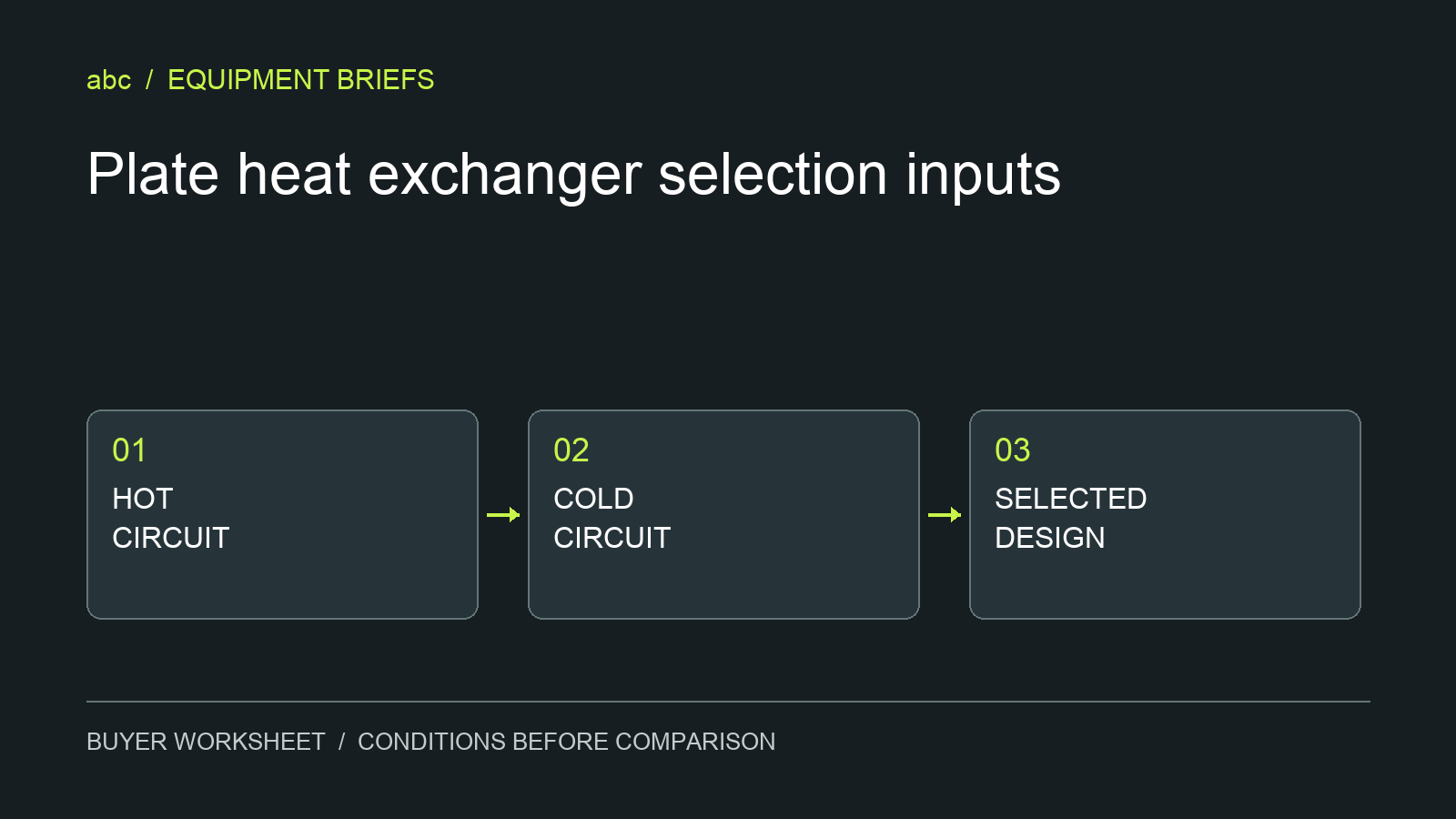
A plate heat exchanger cannot be selected from a photograph or a connection size alone. A purchasing enquiry should describe the two circuits and give the supplier a way to return a documented selection. This worksheet is intended to organise that exchange, not to calculate exchanger size or approve materials.
Identify the application before the construction
Alfa Laval's PHE Select tool describes selection for HVAC water-to-water and water-to-glycol systems and states the operating ranges for which its tool is optimised. That illustrates a useful first question: does the proposed selection method cover the fluids and operating conditions in this enquiry? A selection outside a tool's stated scope needs a different assessment.
Give each circuit its own record
Label the circuits clearly. For each, ask the designer to provide the fluid, concentration where relevant, inlet temperature, desired outlet temperature, flow or heat duty and pressure constraints. Add operating and design conditions as separate entries. If a value is still being established, mark it as pending rather than placing an invented zero in the form.
Use one set of units throughout the brief. If a supplier returns different units, retain the original value and document the conversion used in the comparison. The selected model and the selection document revision should stay attached to these conditions.
Ask the supplier to define the construction
Request plate material, sealing or joining arrangement, connection specification and maintenance provisions for the offered unit. Ask the supplier to confirm fluid compatibility and the applicable design documentation. Do not assume that one model's material or certificate covers every product shown under the same family name.
Resolve omissions before comparing offers
Create a row for every missing condition and assign the question to the designer or supplier. This prevents a bid comparison from rewarding the quotation that made the fewest explicit commitments. Record accessories, insulation, mounting and delivery scope separately from thermal performance.
What a useful response looks like
A complete response identifies an orderable configuration, the conditions used for selection, the performance output and the supporting drawing or datasheet. Ask for deviations from the enquiry to be listed explicitly. Keep unresolved matters visible until they are closed; a directory listing and a product image are starting points for an enquiry, not substitutes for a project selection.
By HVACDeck Editorial · Updated 2026-10-07
References and scope
Technical references support the points identified in this guide. They do not certify any directory supplier.
Download blank quotation worksheet (CSV) Buyer requirements, supplier response, document revision and clarification status. Blank fields are not product ratings.
Heat-exchanger quotation worksheet
Use this procurement workflow to turn a catalogue enquiry into a comparable supplier response. The blank worksheet below separates buyer requirements, supplier declarations and evidence still to obtain.
Write one schedule for each circuit
Label the circuits hot and cold, then record each fluid, concentration, inlet and required outlet temperature, flow and pressure conditions. If duty or outlet temperature has not been established, identify the project engineer who will resolve it rather than sending several conflicting targets. State whether the enquiry covers the exchanger only or also pumps, valves, insulation and instruments.
Expose constraints that change construction
Ask for the proposed exchanger construction, plate/tube and wetted materials, gasket or joining arrangement where relevant and connection standard. Provide the fluid-quality and cleaning constraints that are known. For gasketed equipment, ask how the selected gasket is compatible with the actual fluid and operating conditions. Do not use a stainless-steel or titanium option in a family brochure as proof that it is included in the quoted assembly.
Request the complete thermal and hydraulic selection
The return document should identify the exact model, arrangement, selected surface or plate configuration where applicable, predicted duty and pressure loss for both circuits. Request design pressure/temperature separately from the operating schedule. Ask the supplier to state fouling allowance and any margin it has applied. Record selection assumptions in the comparison so a lower pressure-drop allowance or different fluid does not quietly change the offer.
Plan cleaning and access before installation
Request a drawing showing connections, opening or service space and the mounting arrangement. Identify how cleaning is performed and which parts are replaceable. Ask for a spare-parts list and the maintenance instructions applicable to the quoted construction. A compact footprint in a photograph does not establish the space needed to open, clean or replace the equipment.
Example clarification request
Editorial enquiry example: “Your family page identifies a removable plate construction but not the selected plate count or two-circuit duty. Please return a selection using the attached fluids, temperatures, flows and pressure-loss allowances; identify wetted materials, design limits, connections and service clearance.” Keep the manufacturer reply and its revision with the original buyer schedule.
Decide whether the response is selection-ready
Treat the response as incomplete if either circuit, the material selection or the return selection basis is missing. Resolve inconsistent model labels before accepting a drawing. The linked selection tool belongs to Alfa Laval and has its own supported applications and products; its limits are not limits of the Chinese equipment families in this directory.
Sources and review scope
- Alfa Laval plate heat-exchanger selection workflow · Source checked 2026-10-07 · A manufacturer selection workflow; its product limits must not be transferred to directory suppliers.
Compiled by HVACDeck Editorial · Page updated 2026-10-07. Source review establishes what the document states; it does not independently certify factory capacity or equipment performance.