
Ventilation fan enquiries: define the duty point
Ask for a matched flow, pressure basis and selected configuration.
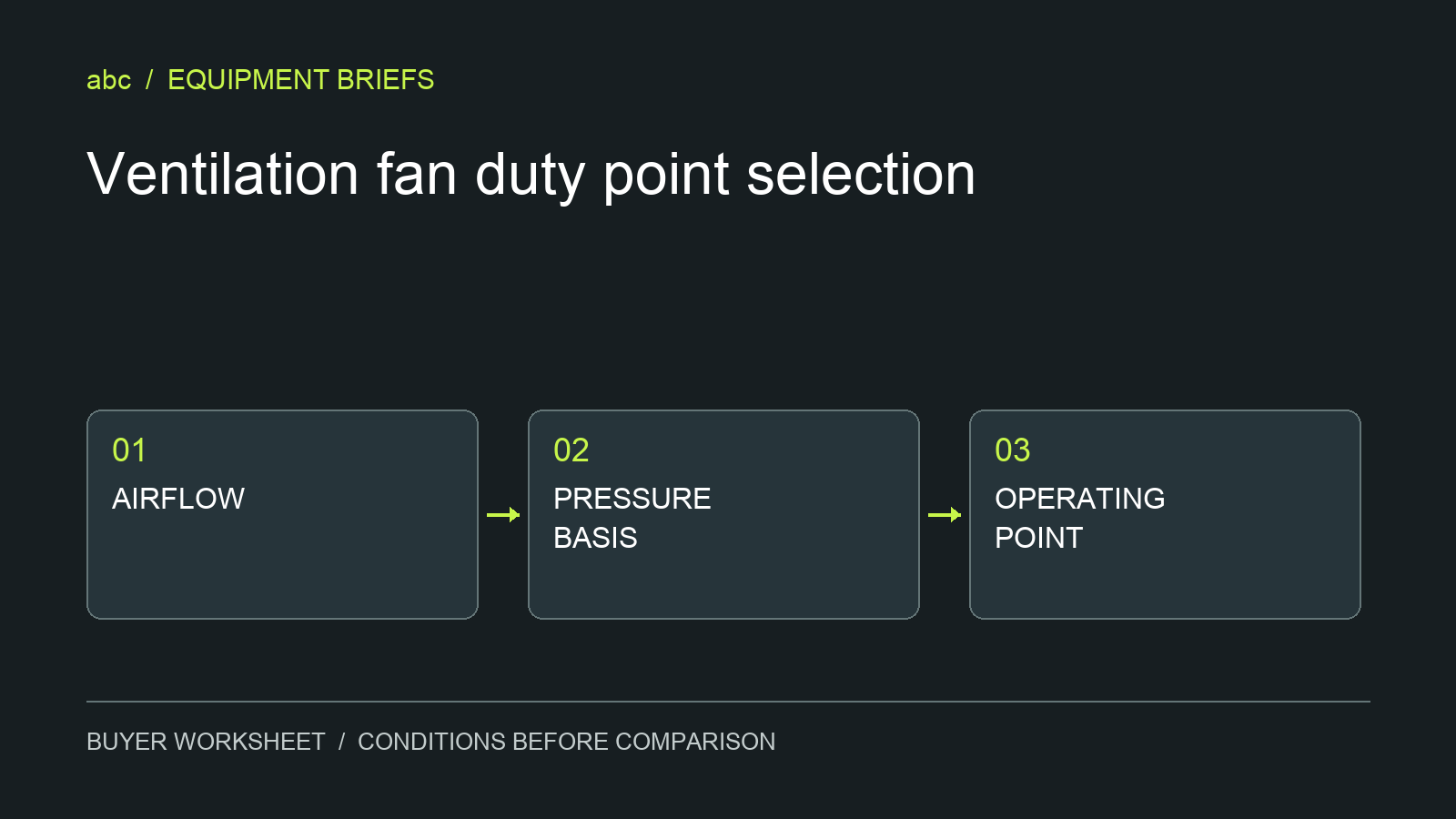
A fan family name does not identify a complete ventilation selection. Buyers need a response that connects the required duty to a particular configuration and its supporting performance information. This guide provides a way to organise the enquiry without inventing a fan curve or an installation requirement.
Match the pressure terminology
AMCA's educational material explains the relationship between airflow and pressure in fan curves. Its guidance on pressure terminology also warns against mixing the system's required pressure basis with a differently stated fan performance basis. Ask the designer and supplier to name the pressure quantity explicitly rather than exchanging an unlabeled pressure number.
Request a marked selection
Ask for the required airflow, stated pressure basis, air conditions and the selected operating point to be shown with the proposed model. Request speed, electrical input and the applicable acoustic information. A curve should identify the tested or rated arrangement and the document revision. It should not be treated as interchangeable with another size in the same product family.
If the initial quotation supplies only a catalogue picture, return a clear request for the selection document. Record which requirement each supplied table or curve addresses. A missing entry is an open question, not evidence of poor performance or proof that a requirement is met.
Record the physical arrangement
Add inlet and outlet arrangements, installation space, service access and electrical supply to the enquiry. Ask the supplier to state the included drive, controls and accessories. Record installation limitations alongside the technical selection so that a later layout change triggers a review rather than leaving an outdated selection in the purchasing file.
Treat special applications separately
Where the project has a special duty such as smoke extraction, ask the responsible designer to identify the applicable requirements and request documents for the exact offered configuration. A series name containing a fire-related term does not by itself establish compliance. This guide does not specify a fire-safety design or approve equipment for that duty.
Close the comparison
Build the shortlist around matched operating conditions and defined scope. Keep performance evidence, installation details and commercial exclusions in separate sections. Before purchase, ask the supplier to confirm the final model and configuration on the same revision of the quotation. This makes the decision traceable without claiming that every unknown can be resolved by a directory page.
By HVACDeck Editorial · Updated 2026-10-07
References and scope
Technical references support the points identified in this guide. They do not certify any directory supplier.
Download blank quotation worksheet (CSV) Buyer requirements, supplier response, document revision and clarification status. Blank fields are not product ratings.
Fan and ventilation quotation worksheet
Use this procurement workflow to turn a catalogue enquiry into a comparable supplier response. The blank worksheet below separates buyer requirements, supplier declarations and evidence still to obtain.
Define the fan duty and installation
State the airflow with units, the pressure requirement and whether that pressure is static or total. Identify the duty location in the system and the inlet/outlet arrangement expected at installation. Record the air temperature, density basis or site conditions that the supplier should use. Include duct layout, filters, dampers and other connected equipment in the enquiry so the supplier can identify what its selection assumes.
Ask for a curve for the selected assembly
Request the fan model, size, speed, configuration and curve document revision. Ask the supplier to mark the proposed duty point and provide the pressure, power and efficiency information associated with that selection. Record which installation/test arrangement the curve represents. A motor nameplate or a large catalogue airflow range does not, by itself, show what the assembly delivers at the required pressure.
Separate motor, controls and accessories
Ask for motor power and electrical supply, starting/control method, speed-control range and protection included in the quote. Identify transmission arrangements and access requirements. If dampers, actuators, flexible connections or silencers are included, list them separately with their own data. A damper operating temperature or actuator voltage printed beside a fan family should not be reused as a fan rating.
Treat smoke duty and general ventilation as different scopes
If the project requires smoke-control operation, request the applicable test/report and selected configuration, and have the project designer confirm the required duty. Record the report’s temperature/time and assembly scope without assuming that an HTF or HTFC label proves compliance. For general ventilation, still request the operating envelope, acoustic basis and maintenance instructions. Keep smoke-control claims outside a comparison until the applicable evidence has been reviewed.
Example supplier request
Editorial enquiry example: “Select the exact fan for the attached airflow and defined pressure duty at the stated air conditions. Mark the point on the applicable curve and identify model, size, speed, power basis, motor, controls and installation assumptions. List accessories separately and provide drawings, sound declaration basis and required reports.” The worksheet is an enquiry aid, not a completed system design.
Handle missing or ambiguous units
If a source lists airflow without a unit, keep the number out of a numerical comparison and ask the supplier to confirm it. Clarify static versus total pressure before comparing curves. AMCA explains how fan curves and pressure definitions relate; it has not tested or certified a directory product merely because its guidance is cited here.
Sources and review scope
- AMCA explanation of fan curves and pressure · Source checked 2026-10-07 · Fan curve interpretation; not a test certificate for the equipment listed here.
Compiled by HVACDeck Editorial · Page updated 2026-10-07. Source review establishes what the document states; it does not independently certify factory capacity or equipment performance.