
No.2.8–6
A drive listed. Confirm selected size, speed, motor, mounting and rotation/outlet orientation.
Read the source HVAC & REFRIGERATION
Single-inlet backward-curved fan family with several size/drive options: require a curve at the required airflow and pressure before selecting.
From Zhejiang Pengxiang HVAC Equipment Co., Ltd.
Individual product research · HVACDeck Editorial · Sources checked 2026-10-11
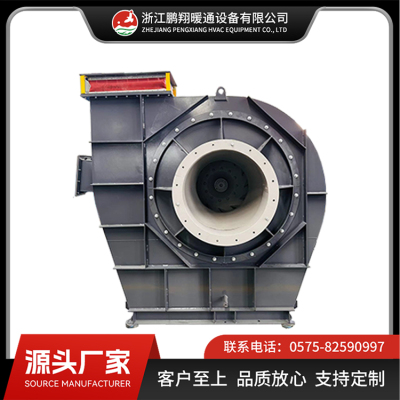
Pengxiang’s original 4-73 page describes centrifugal ventilation fans for factories and large buildings. It gives broad impeller, airflow, pressure and temperature limits, then separates available drives by fan size and identifies optional accessories. This is a family overview, not a table matching each size and speed to one operating point.
Both source photographs were inspected. They show the scroll casing and inlet; one also exposes a belt/drive guard and base assembly. The photographs illustrate a configuration without identifying a legible rating plate, dimensions, speed, motor power or measured performance.
A useful selection begins with required airflow, the specified static/total pressure basis and air conditions. Ask for the selected size/speed curve, absorbed-power data and installation drawing. A series maximum cannot tell a buyer which fan will meet those conditions efficiently and within its operating limits.
This is an equipment family; its range does not identify one orderable configuration.
Swipe the table, or focus it and use arrow keys, to read the conditions and sources.
| Parameter | Published value | Conditions and evidence |
|---|---|---|
| Published configuration | Single inlet; backward-curved centrifugal impeller | Supplier description of the family; exact selected wheel/material remains an order item. Source |
| Impeller range | 280–2000 mm | Series range, not a dimension for every configuration. Source |
| Airflow envelope | 1000–220000 m³/h | No model/speed-specific curve given; extremes do not imply pressure capability at the same point. Source |
| Pressure envelope | Up to 3000 Pa | Family upper statement; selected-duty static/total basis and curve need confirmation. Source |
| Published temperature range | −20°C to 80°C | General family statement; hazardous/corrosive or hot-process duty is not automatically covered. Source |
The family’s upper airflow and pressure numbers cannot be combined into a promised operating point. Request a curve for the exact fan size, rotation and speed, with the pressure definition and air density/test conditions identified. Include the duty and operating range, rather than sending only a catalogue maximum.
Provide required airflow, duct/filter/process resistance, air temperature and other relevant air properties. Ask the supplier to identify absorbed shaft power, motor input assumptions, efficiency and acceptable operation around the selected point. Its general high-efficiency/low-noise description is not a numerical efficiency or acoustic guarantee.
The original page assigns drive letters by fan-number ranges. These identify available configurations, not a motor-power or speed table. The buyer should receive a drawing and drive schedule defining what the offered assembly actually includes.
A drive listed. Confirm selected size, speed, motor, mounting and rotation/outlet orientation.
Read the sourceC or D drive listed. Request the actual transmission arrangement, guards, bearings/coupling or belt schedule and service access.
Read the sourceB, C or D drive listed. Define the complete base/drive assembly and inspection responsibilities in the offer.
Read the sourceThe source offers flexible inlet/outlet connections and spring-type vibration isolation, with inlet adjustment, bearing temperature/vibration monitoring and impeller-cleaning options also mentioned. Their availability does not establish that every offer includes them.
Agree the accessories and their mechanical/electrical interfaces, control/monitoring points and operating requirements. The supplier’s source photos do not replace the bill of materials. Ask how the selected support, isolation, flexible connections and guard arrangement will be installed and maintained at the actual site.
The page describes an explosion-protected variant using an explosion-protected motor and aluminium-alloy impeller. That wording does not provide a gas/dust category, zone, temperature class or complete-assembly approval. It cannot establish suitability for a particular hazardous atmosphere.
If the process requires that duty, give the applicable site requirements to the responsible designer and supplier and obtain a specifically assessed configuration with the relevant documents. Likewise, smoke-exhaust certificates elsewhere in a corporate gallery do not automatically approve the ordinary 4-73 ventilation family for a fire application. Stay within the selected assembly’s documented intended use.
The national standards issuer lists Pengxiang as a drafting participant in industrial-fan balance/vibration and fan-only efficiency-classification standards. Participation is a corporate technical record, not an assigned grade for this family. Request the actual selected fan’s test results and acceptance basis.
The official gallery’s displayed test-system recognition has a printed validity ending in 2024; a 2022 laboratory-comparison document is also historical. Neither is a new model report. Ask for current test-method/range evidence where it matters and check the model, speed, configuration and measurement basis in the report.
Match flow/pressure, speed, density and power/efficiency definition to the offered fan and drive.
Agree the assembly, operating condition, measurement arrangement and acceptance criteria, with traceable results.
Request a defined acoustic metric and test condition; establish installed-system acceptance separately from catalogue fan-only data.
No model-specific outline, weight, flange schedule, electrical diagram or warranty duration was established in the reviewed 4-73 page. Request these for the selected assembly before foundations, duct interfaces or electrical work are finalised.
Approve the size/speed curve, operating range, power and drive, air/process conditions and required special-duty evidence.
Approve rotation/outlet orientation, inlet/outlet dimensions, base/support/isolator drawing, access, guards and included accessories.
Agree inspection and commissioning records, operating/maintenance instructions, identifying details, spare parts and written warranty/service coverage.
Compiled by HVACDeck Editorial. Source review identifies what the publication states; it is not an independent performance test or certification.
Editorial method and corrections · Report a detail with this page URL
Send the manufacturer your required duty, installation conditions and the unresolved items identified in this brief.