
Shangyang scroll-less hot-air insertion fan
Match the chamber and thermal barrier to the exposed-wheel assembly; standard 250°C wording does not qualify an unselected higher-temperature order.
From Zhejiang Shangyang · Industrial centrifugal fan manufacture
Individual product research · HVACDeck Editorial · Sources checked 2026-10-11

Select internal hot-air circulation around the actual chamber
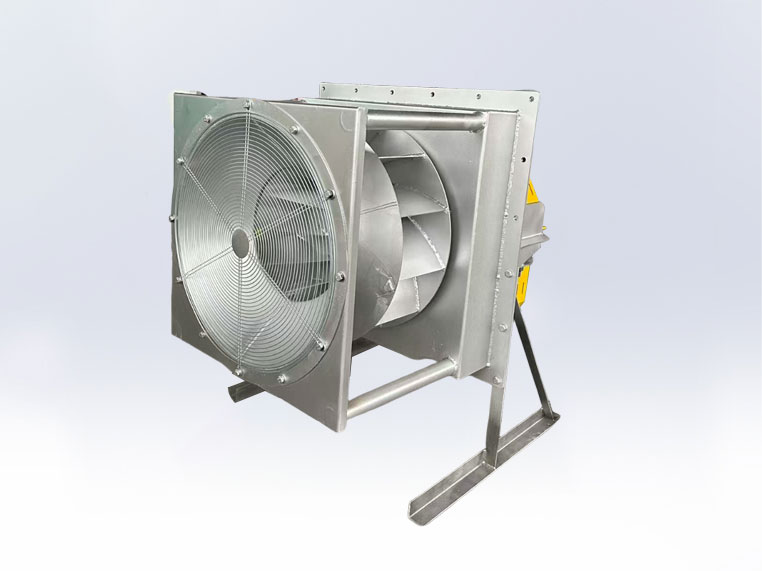
Shangyang describes its scroll-less insertion fan for hot-air circulation inside drying, curing and temperature-controlled equipment. The original photograph shows an exposed wheel within a mounting frame and an inlet guard, unlike a conventional enclosed scroll exhaust unit. Its source assigns a standard hot-gas range at or below 250°C and says higher temperatures require an explicitly upgraded order. No published curve, wheel size, motor power or issued insertion-depth drawing accompanies that description.
The page mentions 100, 150 and 200 mm insulation thickness choices but does not tie them to a particular temperature or ordered thermal barrier. The equipment enclosure and internal flow path are part of the selection, rather than an interchangeable duct connection. Approve the chamber, mounting and motor/thermal arrangement together; a compact exposed-wheel photograph does not establish uniform oven temperature, low sound or reduced energy use for an arbitrary production line.
Published parameters and their scope
This is an equipment family; its range does not identify one orderable configuration.
- Family designation
- Scroll-less insertion family
Swipe the table, or focus it and use arrow keys, to read the conditions and sources.
| Parameter | Published value | Conditions and evidence |
|---|---|---|
| Construction/application | Scroll-less insertion fan for drying, curing and hot-air circulation | Original frame/wheel/guard image inspected; exact ordered dimensions and model code unprovided. Source |
| Standard gas range | At or below 250°C according to the product description | Supplier statement, not an independent test or the motor’s allowable ambient. Source |
| Higher-temperature route | Explicitly ordered wheel, insulation and motor upgrades | No quantified upgraded temperature limit, curve or complete BOM supplied. Source |
| Insulation options | 100/150/200 mm mentioned | No thickness-to-temperature mapping, barrier conductivity or certified fire properties reviewed. Source |
| Custom selection variables | Airflow, pressure, medium, temperature, installation size and motor power | Source identifies inputs but provides no current numerical fan schedule. Source |
| Chamber performance limits | Uniformity, vibration, sound and energy benefits described qualitatively | No independently measured chamber distribution, acoustic data or matched efficiency baseline. Source |
Selection and application review
Define the chamber flow task before selecting the wheel
Provide the oven or curing-chamber arrangement, process load, target operating temperature, circulation path and pressure losses. Identify product racks, partitions and return paths that affect the installed flow. The source offers a scroll-less wheel intended for insertion; it does not supply a selected fan curve for any chamber.
Obtain flow/pressure/input at the actual gas density and operating speed, along with the acceptable operating range. Agree whether the quotation includes only the wheel/motor frame or additional internal flow guides. A supplier’s circulation-uniformity statement does not establish the temperature distribution in the customer’s equipment.
Separate hot gas, motor ambient and an upgraded order
The page states a normal application at or below 250°C and requires higher temperatures to be declared when ordering. Obtain the selected assembly’s continuous/upset gas limit, motor ambient, insulation and cooling arrangement in writing. Do not transfer the homepage’s 1,000-degree slogan into this product’s rating.
Specify temperature duration, startup/cooldown and the motor/bearing location relative to the hot chamber. A wheel upgrade, thermal barrier and a high-temperature motor are described as possible changes, not proof that every pictured unit carries them. Close the current configuration before evaluating availability or price.
Choose insulation through an issued thermal and mounting drawing
The 100/150/200 mm thickness references do not provide a selection table. Ask for the ordered barrier material, thickness, seal, hot/cold-side temperatures and maintenance requirements. Confirm compatibility with chamber movement and the actual mounting interface. No thermal conductivity or fire classification is invented from the thickness alone.
Obtain insertion depth, opening, frame/support loads and clearance to rotating parts. Identify motor service and wheel-removal routes before closing the oven casing. The compact photograph provides an arrangement, not a safe installed clearance or a complete dimensional envelope.
Agree protection, controls and process acceptance
Define speed/control range, thermal monitoring, permissive and shutdown responsibilities with the process-equipment builder. Request the actual wiring, motor/controller and guard arrangement. The exposed-wheel assembly requires an approved equipment integration file, not a general assertion that installation is simple.
Agree how circulation is checked at loaded operating temperature. The product text links circulation to drying and curing quality but supplies no measured process outcome. Establish the customer’s distribution criteria and the method of verification rather than promising elimination of uneven curing.
Keep maintenance and purchase scope measurable
Specify deposits, cleaning restrictions, inspection access and the permitted cleaning/cooldown procedure for the actual material. Obtain supplier maintenance instructions for the ordered bearings, drive and thermal barrier. No generic lubrication or continuous-life interval is substituted for a real manual.
An enquiry should include the chamber drawing, gas/temperature profile, required flow/resistance, utilities and service envelope. Obtain the current selection, material/drive BOM and agreed duty, thermal, vibration and process checks. Price, delivery and independently verified energy or service-life gains remain unknown. This one insertion-family brief consolidates orientation/material variants into the real chamber decision.
Define chamber circulation
Issue gas conditions, load arrangement and flow resistance.
Freeze thermal integration
Approve selected gas/motor limits, insulation and mounting drawing.
Verify loaded operation
Agree duty/control and chamber distribution with service access.
Sources and review scope
Compiled by HVACDeck Editorial. Source review identifies what the publication states; it is not an independent performance test or certification.
- Official scroll-less insertion productChecked 2026-10-11 · Complete product text read, including standard 250°C range, higher-temperature order route and insulation choices.
- Original insertion assembly photographChecked 2026-10-11 · Original wheel/frame/inlet-guard arrangement visually inspected; exact drive and dimensions not established.

Editorial method and corrections · Report a detail with this page URL
Turn the evidence into an enquiry
Send the manufacturer your required duty, installation conditions and the unresolved items identified in this brief.