
Water cooling
Confirm actual entering/leaving temperatures, cooling load, flow, evaporator loss and permissible variation.
 HVAC & REFRIGERATION
Compare water and glycol duties at actual operating conditions, resolve the CRSC/SNSC designation and include the condenser-water system in the selection.
From Wuhan Sinuo Refrigeration Equipment Co., Ltd.
Individual product research · HVACDeck Editorial · Sources checked 2026-10-07
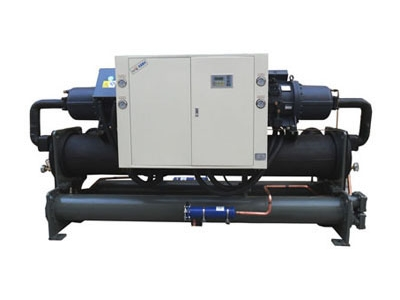
The complete official product text captured and reviewed on 7 October 2026 describes an industrial water-cooled screw-chiller family. Its summary calls the range CRSC while the detailed body says SNSC. The same archived publication distinguishes chilled water, low-temperature ethylene-glycol solution and special temperature-difference requests. No exact order code or model performance table is established by that family text.
During the 11 October review the official URL produced a redirect loop; its HTTPS route also showed a certificate-name mismatch before ending in the same loop. Current page content could not be revalidated. The manufacturer facts below therefore retain the 7 October source date and archived scope. Procurement guidance is our interpretation, and a current selected-unit sheet must resolve both the designation and duty before ordering.
This is an equipment family; its range does not identify one orderable configuration.
Swipe the table, or focus it and use arrow keys, to read the conditions and sources.
| Parameter | Published value | Conditions and evidence |
|---|---|---|
| Family designation | CRSC in summary · SNSC in detailed body | Naming mismatch in the actual archived official publication; current exact order code to confirm. Source |
| Published glycol duty | 0–4 °C ethylene-glycol solution | Archived family statement without glycol concentration, load/flow or performance conditions. Source |
| Published chilled-water duty | 5–20 °C water | Family temperature statement, not a capacity or complete operating envelope for every model. Source |
| Special requirements described | 20–30 °C water, or 8–20 °C inlet/outlet difference | Requirements-dependent options; no same-model capacity/flow guarantee. Source |
| Heat exchangers described | Dry-expansion shell-and-tube evaporator · horizontal shell-and-tube condenser | Selected material, pressure rating, connections and access not numerically specified. Source |
| Controls described | PLC, energy adjustment, multiple compressor-head coordination and protective functions | Exact refrigerant/compressor arrangement and network protocol not supplied. Source |
State continuous and peak cooling loads, entering/leaving fluid temperatures, composition/concentration, flow and allowable pressure loss. For a pulsed process, provide the load profile and permitted temperature variation rather than only a peak kW figure. Identify whether buffer volume or another control arrangement belongs in the system.
The water-side estimate Q = mass flow × specific heat × temperature difference needs the actual fluid properties and units. It is a heat-balance relationship, not a Sinuo rating. Glycol concentration changes heat transfer, viscosity, freezing margin and pressure loss; the published 0–4 °C statement omits concentration and cannot be treated as a water-only performance selection.
The archived text offers different duty descriptions rather than one universal selection. Ask for a current schedule at the actual process conditions and the complete operating limits for the proposed machine.
Confirm actual entering/leaving temperatures, cooling load, flow, evaporator loss and permissible variation.
Specify type/concentration and freezing margin; obtain corrected capacity, power, flow and pressure-loss data.
Validate the selected evaporator, flow limits and compressor/control operation rather than assume the option fits every model.
A water-cooled condenser needs a defined condenser-water inlet/outlet temperature, flow and rejection duty. Rejected heat includes cooling plus relevant compressor energy; a tower chosen only from process cooling kW may be inadequate. Obtain the selected machine’s rejection schedule and evaluate the tower against site ambient wet-bulb and operating conditions.
The archived description says the condenser water side can be cleaned. Confirm tube material, water-quality limits, fouling basis, treatment/filtration and tube-cleaning clearance. Define pumps, valves, strainers, flow proving and tower controls. An existing tower is not proven suitable because it has a matching pipe diameter or a “water-cooled” label.
The publication describes an economised semi-hermetic twin-screw compressor, multi-head coordination and relatively independent circuits in multi-compressor arrangements. Some component wording is masked or incomplete. No missing brand, refrigerant or compressor count is reconstructed here. Require the offered component and circuit schedule.
Ask for full- and part-load capacity/input at the intended water/glycol and condenser conditions, minimum stable load, staging/unloading behaviour and start/stop limits. “Energy adjustment” is not proof of a particular turndown or annual saving. Agree the plant control sequence and what happens when load drops, one circuit faults or condenser conditions change.
The archived page lists compressor discharge/motor overtemperature, fluid freeze, overcurrent, phase, refrigerant pressure, oil-level and water-flow protection. Ask for the selected unit’s actual alarm/interlock schedule and approved verification method. Check which functions require external sensors, flow switches or plant-controller signals.
Remote/multiple-unit control is offered on request but no protocol or point register is stated. Close start/stop permissions, setpoint authority, status/fault feedback and communications failure behaviour in writing. Confirm electrical supply/protection and manufacturer operating instructions; do not assume a PLC label guarantees compatibility with the buyer’s building or process network.
The archived supplier publication says machines undergo full-load operation and leave with refrigerant. This platform has not witnessed a selected-unit test. Request the serial-number report, measured conditions, capacity/power and acceptance basis, and clarify what the test omits. A factory full-load run is not evidence of every part-load condition.
Confirm transport charge/state, lifting, base/support and vibration requirements on the actual machine drawing; the general low-vibration wording is not a universal foundation exemption. Before commissioning, complete both water circuits, water quality, power, drainage/access and controls. Agree commissioning, maintenance, spares and warranty instead of interpreting “water and power ready” as complete site responsibility.
The official URL could not be freshly read on this review date. The archived publication still supports focused questions, but supplier confirmation is essential for the present offer. No price, MOQ or fixed delivery/warranty period is inferred.
Confirm CRSC/SNSC, full model code, refrigerant, compressor/circuit count and current technical sheet.
Issue process-fluid and condenser-water conditions; review full/part-load performance, flow/loss and control sequence.
Review serial-number factory records and commissioning results; hand over drawings, operating limits and maintenance/spares.
Compiled by HVACDeck Editorial. Source review identifies what the publication states; it is not an independent performance test or certification.
Editorial method and corrections · Report a detail with this page URL
Send the manufacturer your required duty, installation conditions and the unresolved items identified in this brief.