
Preformed tube or pipe wrap
Approve pipe OD/fit, insulation thickness and details at elbows, valves, ends and supports.
 HVAC & REFRIGERATION
An image-led roll catalogue; obtain a current grade-specific schedule before choosing thickness, facing, adhesive or pipe fit.
From Guangzhou Heqiang HVAC Materials Co., Ltd.
Individual product research · HVACDeck Editorial · Sources checked 2026-10-11
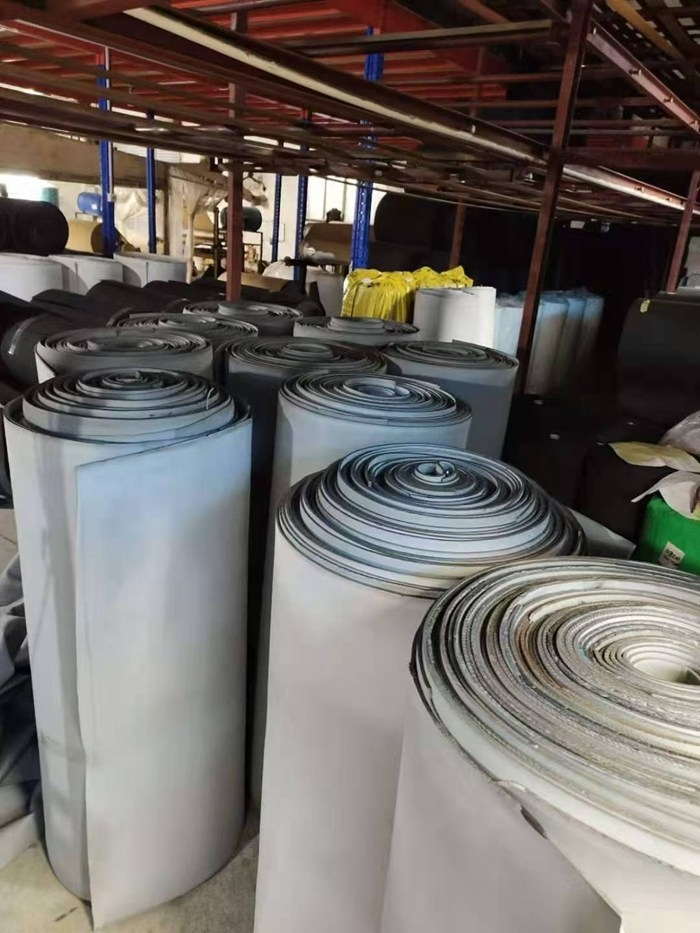
The official PEF item 632, listed on 15 August 2024, shows rolls of material in a workshop/storage setting. The description area does not supply a model, thickness table, facing identification, conductivity test or fire report. The photograph is evidence of the displayed form, not the delivered material’s grade or performance.
Heqiang separately lists tubing, foil-faced and adhesive-backed boards, support blocks and tapes. Those alternatives are not automatically included in this item. A separate 2015 article publishes general PEF figures, which are kept below as historical context rather than a new certified product specification.
A useful enquiry defines whether the job is heat-loss control, cold-service condensation control or another stated use, then identifies the exact material system and installation details.
This is an equipment family; its range does not identify one orderable configuration.
Swipe the table, or focus it and use arrow keys, to read the conditions and sources.
| Parameter | Published value | Conditions and evidence |
|---|---|---|
| Catalogue item | PEF insulation materials · item 632 | Listed 15 August 2024; photographed rolls, no readable grade/rating label. Source |
| Historical density | 20–30 kg/m³ | 2015 adhesive-backed PEF article, not confirmed for item632 or its current offered grade. Source |
| Historical conductivity wording | 0.035 w/m.h.℃ as printed | Unusual source unit; no test method/mean temperature. Not silently converted into a certified W/(m·K) value. Source |
| Temperature wording | −50°C to 110°C, marked short-term | Historical article; continuous limits and adhesive/facing limits require current confirmation. Source |
For pipe insulation, give actual pipe outside diameter, thickness and the fitting/support schedule; do not use nominal pipe size alone as the inner-diameter requirement. For duct sheets, state area, sheet/roll width and length, thickness, facing and edge/joint details. For adhesive-backed work, identify the substrate and required backing adhesive.
The 2015 text interleaves Ø15–1020 mm and 20–100 mm thickness entries with 1000×2000 mm sheets and 10–100 mm thickness. It does not clearly assign all values to item632. Request a current size and tolerance schedule for the exact form rather than merging those entries into one universal catalogue.
Approve pipe OD/fit, insulation thickness and details at elbows, valves, ends and supports.
Specify roll/sheet size, thickness, facing, corners and fixing/sealing method.
Identify foam grade, foil/facing and adhesive as one offered construction, with applicable reports for that build-up.
For cold-service design, provide fluid/surface temperature, ambient temperature and humidity, geometry and required surface condition. For heat-loss design, state the operating temperature and allowed loss or surface-temperature requirement. Ask for the insulation calculation and the material conductivity at the relevant mean temperature.
The general historical conductivity entry has an unclear unit and no test conditions. It cannot support a reliable thickness recommendation by itself. This page does not prescribe a universal thickness or claim that the pictured rolls prevent condensation in every environment. Require a current verified design basis and the manufacturer’s continuous-service limits.
The 2015 article lists oxygen index ≥27, water absorption ≤1%, rebound 90% and other general properties. It does not supply the test reports or conditions for item632. Oxygen-index wording is not a complete project reaction-to-fire classification, and water absorption does not establish water-vapour performance or sealed-system continuity.
Obtain the required test reports for the actual foam formulation, thickness, facing and adhesive. Check the sample description, method, conditioning, result and limits of application. General antibacterial, mould-resistant, antistatic or environmental wording should likewise be supported by the specific evidence needed for the project.
General figures in a dated 2015 article, without current item632 report mapping.
Read the sourceCurrent technical data, thermal/service limits and the relevant finished-material test/classification reports.
Heqiang’s historical installation article emphasises sealing joins/cuts with dedicated glue and bonding at insulation ends. It does not identify the adhesive product, cure/application conditions or a complete joint/support standard. Ask for current installation details and compatible glue/tape rather than substituting any available adhesive.
Approve dry/clean substrate preparation, edge closure, fitting and termination details, and supports without an uncontrolled break in the insulation system. Confirm storage/application conditions and how installed seams are inspected. A facing or backing adhesive cannot compensate for an open joint; the actual supplied instructions and project specification must govern installation.
Original invention grant publication CN115353681B names Heqiang and describes a particular flame-retardant material/preparation method, with experimental examples. The official qualification image separately shows two utility-model certificates. Neither identifies item632’s current delivered composition or provides its thermal/fire classification.
If the supplier proposes a patented grade, ask for its exact grade name, composition-control statement and current applicable product reports. Do not transfer experimental values from the invention document into the sales specification of a visually similar roll. Patent ownership and product compliance are separate enquiries.
The source does not establish a fixed price, MOQ, current manufacturing lead time or warranty duration. Define the quantity in the correct unit—roll, sheet, tube length or insulation area—with dimensions and accessories stated. Agree thickness/density/dimensional tolerances and sample acceptance before production.
Close service temperatures, ambient/humidity, geometry, required insulation performance and selected material construction.
Check foam/facing/backing, dimensions/tolerances and the matching technical/test/install information.
Require lot/grade identification, quantities, protected packing, storage instructions and written defect-remedy terms; control formulation/facing changes.
Compiled by HVACDeck Editorial. Source review identifies what the publication states; it is not an independent performance test or certification.
Editorial method and corrections · Report a detail with this page URL
Send the manufacturer your required duty, installation conditions and the unresolved items identified in this brief.