
Straight circular run
Schedule actual internal diameter, length, gauge, seam and end connection.
 HVAC & REFRIGERATION
A custom circular-duct family for ventilation: prepare a drawing-led schedule and define material, fittings, pressure/leakage and insulation requirements.
From Sichuan Jingxin Ventilation Equipment Co., Ltd.
Individual product research · HVACDeck Editorial · Sources checked 2026-10-11
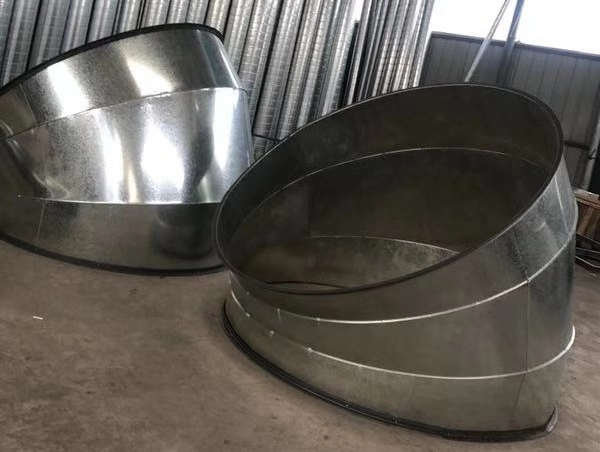
The actual official item is titled 绵阳螺旋风管. It describes spiral duct for general supply/exhaust air, cooled air with insulation, and kitchen fume exhaust. The inspected embedded image shows metallic round duct pieces with spiral seams; it is an appearance reference, without a readable diameter, gauge, material grade or pressure marking.
The manufacturer claims good sealing, rigidity, low resistance/noise and fewer connections, but publishes no numerical performance schedule on this item. It describes ordinary ventilation as a high-flow, low-pressure use without stating a rated pressure envelope. This page therefore treats the offering as custom duct fabrication rather than an authenticated standard model or a certified smoke/grease assembly.
This is an equipment family; its range does not identify one orderable configuration.
Swipe the table, or focus it and use arrow keys, to read the conditions and sources.
| Parameter | Published value | Conditions and evidence |
|---|---|---|
| Reviewed item | 绵阳螺旋风管 · spiral circular duct family | No fixed model designation or stock-size schedule provided. Source |
| Material descriptions | Galvanised for ordinary ventilation; stainless for corrosive/damp settings | Grade, coating and exposure limits are not published; actual material must be selected. Source |
| Cold-air description | Insulation required; internal lining is mentioned as an option | No insulation thickness, fire class, conductivity or vapour-barrier specification provided. Source |
| Numerical order data | Diameter, gauge, section length, joint and pressure/leakage criteria to confirm | No ratings inferred from photos or general feature claims. Source |
Provide the design airflow for each section and the actual route, branch take-offs, transitions and available clearances. For an ideal circular internal air passage, area A = πD²/4 and mean velocity v = Q/A when Q is in m³/s and D in metres. This is a geometry check, not a supplier pressure-loss or noise rating.
The actual internal diameter matters where a liner reduces the clear air space. Pressure loss also depends on length, roughness, fittings and terminals; a straight-tube photo cannot establish the whole network resistance. Ask the responsible designer to confirm the route and fan duty, rather than reduce the duct size solely to suit a convenient stock diameter.
State galvanised or stainless sheet, exact grade, gauge and coating/finish requirements. Ask how the spiral seam is formed/sealed, which joints and fittings match it, and what material documents are supplied for the batch. No sheet-thickness or zinc-coating range is published on the reviewed item, so a numeric range from another manufacturer must not be assigned to this product.
For humid or chemically contaminated air, give the actual exposure and cleaning conditions. “Stainless” alone does not identify grade or guarantee immunity to corrosion. Check compatibility between duct, joint hardware, supports and sealants, and define how fabrication damage or dissimilar-metal contact is controlled.
List every elbow, reducer, branch, connector, access opening and terminal interface by drawing reference. Approve internal/external end diameters, overlap or flange arrangement, gasket/sealant, fastening and allowable tolerances. Site pieces from different fabrication routes should not be assumed to fit because their nominal diameter matches.
The supplier’s fewer-connections claim has no stated section-length basis. Choose transportable lengths against loading access, turning space, lifting and installation sequence. Agree reinforcement/support requirements for the selected gauge, span and design pressure; circular shape alone does not establish resistance to collapse or deformation.
Schedule actual internal diameter, length, gauge, seam and end connection.
Provide geometry, orientation and matching ends; check access, balancing and transitions.
Approve supports, penetrations, joints and test boundaries; delivered tubes are only part of the system.
The official text says cold-air duct needs insulation and mentions internal lining. It does not specify a complete insulated construction. Decide internal versus external insulation based on the actual design, then define thickness, thermal properties, vapour barrier, fastening and sealed terminations. Check the reduced clear air passage if a liner is used.
Pay attention to supports, flanges and penetrations where the vapour barrier may be interrupted. Agree the finished exterior requirement if the spiral duct is exposed, and confirm cleaning/access and any liner surface requirements. A neat appearance is not proof that condensation control or fire/smoke requirements have been met.
Kitchen exhaust is listed as an application, but the reviewed item provides no grease-tight construction, cleaning-access plan or fire-resistance evidence. The website’s separate smoke-exhaust navigation is also not a rating for this spiral product. Have the responsible project designer define the necessary complete assembly and approval evidence.
For general ventilation, agree a design-pressure and leakage-test basis with clear test boundaries and pass criteria. The phrase “good sealing” cannot substitute for a leakage report. Likewise, “low noise” is not a measured acoustic result; noise depends on velocity, fittings, supports and connected equipment as well as the fabricated tube.
Ask for a current quotation tied to approved drawings, not a price inferred from a generic catalogue image. The page ends with the processing-factory name while the site contact uses a limited-company name; confirm the actual seller/invoicing entity before payment.
Approve numbered sizes, material/gauge, seams/joints, fittings, reinforcement, insulation and inspection criteria.
Check dimensions, roundness, edges, seams, finish and fitting interfaces; retain material and agreed test records.
Match zone labels to drawings, inspect transport damage, complete supports/sealing and perform agreed system checks before concealment.
Compiled by HVACDeck Editorial. Source review identifies what the publication states; it is not an independent performance test or certification.
Editorial method and corrections · Report a detail with this page URL
Send the manufacturer your required duty, installation conditions and the unresolved items identified in this brief.