
Panel supply
Define sheet size, complete layers, tolerances and handling conditions; identify who cuts, closes edges and fabricates sections.
 HVAC & REFRIGERATION
Compare the quoted panel, fabricated sections and installed system separately; match joints, supports, fire evidence, pressure and moisture protection to the actual construction.
From Zhejiang Jinyi HVAC Equipment Co., Ltd.
Individual product research · HVACDeck Editorial · Sources checked 2026-10-11
Jinyi publishes a steel-faced magnesium composite duct item dated 1 July 2022 and a separate magnesium high-crystal composite board item dated 30 June 2022. Both readable descriptions introduce sales of composite, galvanised-steel and stainless-steel ducts rather than a numerical technical schedule. No panel layer thickness, pressure class, thermal conductivity or fire-resistance duration is stated in these two descriptions.
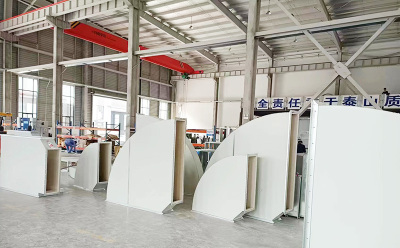
The five actual duct-gallery photographs show rectangular straight sections, curved elbows, flange edges and exposed light-coloured interiors in a workshop setting. They do not contain a readable rating table or identify the panel manufacturer, core composition or factory ownership. The neighbouring board page uses a parking-garage installation image, not a labelled board cross-section. These images help discuss fabrication and interfaces; they cannot authenticate a tested assembly or an installed-project result.
This is an equipment family; its range does not identify one orderable configuration.
Swipe the table, or focus it and use arrow keys, to read the conditions and sources.
| Parameter | Published value | Conditions and evidence |
|---|---|---|
| Published item | Steel-faced magnesium composite ducts | Catalogue heading; not a complete panel build-up, material specification or selected duct schedule. Source |
| Distinct neighbouring offer | Magnesium high-crystal composite duct board | Separate publication with the same broad sales description; board and fabricated-system scope must be agreed. Source |
| Visible fabrication forms | Rectangular straight sections, elbows and flange connections | Actual five-image gallery inspected. No numerical dimensions, thickness or tested joint construction confirmed. Source |
| Selected panel build-up | Not specified in the reviewed publication | Face metal/grade/coating, core, bonding and layer thickness need the actual offered construction. Source |
| Fire, pressure and leakage ratings | No numerical assembly rating reproduced | Application labels and photographs are not configuration-matched test evidence. Source |
A panel supply, a fabricated section package and an installed duct system are three different purchases. State the boundary before comparing price or asking for certification. Jinyi’s sales description does not show that it manufactures the composite core or owns the workshop pictured. Identify the actual panel maker, fabrication party and proposed construction.
Define sheet size, complete layers, tolerances and handling conditions; identify who cuts, closes edges and fabricates sections.
Issue section/fitting drawings, joints, reinforcement, supports and accessories; agree transport splits and dimensional acceptance.
Define site measurement, installation, sealing, penetrations, interfaces, pressure/leakage checks and handover responsibility.
The images show steel-like outer faces and light-coloured interiors, but appearance cannot establish steel grade, coating mass, core chemistry, density or fire behaviour. Obtain a section drawing showing both faces, core, adhesive/bonding, overall and layer thicknesses, edge closure and joint profiles. Record the exact product designation and batch traceability.
For each duct size, request permitted unsupported spans, reinforcement and support spacing with the applicable pressure/temperature conditions. Identify how elbows, branches, transitions and inspection openings are formed and supported. A thick-looking wall or large workshop section does not establish allowable size or resistance to deformation. Changes to panel, adhesive, joints or reinforcement may change the assembly evidence and should require a documented review.
The site lists smoke-exhaust applications but the reviewed item reproduces no fire-resistance result or report number. Ask for the complete original report when the project specifies a fire or hot-smoke requirement. Compare the tested face/core construction, joints, reinforcement, section dimensions, support system and orientation with the proposed installation.
A material reaction-to-fire result and a duct assembly fire-resistance test answer different questions. Neither a magnesium-based name nor a board certificate alone proves that the fabricated duct retains the required integrity, insulation or leakage behaviour. Have the responsible project designer identify the applicable requirement and permissible changes; do not invent a duration or approval from a photograph of garage ductwork.
Two dated official product descriptions and actual fabrication/application photographs, with no complete assembly test package.
Read the sourceConfiguration-matched original report and applicable status, tested limits, installation details and confirmation that the offered assembly is covered.
Specify design airflow, operating pressure sign and range, temperature and the required leakage basis. A supply duct operating under positive pressure and an extract duct under negative pressure do not present identical deformation and joint behaviour. Request the manufacturer’s documented size/reinforcement limits for the actual duty.
Agree how flange joints, corners, access panels and connections to fans, dampers and conventional metal ducts will be sealed and supported. Include gasket/sealant identity, connection drawing and any movement allowance. Plan an accessible representative section for the agreed pressure/leakage inspection before ceilings or shafts conceal the joints. Published application categories cannot replace a recorded test of the delivered system.
For conditioned-air service, establish insulation performance and the vapor-control detail for the actual air temperatures, humidity and surrounding conditions. No thermal-conductivity figure or condensation-free promise is published here. Check flanges, cut edges, supports and equipment connections for continuity of the proposed insulation and moisture barrier.
Ask for permitted storage/exposure conditions, protection of exposed edges and cleaning/repair instructions for the selected panel system. The gallery contains finished sections with open ends; agree dry protected packaging, end protection and delivery inspection rather than assume their construction is suitable for outdoor exposure. For grease, corrosive or hygienic service, obtain explicit suitability and cleaning evidence instead of transferring properties from the supplier’s stainless-steel duct offer.
The useful comparison is a documented assembly and supply boundary. The website’s broad service promises do not give a project lead time, installation team or contract warranty. Resolve those commercially with the named supplier after the technical package is defined.
Review actual panel layers, joints, reinforcement, accessories, tested limits and fabrication drawings against the project conditions.
Inspect dimensions, edge closure, joint fit, workmanship, traceability and agreed pressure/leakage evidence before repeating the construction.
Record delivered sections, supports and interfaces, inspection results, approved changes, cleaning/maintenance access and repair instructions.
Compiled by HVACDeck Editorial. Source review identifies what the publication states; it is not an independent performance test or certification.
Editorial method and corrections · Report a detail with this page URL
Send the manufacturer your required duty, installation conditions and the unresolved items identified in this brief.
