
Article designation
OMBR heading and BR body description; obtain one exact order code.
Read the source HVAC & REFRIGERATION
A removable gasketed plate range with stainless or titanium options claimed; verify the actual plate/gasket schedule, branded illustration and leakage provisions before selecting a duty.
From Weifang Aoming HVAC Equipment Co., Ltd.
Individual product research · HVACDeck Editorial · Sources checked 2026-10-11
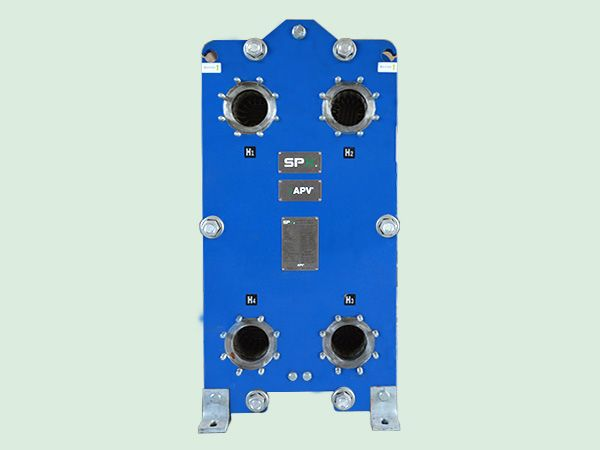
Oming’s article is headed OMBR but describes a BR-type plate exchanger in the body. It presents a removable assembly of corrugated metal plates, gaskets, a frame and clamping bolts. The actual original illustration shows a blue front plate with four connections and visible SPX/APV marks; its model/rating plate is not readable. That image does not independently establish that the offered OMBR assembly is made by Oming, made by APV, or supplied under an authorised relationship.
The article, dated 5 March 2019, makes qualitative efficiency, service-life and cleaning claims. It lists stainless steel or titanium-alloy plates and replaceable gaskets without an exact selected material schedule. No capacity, permissible pressure/temperature or selected pressure-loss table is supplied. The useful next step is a traceable assembly selection with actual fluids and construction, not an assumed branded or thermal equivalence.
This is an equipment family; its range does not identify one orderable configuration.
Swipe the table, or focus it and use arrow keys, to read the conditions and sources.
| Parameter | Published value | Conditions and evidence |
|---|---|---|
| Item and body designations | OMBR title; BR in the description | Exact order designation requires clarification; no interchangeable model mapping established. Source |
| Published construction | Removable corrugated plates with gaskets and clamping frame | Supplier description; selected geometry, plate count and tightening dimension not given. Source |
| Plate materials named | Stainless steel or titanium alloy | Family choices claimed; grade, thickness and actual ordered material not established. Source |
| Heat-transfer coefficient string | 3000–4000 “kacl/㎡·℃·h” | Original text has an unclear unit spelling and no test conditions; not converted into a guaranteed rated coefficient. Source |
| Original illustrated branding | SPX/APV marks on the blue assembly | Actual image read; not proof of the origin or authorisation of the proposed OMBR unit. Source |
Require the complete offered designation, assembly manufacturer and supply arrangement, with a selected nameplate/drawing and model-specific documentation. If APV equipment or components are proposed, request the actual model and evidence relevant to that supply relationship; the site image and the company’s APV category are not a substitute.
Keep responsibilities explicit for thermal selection, material procurement, pressure/leak testing, assembly and spare plates/gaskets. A buyer should know which party warrants the actual equipment and supplies the correct replacement parts. The OMBR/BR wording and branded illustration are unresolved identifiers, not a reason to silently merge Oming and APV product data.
OMBR heading and BR body description; obtain one exact order code.
Read the sourceSPX/APV marks visible, but no readable full model or manufacturer/rating schedule.
Read the sourceNamed assembly maker, supplied model, support party and matching documents; do not infer authorisation from an illustration.
The supplier says the range handles ordinary industrial water through high-viscosity liquids, but provides no viscosity limit or selected flow-channel design. Identify both fluids, their composition and temperature-dependent properties, contamination/solids and viscosity under actual operating conditions. State inlet/outlet temperatures, flows or thermal duty and permissible pressure loss for each side.
Have the supplier reconcile both energy balances and provide a selection with plate geometry, passes, number of plates, effective area and any fouling allowance. For viscous fluids, ask how the hydraulic/thermal calculation addresses the actual viscosity rather than use a water nominal duty. Minimum, normal and maximum conditions can demand different compromises in pressure loss and heat transfer; compare offers on one agreed basis.
The article prints a 3000–4000 heat-transfer-coefficient range with the string “kacl” and no complete measurement conditions. The unit spelling is unresolved, and the text’s comparison with shell-and-tube efficiency gives no common duty or test method. These statements are not a selected coefficient, an energy-saving percentage or a capacity per square metre.
Request actual predicted duty and pressure losses at the approved fluid properties and temperatures, with the assumptions visible. If performance acceptance matters, agree what temperatures, flows and operating stability will be measured and how transferred heat will be calculated. Use that result to compare technologies, including maintainability and available pressure, rather than choose an exchanger using the marketing multiplier.
The stainless/titanium family wording does not identify plate grade, thickness, port material or the gasket compound in the pictured assembly. Obtain those exact specifications and match them to fluid chemistry, temperature, concentration and the intended cleaning process. Titanium is not assumed merely because a corrosive duty is mentioned.
Ask for design and operating pressure/temperature limits for each side, including allowable differential pressure and transient conditions. Confirm gasket attachment, replacement identification and approved storage/cleaning practices. The claim of resistance to various corrosive media is not a universal corrosion guarantee or a documented life expectancy. Material compatibility needs a selected service basis and traceable records.
The article says sealing grooves include a leak-drain passage and asserts that media do not cross. The reviewed material supplies no selected cross-section, leakage test or double-wall configuration proving that outcome for every failure mode. Ask for the exact gasket/port separation drawing and the relevant leakage-test method for the ordered unit.
Where cross-contamination has serious consequences, issue that requirement explicitly and have the designer/supplier establish an appropriate construction and monitoring arrangement. Confirm how an external leak becomes visible and is safely drained. The article’s wording alone does not establish potable-water, food-service or other hygienic approval.
A leak-drain passage is described in the supplier text.
Read the sourceActual gasket/port drawing, applicable tests and any special separation requirement; no universal zero-cross-contamination promise is adopted.
Read the sourceA removable pack can be serviced only within its actual installation and manual requirements. Obtain the plate-removal envelope, movable-frame clearance, lifting/support provisions and the model’s tightening/reassembly instructions. Reserve access before connecting fixed pipework or mounting it in a skid.
The supplier says plates can be added or removed to change arrangements. Any alteration should have a revised approved thermal/hydraulic and mechanical selection; it is not an instruction to change plate count in the field without review. Retain selected materials, plate order, gasket identification, approved tightening dimension and inspection/testing records. No exact price, lead time, warranty or verified operating life is established by the article.
Agree exact model, actual manufacturer/supplier, fluid duty, materials and maintenance responsibility.
Review calculations, pressure/temperature limits, gasket/leakage drawing, service envelope and test basis.
Match identification and material/test records, verify the agreed duty at recorded conditions and retain the manual and correct spares schedule.
Compiled by HVACDeck Editorial. Source review identifies what the publication states; it is not an independent performance test or certification.
Editorial method and corrections · Report a detail with this page URL
Send the manufacturer your required duty, installation conditions and the unresolved items identified in this brief.
