


Plate selection
Exact grade, thickness and channel pattern must match fluids, duty and cleaning requirements.
 HVAC & REFRIGERATION
Use the actual material and model images to prepare a two-fluid selection; distinguish gasket temperature, frame pressure and assembly duty before ordering.
From Shandong Shuangteng HVAC Equipment Co., Ltd.
Individual product research · HVACDeck Editorial · Sources checked 2026-10-11
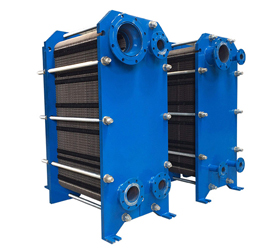
The actual Shuangteng publication describes corrugated plates clamped between fixed and moving frame plates with gasketed fluid channels. Its gallery shows blue/red framed exchangers and plate-pack details. Beyond the readable webpage text, original brochure images supply material choices, gasket temperature ranges and a BR/BRb size schedule. These are family references, not a heat-duty guarantee for a selected plate count and pass arrangement.
The catalogue also names wide-gap/free-flow, double-wall, semi-welded and multi-section alternatives. One original construction term is unclear; no definite brazing process is invented from it. Specify the actual proposed construction and flow arrangement instead of combining all listed alternatives into one interchangeable product.
This is an equipment family; its range does not identify one orderable configuration.
Swipe the table, or focus it and use arrow keys, to read the conditions and sources.
| Parameter | Published value | Conditions and evidence |
|---|---|---|
| Plate thickness stated | 0.5–0.8 mm | Family brochure range; selected grade/thickness must appear on the order. Source |
| Frame design-pressure options | 1.0, 1.6 or 2.5 MPa | Brochure design classes, with1.0MPa described as ordinary; not all ratings on every frame. Source |
| Assembly temperature statement | Design170 °C; brochure recommends long-term use below150 °C | Selected gasket, pressure and medium may impose tighter limits; not every gasket’s maximum. Source |
| Plate material options | 304/321/316/316L stainless,254SMO,2205,TA1 titanium and other alloys listed | Catalogue choices; fluid compatibility and exact available plate grade to verify. Source |
| EPDM and nitrile gasket ranges | EPDM −50 to150 °C · nitrile −20 to110 °C | Printed gasket-material table, not a complete exchanger operating envelope. Source |
| Fluoroelastomer gasket range | 0 to180 °C | Material-table range exceeds the brochure assembly170°C statement; cannot raise the assembly rating. Source |
| Example BR0.12 row | 0.12 m²/plate ·3–12 m² assembly ·30 m³/h maximum listed ·DN40/50 | Catalogue maximum flow is not the selected flow at allowable pressure loss. Source |
| Example BR0.12 dimensions | A280–1200 ·B325 ·H810 mm | Drawing letters refer to the actual size sketch; confirm selected pack and opening clearance. Source |
Issue both fluids’ composition, entering/leaving temperatures, flow and allowable pressure loss. Calculate the heat-duty balance with appropriate fluid properties and check consistency before asking for a selection. A plate-area number cannot establish duty without the driving temperatures and heat-transfer conditions.
Ask for selected plate type, count, pass arrangement, thermal duty, approach temperatures and pressure loss on each side, with a stated fouling basis. The brochure prints general heat-transfer-coefficient discussions in different ranges; these are explanatory claims rather than a guaranteed coefficient for the actual liquids and operating point. No universal kW per m² is assigned here.
The actual table includes plate area, assembly area, maximum treated flow, connection size, channel data and installation dimensions. For BR0.12 it lists0.12m² per plate,3–12m² assembly area,30m³/h maximum and DN40/50. These values help identify a frame/plate family, but the selected duty still needs the complete thermal/hydraulic calculation.
The table also has an apparent repeated BR1.2 label beside a different plate area, and some low-resolution characters. Those ambiguous rows are not silently corrected into new model codes. Request a current legible selected drawing and schedule. Use the actual A/B/H sketch to interpret dimensions and reserve room to withdraw the moving plate and service the pack.
The material image lists stainless grades, titanium and other alloys; it also gives gasket-material temperature ranges. State the actual fluids, concentration, contaminants, cleaning chemicals and temperature history. Ask the supplier to confirm compatibility and identify exact compounds and grade/thickness in the bill of materials. A generic material category does not establish chemical suitability for every process.
The brochure’s fluoroelastomer table reaches180°C while the assembly statement gives170°C and recommends long-term use below150°C. These are different limits; use the approved assembly envelope, not the highest gasket-table value. Likewise,1.0/1.6/2.5MPa are frame design options, not permission to operate any photographed exchanger at2.5MPa.
Exact grade, thickness and channel pattern must match fluids, duty and cleaning requirements.
Confirm compound and compatibility at actual temperature/concentration; a material range is not an assembly rating.
Approve design pressure/temperature, pack arrangement, connections and test documentation together.
The webpage says a special structure prevents cross leakage, without a selected leakage-detection arrangement or test record. Where cross-contamination matters, define the consequence and required construction with the responsible process designer. Double-wall and semi-welded alternatives need their own proposed drawings and evidence. A dairy or pharmaceutical application listing is not a hygienic or food-contact approval.
The brochure describes clip-on gasket and unequal-channel options. Ask whether they apply to the offered plate and how solids/fouling and unequal flows are addressed. Close cleaning-in-place versus opening, cleaning method, spare plates/gaskets and reassembly instructions. Do not adopt a general “self-cleaning” turbulence claim as freedom from maintenance.
Approve connections, foundation/support, opening clearance and pipe support so external loads are not unintentionally imposed on the frame. Identify isolation, vents/drains, strainers and controls according to the actual circuit. State maximum pressure and differential/transient conditions on both sides.
Require an approved start/stop and cleaning procedure, tightening dimension and bolt sequence for the selected pack. The frame’s expansion capability does not mean extra plates can be added without recalculating duty, pressure loss and connection requirements. Obtain the selected assembly’s test and traceability records rather than infer them from a brochure’s printed GB16409-1996 reference.
Shuangteng also markets packaged heat-exchange equipment. The reviewed item does not define pumps, sensors, controls, treatment equipment or installation as included. No fixed price, lead time or warranty is supplied.
Provide both-fluid thermal/hydraulic duties, material/cleaning constraints, pressure/temperature and contamination consequences.
Review exact frame/plate/gasket, count/passes, performance, drawing/access and test scope; resolve uncertain model-table labels.
Verify identification, materials, dimensions, agreed pressure/leak checks and installed duty; hand over tightening/cleaning instructions and spares.
Compiled by HVACDeck Editorial. Source review identifies what the publication states; it is not an independent performance test or certification.
Editorial method and corrections · Report a detail with this page URL
Send the manufacturer your required duty, installation conditions and the unresolved items identified in this brief.
