1 published equipment referenceLatest source review 2026-10-11
01 / COMPANY
What this manufacturer offers
Shandong Shuangteng HVAC Equipment Co., Ltd. is presented on its official website as a Dezhou-based supplier combining the design, production, sale and installation of plate heat exchangers, packaged heat-exchange units, HVAC auxiliaries and water-treatment equipment. The company also lists pipe fittings, valves and energy-saving equipment. Its published contact location is the Dewu development area in Sinüsi, Wucheng County, Shandong. The company introduction does not establish the production allocation or installed manufacturing capacity for a particular order.
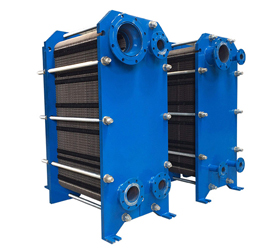
The plate heat-exchanger publication is the central technical source for this profile. It describes corrugated plates clamped between fixed and moving frame plates, rubber sealing between channels and separate fluid connections. It also lists other construction families, including wide-gap/free-flow, double-wall, semi-welded and multi-section arrangements. These alternatives should not all be assigned to the illustrated clamped unit.
Shuangteng’s offering spans both an individual exchanger and plantroom equipment around it. A buyer should therefore decide whether the enquiry is for the heat-transfer component alone or an assembled system with pumps, controls and water-side accessories. The research below follows the published construction and maintenance implications rather than treating ‘plate heat exchanger’ as a complete specification.
Clamped construction described
Corrugated plates between fixed and moving frame plates, tightened by boltsDescription of a clamped arrangement; not proof that every listed construction uses the same assembly. Source
Fluid separation described
Gasketed channels and fluid inlet/outlet portsActual plate material, gasket compound, pressure rating and leakage arrangement must be identified for the selection. Source
Alternative construction families
Wide-gap/free-flow, double-wall, semi-welded and multi-section arrangementsCatalogue options, not interchangeable ratings for one exchanger. Source
Published workshop material
A separate paginated workshop galleryGallery entries are labelled generically; the reviewed listing does not identify machine models, output or dates. Source
Brochure pressure choices
1.0/1.6/2.5MPaFamily frame options; selected class and test record require confirmation. Source
Brochure plate thickness
0.5–0.8mmFamily range; actual grade/thickness and gasket must be specified. Source
Parameters and source limits · Plate heat exchangers
Swipe the table, or focus it and use arrow keys, to read conditions and sources.
Manufacturer-published information · Plate heat exchangers
Parameter
Published value
Conditions and evidence
Plate thickness stated
0.5–0.8 mm
Family brochure range; selected grade/thickness must appear on the order. Source
Frame design-pressure options
1.0, 1.6 or 2.5 MPa
Brochure design classes, with1.0MPa described as ordinary; not all ratings on every frame. Source
Assembly temperature statement
Design170 °C; brochure recommends long-term use below150 °C
Selected gasket, pressure and medium may impose tighter limits; not every gasket’s maximum. Source
Plate material options
304/321/316/316L stainless,254SMO,2205,TA1 titanium and other alloys listed
Catalogue choices; fluid compatibility and exact available plate grade to verify. Source
EPDM and nitrile gasket ranges
EPDM −50 to150 °C · nitrile −20 to110 °C
Printed gasket-material table, not a complete exchanger operating envelope. Source
Fluoroelastomer gasket range
0 to180 °C
Material-table range exceeds the brochure assembly170°C statement; cannot raise the assembly rating. Source
Example BR0.12 row
0.12 m²/plate ·3–12 m² assembly ·30 m³/h maximum listed ·DN40/50
Catalogue maximum flow is not the selected flow at allowable pressure loss. Source
Example BR0.12 dimensions
A280–1200 ·B325 ·H810 mm
Drawing letters refer to the actual size sketch; confirm selected pack and opening clearance. Source
03 / PROJECT REVIEW
Shuangteng: plate construction, service access and the packaged-system boundary
The clamped plate pack has an order-specific material and opening requirement
The official exchanger page explains that thin corrugated metal plates form multiple flow channels, with rubber seals between the plates. Bolts hold the pack between fixed and moving frame plates, and the page describes ports for connection to the external circuits. The text does not identify a plate grade, gasket compound, number of plates, tightening dimension or selected pressure limit. (Source 2.)
Our interpretation is that a quotation must identify the actual plate and seal combination, rather than simply repeating the construction description. State both fluids and their entering and leaving temperatures, then request the selected heat duty, flows and allowable pressure losses. The opening clearance behind the moving plate also matters when locating the exchanger in a plantroom. Neither compactness nor accessibility should be assumed without the arrangement drawing for the selected pack.
The construction shown is not every construction listed
The source describes a clamped plate pack in detail, then lists several other families without their own exact-model selection tables. One original term is unclear and has not been translated into a confirmed brazing process.
Clamped arrangement described
Corrugated plates, rubber seals, fixed and moving frame plates and tightening bolts. The actual plate grade, seal compound, plate count and selected pressure limit are not stated for an order.
Wide-gap/free-flow, double-wall, semi-welded and multi-section choices. Ask which construction is proposed and why it matches the fluids, cleaning needs and consequence of leakage. The listed families are not interchangeable ratings.
An application list does not resolve fluid suitability
The product publication names heating, HVAC and refrigeration alongside steel, power generation, chemical and petrochemical processing, marine applications, pharmaceuticals, dairy and beverage production. Those are broad applications listed by the manufacturer. We have not converted them into named installations, hygienic approvals or certification for handling a specific process fluid. (Source 2.)
A dairy-process enquiry, a district-heating interface and a chemical transfer duty cannot share a selection solely because all appear in the application list. Identify cleaning requirements, fluid composition, design temperature and pressure, and the consequence of cross-contamination. If the medium or process requires a specific approval, ask for evidence applying to the actual plate pack and materials. No sanitary finish, food-contact approval or pressure-vessel licence is inferred here from a market category.
Define what belongs to the plantroom package
Shuangteng’s company page lists packaged heat-exchange units and installation alongside individual exchangers, water treatment, fittings and valves. The reviewed exchanger page does not itself specify the surrounding pumps, controls or commissioning responsibilities. (Source 1.)
Separate the component and package scope
Identify the exchanger, pumps, valves, sensors and treatment equipment actually included in the price. Do not assume that every category on the company page is supplied with this selection.
Assign hydraulic and control design
Confirm who designs the connections and control sequence and how the package meets both fluid-side conditions. A plate-pack quotation alone does not define an operating plantroom system.
Assign installation and handover
Name who installs, starts and maintains the package, and which drawings and records accompany it. Compare quotations using those responsibilities rather than only the component price.
Workshop photographs are useful context, not a production-capacity measurement
The official website has a dedicated workshop listing with multiple pages, but its entries on the reviewed listing use generic workshop titles. The listing does not establish a machine model, manufacturing sequence, photograph date or measured output. We therefore do not turn its presence into a claim about plate-press tonnage, automation or annual production. (Source 3.)
The company introduction mentions an engineering and development team and processing equipment without supplying a current equipment schedule or staffing evidence. Those descriptions remain company statements. What is still needed for an order is the selected exchanger’s drawings and materials, any applicable product approvals, manufacturing-site confirmation and an agreed inspection record. The public catalogue supports a technical discussion; it does not replace those order-specific documents.
The actual material sheet lists pressure classes,0.5–0.8mm plates and gasket-material ranges. Its assembly wording gives170°C with a long-term recommendation below150°C; a gasket table’s higher temperature cannot increase the assembled exchanger rating. A separate actualBR/BRb table provides size and connection references, while an apparent repeatedBR1.2 label remains unresolved. These family documents improve the enquiry but do not establish the selected plate count, pass arrangement or kW duty. Use the independently written product brief for the actual clearBR0.12 reference and selection checks.
07 / TRANSPARENCY
Sources and review scope
Compiled by HVACDeck Editorial. Page review: 2026-10-11. Publications are attributed below; their statements are not independent measurements by this platform.