
Catalogue example
9.52 mm copper tube, 1950 × 1117.6 × 66 mm core and the stated fin die.
Read the source HVAC & REFRIGERATION
A copper-tube, epoxy-coated aluminium-fin condenser coil supplied as an OEM component, with published tube sizes and core geometry.
From Zhejiang Xingchang Fan Co., Ltd.
Product guide · HVACDeck Editorial · Sources checked 2026-10-11
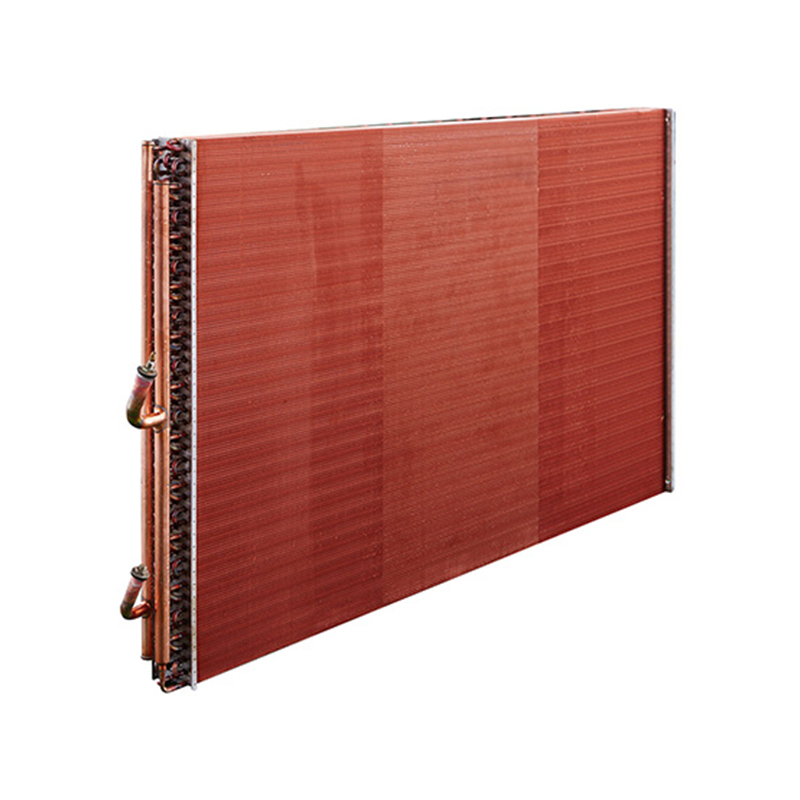
This is a condenser coil supplied as a component for equipment makers: copper tubes through gold-coloured epoxy-coated aluminium fins with a wave form. Xingchang's example uses 9.52 mm tube in a 1950 × 1117.6 × 66 mm fin core, built on a 9.52 × 25.4 × 22 mm fin die, and lists 7, 7.94, 12.7 and 15.88 mm tube as alternatives. It advertises 2000 hours of salt-spray testing for the coating. The photograph shows the finned coil with bent copper connections.
The page gives no heat-rejection duty, refrigerant, circuiting or pressure rating. An OEM uses it to check whether Xingchang's tooling fits its package, then asks for a selected coil. Send the heat-rejection duty, refrigerant and condensing condition, airflow, the space available and the connection positions, and ask for a calculation and a revision-controlled drawing.
This is an equipment family; ask the manufacturer to select the model that matches your duty.
Swipe the table, or focus it and use arrow keys, to read the conditions and sources.
| Parameter | Published value | Conditions and sources |
|---|---|---|
| Tube | Copper; 9.52 mm | Ask for wall thickness, temper and material standard. Source |
| Alternative tube sizes | 7 / 7.94 / 12.7 / 15.88 mm | A different size needs its own tooling, circuit and drawing. Source |
| Fin core | 1950 × 1117.6 × 66 mm | Labelled L × W × H; core only, excluding headers, bends and mounting. Source |
| Fins | Gold-coloured epoxy aluminium; wave form | Fin thickness, spacing and coating thickness come with the selection. Source |
| Fin die | 9.52 × 25.4 × 22 mm | Ask for a marked geometry drawing showing what each figure means. Source |
The core size tells you whether the catalogue example is close to your package. End plates, header and return-bend projection, mounting holes and tube outlets are on the assembly drawing. Read the fin-die figure against Xingchang's drawing for fin spacing, row count and tube pitch.
A new tube size usually means a new circuit and new tooling. Send the space envelope, airflow direction, allowed connection positions and service access, and ask for a drawing that shows the fin core, overall dimensions and mounting points separately.
9.52 mm copper tube, 1950 × 1117.6 × 66 mm core and the stated fin die.
Read the sourceAnother diameter, depth or circuit needs its own duty calculation, tooling check and connection drawing.
Casing, bends and headers, mounting, vibration support and access checked against the whole package.
Xingchang prints no kW rating, condensing condition, inlet-air temperature, face velocity or air-side pressure drop, and no circuit count or refrigerant charge. Capacity comes from a calculation on your conditions.
Give the heat-rejection duty and the refrigerant and operating conditions; rejection duty is higher than the evaporator's cooling duty because it includes compressor input. Ask for the selected-coil calculation or test basis with air temperature and flow, condensing condition, circuiting and pressure drops. Match the air-side resistance, including the coated fin, to your fan and casing; the fan duty point guide explains the figures to exchange.
Xingchang states a 2000-hour salt-spray test but publishes no report, method, sample identity, coating thickness or pass criterion. Ask whether the figure applies to pre-coated fin stock or a finished coil, and whether joints and tube ends are covered. Hours in a salt-spray cabinet are a lab exposure figure and do not translate into years of service.
Describe the site: coastal air, chemical contamination, cleaning method, and whether fin edges, joints and connections need protection. Ask Xingchang to define the coating process, coverage and acceptance criteria for the coils it delivers.
Gold-coloured epoxy aluminium fins and a 2000-hour salt-spray statement.
Read the sourceTest method and conditions, sample and coating identity, report date and criteria, and how the delivered coil matches the tested sample.
Site environment, handling damage, cleaning chemicals and maintenance; ask for any corrosion warranty in writing.
Xingchang's workshop gallery shows a vacuum-helium leak-detection station alongside tube expanding, fin pressing and brazing. The product page gives no maximum working pressure, test pressure, allowable leak rate or shipping holding charge.
Agree the refrigerant, pressure and temperature limits, circuit drawing, materials and internal cleanliness. Request a pressure and leak-test procedure with results tied to the delivered part number and revision. Settle how tube ends are sealed for shipping and which inspection records travel with each batch.
Minimum order, lead time, component warranty and any fan or control package are not on the product page. Agree these alongside the technical approval.
Heat rejection, refrigerant and conditions, inlet air and airflow, pressure-drop limits, operating range and circuit needs.
Space envelope, mounting and connection drawings, site corrosion exposure, coating coverage and inspection criteria.
Drawing revision, materials, pressure, leak and coating records, cleanliness and packing, quantity, delivery and written component warranty.
Ask Xingchang to confirm in writing: tube size, wall and material; fin thickness, spacing and coating thickness; the circuit drawing and connection positions; heat rejection and air-side pressure drop at your conditions; design and test pressure and leak-rate limit; what the salt-spray test covered; end sealing and cleanliness for shipping; and MOQ, lead time and warranty.
Compiled by HVACDeck Editorial. Figures are as published by the manufacturer; ask for test records for the unit you select.
Editorial method and corrections · Report a detail with this page URL
Send the manufacturer your required duty, installation conditions and the points listed above to confirm.