
Hot side
State source fluid/state, temperatures, flow or pressure, permissible pressure loss and operating variations.
 HVAC & REFRIGERATION
A removable gasketed plate pack: agree the actual heat balance, hydraulic limits, materials and service envelope, with pumps and controls specified separately.
From Shandong Zhongchuang HVAC Technology Co., Ltd.
Individual product research · HVACDeck Editorial · Sources checked 2026-10-11
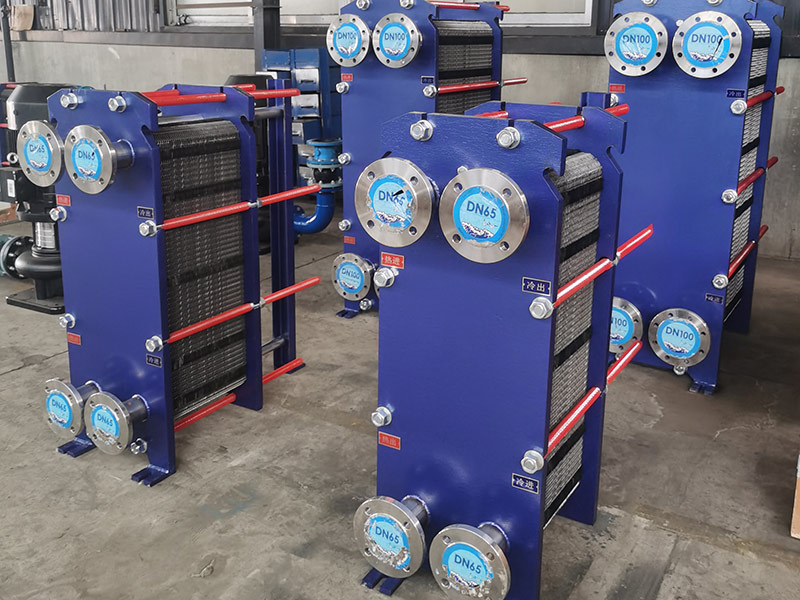
Zhongchuang’s plate-exchanger article, dated 28 September 2022, describes corrugated metal plates with gaskets clamped between fixed and movable frame plates. Alternating channels separate the hot and cold streams. The actual original photograph shows blue framed plate packs with bolted red tie rods, marked connection positions and DN65/DN100 port covers on different pictured units. It contains no readable selected model, thermal duty or pressure/temperature schedule.
A separate intelligent heat-exchange-unit article describes primary heat regulation, secondary circulation and make-up-water controls. Those functions belong to a proposed package, not automatically to the bare plate exchanger. Keep that supply boundary explicit so a selected plate pack and a fully equipped heating station are not compared as equivalent offers.
This is an equipment family; its range does not identify one orderable configuration.
Swipe the table, or focus it and use arrow keys, to read the conditions and sources.
| Parameter | Published value | Conditions and evidence |
|---|---|---|
| Published exchanger construction | Corrugated plates, gaskets, frame and clamping bolts | Actual official construction description; selected materials, plate pattern and gasket compound not specified. Source |
| Flow separation | Alternating hot/cold channels through corner ports | General construction statement; exact pass arrangement and connection assignment require the selected drawing. Source |
| Visible port-cover markings | DN65 and DN100 on different pictured units | Actual original photograph read; not a complete offered connection schedule or selected duty. Source |
| Numerical thermal/pressure limits | Not supplied in the reviewed plate article | No rated heat duty, selected plate count, pressure-drop schedule or temperature/pressure envelope reproduced. Source |
| Separate intelligent-package offer | Heat regulation, secondary circulation and make-up controls | Actual separate publication dated 2026-09-15; not included in a bare exchanger unless scheduled. Source |
For the actual two-fluid service, specify composition, inlet and required outlet temperatures, available flows and the desired heat duty. For liquid streams, use the actual fluid properties to reconcile flow and temperature change on both sides. If a side changes phase, identify pressure/state and the applicable energy balance rather than assuming a single water-temperature calculation.
State minimum, normal and maximum conditions, acceptable approach temperatures and any critical outlet limit. Ask for the selected thermal calculation with plate pattern, passes, number of plates and effective area. The article’s description of turbulence and imported dies supplies no universal heat-transfer coefficient or capacity per plate. A large-looking pack or DN100 cover cannot determine the required duty.
State source fluid/state, temperatures, flow or pressure, permissible pressure loss and operating variations.
State receiving fluid, required outlet condition, flow and permissible pressure loss at the actual duty.
Require one calculation reconciling both sides with the proposed plate count/passes, materials, fouling basis and limits.
The supplier describes herringbone corrugations and supporting contact points between adjacent plates. Those features explain the construction; the claims of higher heat transfer and lower resistance are not a selected hydraulic result. Require pressure drop for each stream at the agreed properties and flow, including the stated connection/pass basis.
Coordinate the exchanger losses with available pump head and the surrounding circuit. A revised plate count, pass arrangement or fluid concentration can change both thermal and hydraulic behaviour. Compare alternatives at the same heat duty and operating conditions instead of ranking them by total surface area alone. Obtain the permitted operating range and any minimum-flow/protection requirements from the selected assembly.
The publication names chemical, marine and seawater-aquaculture applications but does not specify a corrosion-resistant plate grade for this product. Obtain the actual plate material and thickness, gasket compound/attachment and port/connection materials. Match them to fluid chemistry, temperature, concentration and cleaning agents.
A seawater application phrase is not evidence that the photographed blue-frame unit contains titanium or a particular stainless grade. Similarly, gasket compatibility and temperature limits need their own model-specific schedule. Establish whether cross-contamination is unacceptable and what leak-detection, separation or other construction is needed; do not infer a double-wall or food-service approval from the generic channel description.
The separate unit article describes steam or high-temperature-water heat input, primary temperature/flow regulation, variable-speed secondary circulation and pressure-controlled make-up water. It names PLC/HMI and Siemens control components without an exact model schedule. Request an equipment list and hydraulic/control drawing if those functions are part of the offer.
Outdoor-temperature compensation and one-button start are explicitly optional in that publication. Agree included functions, sensor locations, pump duties and actual control/protection sequence rather than assume every package includes them. The text’s claim that a pressure expansion vessel is unnecessary is not adopted as a general design instruction: expansion, pressure control and protective provisions require a project-specific design. No energy-saving percentage follows from the control descriptions alone.
A bolted gasketed heat-transfer assembly described in the 2022 article; selected thermal and mechanical schedule still needed.
Read the sourcePumps, valves, make-up equipment, sensors and controls only as specified in an approved 2026-package selection and scope.
Read the sourceThe plate article describes removing plates, cleaning and replacing gaskets. It provides no selected tightening dimension, bolt sequence or lifting/service procedure. Obtain the actual manual and closed/open service-envelope drawing before arranging pipework or a packaged skid around the frame.
Reserve plate-removal clearance, isolation/drain/vent access and support for connected piping. Match each nozzle to the approved flow diagram; the original photo’s hot/cold labels and port covers are examples, not the order drawing. Agree cleaning compatibility, inspection and replacement plate/gasket identification. A generic promise of easy cleaning does not establish which contractor or spare-parts stock will support an overseas installation.
Compare quotations against a common thermal/hydraulic duty, exact fluid/material schedule and supply boundary. Neither the plate nor package article establishes an exact model price, lead time, warranty or independent performance test.
Issue both fluid states/chemistry, temperatures, duty/flows, pressure-loss and mechanical limits, plus bare-unit or package scope.
Approve selected calculations, plate/gasket schedule, connection/pass drawing, total service envelope and any package/control documents.
Match identification/material records and agreed pressure/leakage evidence; verify temperatures/flows and calculated transferred duty at defined conditions, retaining the manual and spares list.
Compiled by HVACDeck Editorial. Source review identifies what the publication states; it is not an independent performance test or certification.
Editorial method and corrections · Report a detail with this page URL
Send the manufacturer your required duty, installation conditions and the unresolved items identified in this brief.
