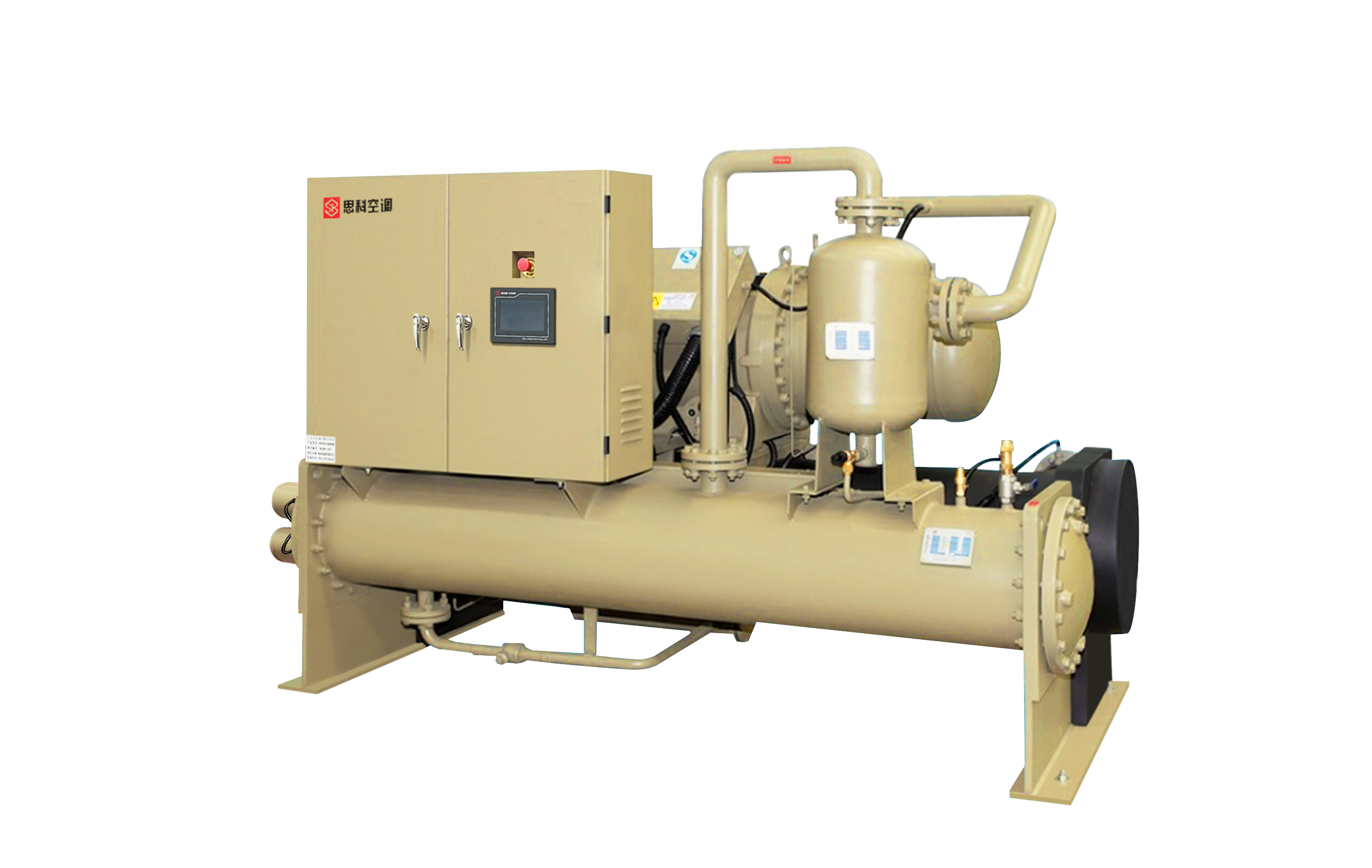
01 / UNDERSTAND THE EQUIPMENTSelect a low-temperature process duty with its complete fluid system
Sino King describes this screw refrigeration family as equipment supplying a medium- or low-temperature secondary coolant. The official publication names ethylene-glycol or calcium-chloride solutions and states that a cooling tower or another cooling-water source is required. The cooling-water connection is a separate selection boundary from the process-side coolant.
The page identifies a low-temperature screw compressor, microcomputer control and oil-management features, but does not publish an exact model, coolant-concentration schedule, refrigerant or rated numerical capacity. It cannot support a purchase based solely on a low-temperature label.
A useful supplier response should connect the chosen fluid and process temperatures to the selected unit, its operating envelope, the cooling-water duty and an agreed test basis. This brief translates the published construction into those buying decisions without assigning undocumented ratings.
Selection and application review
Compare the two fluid choices without assuming interchangeability
The publication supplies no concentration/temperature chart or material-compatibility schedule for either alternative. Ask the designer and supplier to identify the complete fluid specification and explain the effect on the proposed duty. No default concentration or freezing margin is recommended here.
Ethylene-glycol solution
State fluid formulation and concentration, design flow and entering/leaving temperatures. Request the unit selection for that fluid and ask for the project’s handling, compatibility and maintenance requirements.
Read the sourceCalcium-chloride solution
State concentration and the same operating duty, then obtain confirmation of wetted materials, seals and applicable corrosion-control requirements. A catalogue alternative is not confirmation that an existing water circuit can be used unchanged.
Read the sourceDefine process cooling and heat rejection as separate duties
Provide the process load profile, including pull-down, holding load, batch duration and minimum/maximum coolant temperatures. Ask for capacities and electrical demand at those requested conditions, not at a different comfort-cooling rating point. The supplier must identify any operating limit that excludes part of the requested cycle.
For the cooling-water side, provide available inlet conditions, flow/pressure constraints and water quality. Request the required heat-rejection duty, water flow, allowable conditions, pressure drop and connection details from the selected-unit schedule. Identify who supplies and controls the cooling-water source and what happens when it is unavailable.
The public text provides no published lowest leaving temperature, refrigerant, compressor brand, connection size or unit power. Neither the photographed equipment nor the phrase low-temperature screw establishes those values.
Turn the protection list into documented operating behavior
The manufacturer lists high/low pressure, discharge temperature, oil temperature/level, overload, internal overheating, phase loss/reversal, a safety valve and a water-flow switch. It also describes controller functions for fault diagnosis, energy management and freeze monitoring. These are declared functions, not a complete control diagram or witnessed protection test.
Request the actual interlocks, sensing locations, alarm outputs, reset behavior and relevant setpoint documentation for the selected configuration. Ask which circuit the flow switch monitors and how pump/flow availability is proven before operation. Do not infer that a flow switch and freeze monitoring eliminate every freeze scenario.
The publication also mentions internal and external oil separation, an oil-level protection switch and a forced oil-ejection arrangement. Require the supplier’s operating-envelope and service documentation; do not invent oil settings or a commissioning procedure from this catalogue language.
Keep component claims separate from whole-unit efficiency
The product states that its heat-transfer tube has a coefficient 1.3 times that of an ordinary high-efficiency tube. The readable text does not define the reference tube, conditions or a supporting test report. This component comparison is not a 30% increase in whole-unit capacity, COP or annual energy savings.
Three patent numbers are printed in the article: ZL 201320010021.2, ZL201310006969.5 and a spaced oil-cooling-control number. Their ownership, current legal status and connection to the delivered configuration were not independently established. The presence of a patent reference is not a rated-performance or product-compliance certificate.
The separate Zhejiang Made listing concerns SKZK evaporatively cooled equipment. Its standard, quality commitment and service terms are outside the evidence scope of this water-cooled low-temperature family. Obtain the applicable documents for the unit actually offered.
What a comparable quotation should return
Use this outline to obtain like-for-like bids for the actual process. It is an editorial enquiry checklist, not a Sino King installation instruction.
Selected duty and configuration
Full model/revision; fluid and concentration; entering/leaving temperatures and flow; process capacity and electrical demand at stated conditions; operating envelope and proposed control range.
Interfaces and supply boundaries
Cooling-water schedule, unit drawings, connections, electrical supply, control interfaces, fluid-circuit and heat-rejection equipment, installation/startup responsibilities and exclusions.
Acceptance and operating documents
Applicable test method and tolerances, matched-duty evidence, unit/material inspection records, protection documentation, manuals, maintenance requirements, spare parts and written warranty/support scope.
What still requires a supplier document
The reviewed publication is a descriptive family article without a dimensioned model schedule or numerical selection table. Exact cooling capacity, lowest outlet temperature, power, refrigerant, pressure limits, minimum flow, noise and current conformity documents remain unestablished.
Ask for the current technical schedule and a signed selection against the requested process and cooling-water conditions. If a response quotes another Sino King family or a different secondary fluid, request a new matched selection rather than carrying the old ratings into the revised offer.