
FNV-28.4/100
28.4 kW at the reference condition; 100 m² area. Two 450 mm fans, 2×4711 m³/h airflow and 2×250 W fan power. Gas/liquid connections φ25/φ19 mm.
Read the source HVAC & REFRIGERATION
V-coil air-cooled condensers with top fans, rated for heat rejection at 35°C inlet air and 50°C condensing temperature.
From Zhejiang Xiangneng Refrigeration Equipment Co., Ltd.
Product guide · HVACDeck Editorial · Sources checked 2026-10-11
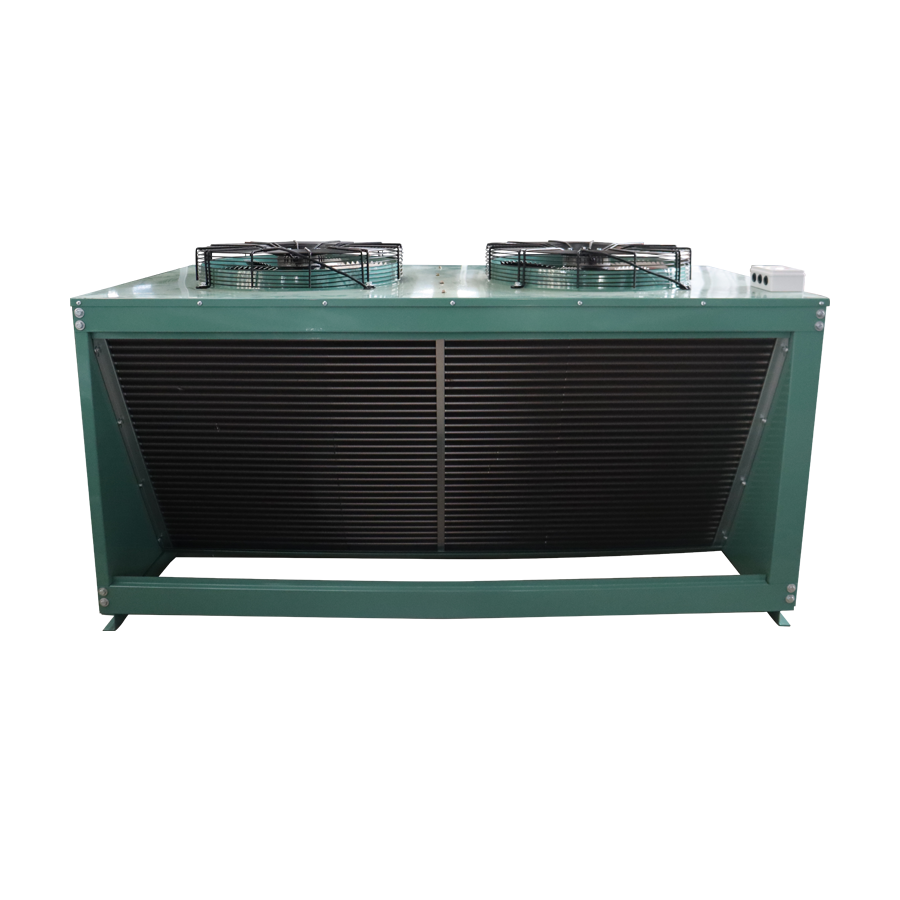
FNV is Xiangneng's family of air-cooled condensers for refrigeration plant. Each unit has a V-shaped coil with fans mounted above it. Xiangneng's 2023 manual lists sixteen models, from FNV-28.4/100 to FNV-166.8/600, with heat exchange of 28.4–166.8 kW at 35°C inlet air and 50°C condensing temperature. The table gives heat-exchange area, fan count, size, airflow and power, gas and liquid connection diameters, and a separate drawing gives installation dimensions.
These are condenser heat-rejection figures. Select an FNV against the heat your compressors reject at your operating condition, which is larger than the evaporator cooling duty. The table names no refrigerant and gives no pressure rating, coil material, coating or sound data. The manual also warns that dimensions may change in later production, so ask Xiangneng for the current schedule and drawing of the selected model with your quotation.
This is an equipment family; ask the manufacturer to select the model that matches your duty.
Swipe the table, or focus it and use arrow keys, to read the conditions and sources.
| Parameter | Published value | Conditions and sources |
|---|---|---|
| Rating condition | Inlet air 35°C; condensing temperature 50°C | Manual printed page 14 (PDF page 17). The table note names no refrigerant. Source |
| Heat-exchange range | 28.4–166.8 kW across sixteen models | FNV-28.4/100 through FNV-166.8/600 at the printed condition. Condenser duty only. Source |
| Fans | Two to four fans per model; 380 V in the table | Ask for the wiring and fan-control arrangement of the delivered unit. Source |
| Installation schedule | L/W/H and A/B drawing markers | Printed page 15 (PDF page 18). The manual says dimensions may change, so ask for a signed current drawing. Source |
The examples below show how the range steps up in area, fan size and connection size. Each row is one model; keep its capacity, fans and connections together when comparing. Fan airflow and power are printed per fan, multiplied by the fan count.
28.4 kW at the reference condition; 100 m² area. Two 450 mm fans, 2×4711 m³/h airflow and 2×250 W fan power. Gas/liquid connections φ25/φ19 mm.
Read the source52.2 kW at the reference condition; 200 m² area. Three 500 mm fans, 3×6765 m³/h airflow and 3×414 W fan power. Gas/liquid connections φ25/φ19 mm.
Read the source166.8 kW at the reference condition; 600 m² area. Four 630 mm fans, 4×11800 m³/h airflow and 4×800 W fan power. Gas/liquid connections φ42/φ22 mm.
Read the sourceGet the condenser heat-rejection figure from the refrigeration designer or the compressor supplier. It includes compressor input and depends on the system condition, so cold-room volume or evaporator duty alone will undersize the condenser. Xiangneng publishes no correction curve for other air or condensing temperatures.
Send Xiangneng the refrigerant, design inlet-air temperature, required rejection duty, target condensing temperature, operating range and seasonal control needs. Ask it to confirm the selected model's output and its pressure and temperature suitability for that refrigerant. A hotter design ambient or a lower condensing target means a fresh selection from Xiangneng.
The drawing shows the V-coil and top fans but gives no inlet or discharge clearance figures. Ask Xiangneng for the airflow direction and minimum clearances, and check nearby walls, screens and other equipment with your designer so warm discharge air is not drawn back into the coil.
Request the fan and motor make, electrical protection, isolator and fan-speed control for the delivered unit. The 380 V column and per-fan power figures are a starting point for the electrical design. Low-ambient head-pressure control and sound data at a stated measuring condition are separate items to request.
The manual's drawing marks L, W, H, A and B and also shows an L+100 extent. Two rows need a check with Xiangneng: FNV-74.1/280 lists L=2660 mm and A=2710 mm, and FNV-105.8/380 lists L=3230 mm and A=2180 mm. Ask which label is the overall length and which is the mounting centre before you build a frame or slab.
Request a signed drawing of the selected model with overall size, mounting centres, gas and liquid connection positions, service access, supports, lifting points and weight.
The FNV pages leave out coil material and thickness, fin spacing, coating, refrigerant compatibility, design and test pressure, and certificates for the assembly. Xiangneng's compressor-unit pages mention other configurations and media; ask for FNV-specific answers.
Approved material, coating, connection schedule, refrigerant and operating limits, with pressure and leak test records.
A selection calculation or test report for the model at your inlet air, condensing condition, refrigerant and fan set-up.
Conformity documents that name the exact model, company and site; a company ISO certificate covers the management system.
An FNV condenser on its own and a complete condensing unit are different orders. Say which you need and which compressor, refrigerant controls and installation work already exist. Xiangneng publishes no warranty period for FNV, so ask for one.
Condenser rejection duty, refrigerant, air and condensing temperatures, operating range and controls.
Space limits, electrical supply, noise and corrosion needs and connection positions; ask for the latest marked drawing.
Selected model, included controls and accessories, inspection documents, packing, acceptance and written warranty and service terms.
Get Xiangneng's written answer on: the FNV size and its heat rejection at your refrigerant, inlet air and condensing temperature; design and test pressure; coil, fin and coating materials; fan data, speed control and low-ambient operation; clearances and the signed current drawing, including the L and A values; sound data; test records; and price, lead time and warranty.
Compiled by HVACDeck Editorial. Figures are as published by the manufacturer; ask for test records for the unit you select.
Editorial method and corrections · Report a detail with this page URL
Send the manufacturer your required duty, installation conditions and the points listed above to confirm.