

Electrical configuration
Close poles, D/E supply, frequency, current, protection and any capacitor/control requirements.
 HVAC & REFRIGERATION
External-rotor axial fans for coil/OEM equipment, with pole, phase, air-direction and frame codes that must all be frozen in the ordered drawing.
From Zhejiang Jiayi Fan · HVAC and refrigeration air movement
Individual product research · HVACDeck Editorial · Sources checked 2026-10-11
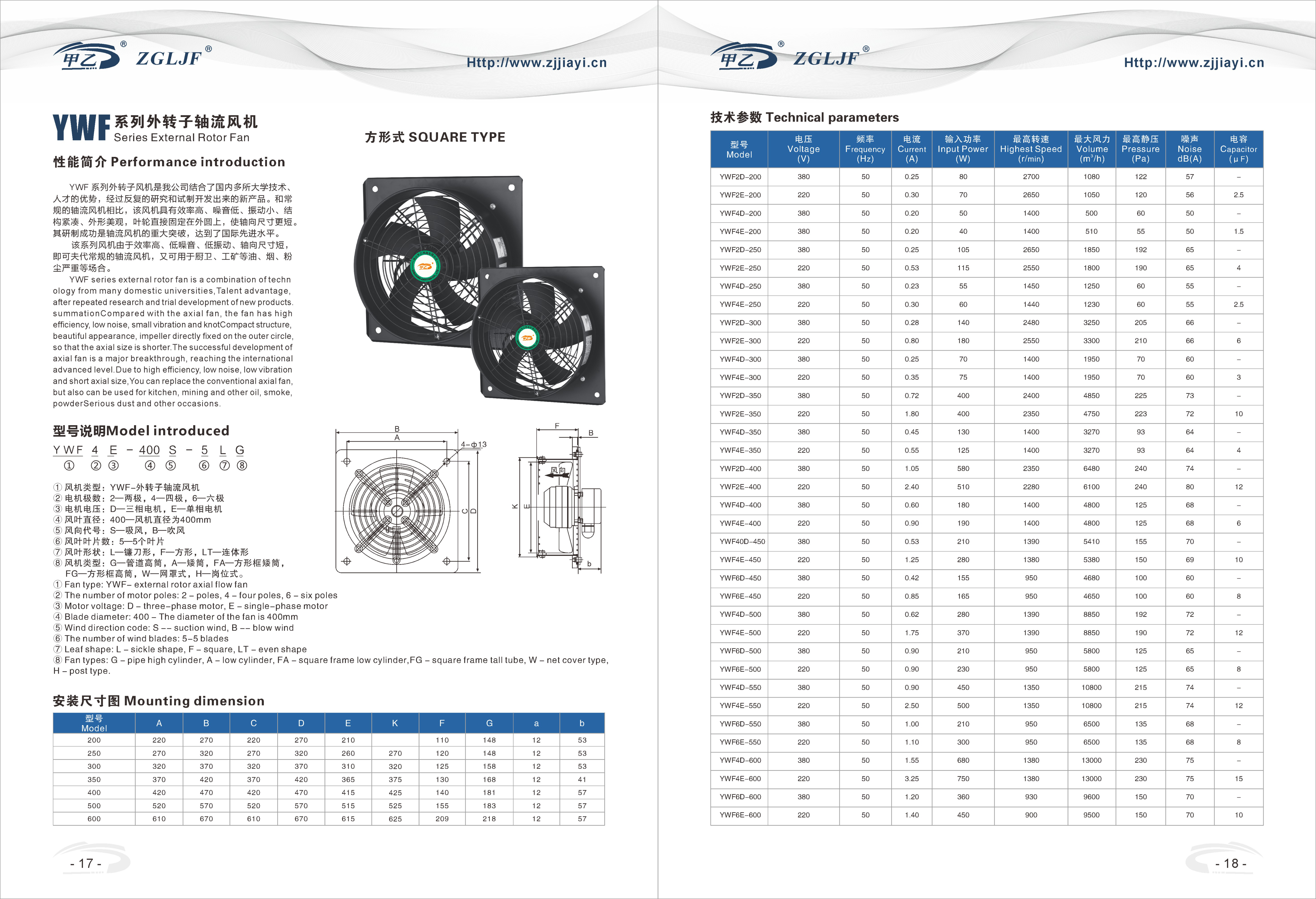
Jiayi's YWF square-type original spread describes external-rotor axial fans whose impellers attach to the motor's outer circumference. The website positions them for refrigeration condensers, evaporators and other equipment ventilation. That application description supplies no cold-room, refrigerant-system or complete-unit cooling rating.
The original YWF4D-500 row lists 380 V/50 Hz, 280 W, 0.62 A and 1,390 r/min, with 8,850 m³/h maximum volume and 192 Pa highest static pressure. Other web rows disagree with the image: YWF4D-300 is transcribed as 180 W and 192 Pa online, while the original shows 70 W and 70 Pa. A current issued curve and model suffix must settle selection; the page does not hide this difference.
This is an equipment family; its range does not identify one orderable configuration.
Swipe the table, or focus it and use arrow keys, to read the conditions and sources.
| Parameter | Published value | Conditions and evidence |
|---|---|---|
| Original YWF4D-500 electrical row | 380 V / 50 Hz; 280 W; 0.62 A; 1,390 r/min | Original square-type printed page 18. D is three-phase in the model legend. Source |
| YWF4D-500 flow / pressure maxima | 8,850 m³/h maximum volume; 192 Pa highest static pressure | Separate maxima, not a validated operating point at 8,850 m³/h and 192 Pa. Source |
| Web/image inconsistency | YWF4D-300: HTML 180 W / 192 Pa; original 70 W / 70 Pa | Actual source rows compared; no preferred current revision confirmed. Source |
| Model legend | 2/4/6 poles; D three-phase / E single-phase; S suction / B blowing; FA square-frame low cylinder | Original code explanation; the exact complete suffix and ordered assembly require confirmation. Source |
| Original YWF4D-500 noise | 72 dB(A) | No measurement distance or test setup supplied on this spread; not room or condenser-system sound. Source |
Send the required coil airflow, resistance, air temperature/density and full condenser/evaporator arrangement. Ask for the current curve and operating point including grille, shroud, coil and neighbouring fan effects. The original table labels volume and pressure as maxima; do not accept them as a simultaneous delivered duty.
Have the equipment designer close heat-transfer duty using the actual coil/system, refrigerant or fluid conditions and fan operation. A fan's airflow is not a cooling capacity in kW, and its advertised application does not establish useful performance in an arbitrary refrigeration system.
The original model legend distinguishes pole count, D/E motor supply, suction/blowing direction and different mechanical frames. A short label such as YWF4D-500 omits some complete-assembly choices. Obtain the full ordered code, wiring/nameplate, control compatibility and the drawing that fixes the actual frame and air path.
The E-series entries use different current and capacitor requirements; they are not interchangeable with the D three-phase row. Do not infer an EC drive, arbitrary inverter suitability or a 60 Hz rating from the external-rotor construction. The original inspected table is 50 Hz; any different supply needs its own selected documentation.
Close poles, D/E supply, frequency, current, protection and any capacitor/control requirements.
Approve suction/blowing code and the direction through the actual coil assembly.
Approve complete FA/other suffix, fixing holes, grille and ordered unit drawing.
The YWF4D-300 discrepancy affects both power and pressure; other shortened HTML rows also differ from the original spread. Obtain the issued current sheet with a revision and test conditions before committing the motor or system duty. This review keeps the actual examples in their source scope rather than averaging or silently replacing one value.
Agree production tolerances and acceptance for airflow, electrical input and direction at the chosen point. Keep the reference curve/drawing with sample approval and the order. A family web maximum is not evidence that every diameter or pole configuration reaches it.
An evaporator or outdoor condenser can involve moisture, low/high temperatures and exposure different from general ventilation. Obtain the exact selected operating limits, enclosure protection, materials/coatings, drainage and maintenance instructions. The webpage's broad dusty/oily application examples are not reviewed proof of suitability for corrosive or explosive media.
Coordinate guarding, support, vibration isolation, terminal access and fan removal with the equipment designer. Require current sound data with its test basis for a site noise assessment; the table's 72 dB(A) entry alone does not define the finished condenser noise at a property boundary.
For an OEM fan, approve the motor/impeller/grille/shroud scope, mounting tolerances, cable/terminal position, balancing basis and traceability. Ask which components are made or sourced and what final performance inspection is delivered. No university collaboration or certification is independently established by the supplier's general prose.
Obtain sample records and current conformity documents for the exact assembly/destination, with packing, spares, price, programme and warranty in the legal seller's offer. The platform has not tested the fan or the equipment using it. This brief's purpose is to make the known rows, actual differences and remaining selection decisions readable and reviewable.
Compiled by HVACDeck Editorial. Source review identifies what the publication states; it is not an independent performance test or certification.
Editorial method and corrections · Report a detail with this page URL
Send the manufacturer your required duty, installation conditions and the unresolved items identified in this brief.
Jiayi 4-72 general ventilation and F/B variants