
Normal process duty
Define required flow and pressure at actual inlet conditions, with the measurement/reference basis.
 HVAC & REFRIGERATION
The published item has no model rating: define the actual gas duty and blower architecture, then verify curves, motor loading, alignment and the selected maintenance manual.
From Shanghai Guandai Ventilation Energy Saving Equipment Co., Ltd.
Individual product research · HVACDeck Editorial · Sources checked 2026-10-11
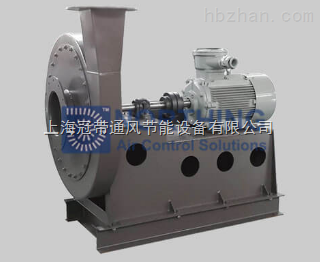
Guandai’s light-duty turbo-blower item is dated 23 October 2019 and has a blank model field. The actual detail text describes a centrifugal blower using an impeller, diffuser and volute, then discusses rotor corrosion, alignment and vibration. It contains no numerical selected-model curve, airflow rating, temperature range or efficiency test.
The original product image, viewed embedded on the official page, shows a scroll casing, flanged inlet/outlet, motor, shaft/coupling arrangement and common base. It has no readable numerical nameplate. Direct image access returned 403, while the embedded original was readable. Neither the photograph nor the maintenance discussion establishes a multi-stage architecture, a bearing lubrication system or an approved process-gas application for the unit being offered.
This is an equipment family; its range does not identify one orderable configuration.
Swipe the table, or focus it and use arrow keys, to read the conditions and sources.
| Parameter | Published value | Conditions and evidence |
|---|---|---|
| Published item record | Light-duty turbo-blower family · model field blank | Actual 2019-10-23 publication; no complete designation or numerical performance schedule. Source |
| Construction in the description | Impeller, diffuser and volute | Supplier’s generic centrifugal-blower description; the selected drawing must confirm actual architecture. Source |
| Visible drive arrangement | Motor, shaft/coupling region and common base | Actual original photograph reviewed; no nameplate, coupling specification or bearing schedule read. Source |
| Published performance curve | Not reproduced for the selected product | Company-wide pressure, temperature and power limits are not assigned to this item. Source |
| Wider company envelope | 0.55–1,000 kW; 250–2,500 mm impellers; up to 30,000 Pa static | Separate overall supplier offer, not a combined single-machine duty or this light-duty model rating. Source |
State the process flow requirement and whether it is an actual volumetric flow at inlet conditions or a reference/normalised quantity. Give inlet temperature, absolute pressure and gas composition so the supplier can establish density. Add humidity, dust, condensable, corrosive or other relevant constituents and operating variations.
Identify inlet and outlet pressure conditions and the required pressure rise using a consistent static/total basis. The company’s 30,000 Pa statement is a maximum static-pressure claim across its whole offer, not a demonstrated rise for this light-duty unit. A process enquiry should show the complete system operating points rather than request the “highest pressure” family by name.
Define required flow and pressure at actual inlet conditions, with the measurement/reference basis.
Define minimum/maximum demand, gas-condition changes and the proposed means of control.
Identify blower, motor/drive, base, valves/accessories, controls, instrumentation and installation/commissioning responsibility.
The page’s maintenance discussion refers to high/low-pressure blades, casing opening and standby preservation. Those statements resemble a broader industrial-machine discussion; they are not a configuration drawing for this product. Obtain the number of stages, impeller/casing materials, drive arrangement, bearing and sealing systems for the actual offered model.
Do not classify the machine as oil-free, multi-stage or suitable for fuel gas from isolated maintenance phrases or another linked article. A process-gas duty may need containment, sealing, drainage or protective measures that this item does not document. Match the selected architecture and approved operating manual to the actual medium and destination requirements.
Require paired flow/pressure points, speed, gas-condition basis, power and efficiency information for the selection. Ask for the stable permitted operating range and the proposed control method. If a configuration has a restricted low-flow region or needs protective control, require the supplier to identify it; do not invent a generic surge line for a machine whose stage and curve are not established.
Check motor loading, starting and permissible speed changes across the agreed conditions. A company maximum motor size is not this blower’s absorbed input. Confirm whether throttling, variable speed or another method is proposed, with the actual motor/drive limits and control responsibilities. Compare quotations only when their inlet basis, pressure definition and operating range are equivalent.
The official detail emphasises coupling and bearing alignment as possible vibration causes. It gives no selected-machine tolerance, measurement locations or acceptance limit. Obtain an arrangement drawing, foundation/base requirements, coupling information and approved alignment procedure for the offered unit.
Agree who checks transport damage, mounting, shaft alignment and duct connection loads before start-up. Record alignment and relevant checks at the conditions required by the supplier’s manual. Establish vibration/current measurement locations and acceptance criteria in the order. The page’s claim that 60% of failures relate to misalignment has no cited study or population and is not used here as a verified reliability statistic.
The page mentions periodic vibration diagnosis with a 2120 data collector, corrosion inspection, balancing and standby nitrogen preservation. These are supplier discussion points, not proof that this product includes that instrument or that those actions are suitable for every buyer’s unit. Nitrogen handling and casing opening require an approved site procedure and responsible personnel; the generic paragraph is not an installation instruction.
Obtain lubrication, inspection, seal/bearing and storage requirements from the selected model’s manual. Identify accessible inspection points, coupling/guard removal clearance, lifting needs and service parts. Define replacement part numbers and supply responsibility before committing to a process that depends on continuous operation. No maintenance-free life, failure rate or international response time is established by the publication.
Actual maintenance-oriented description and a visible coupled-base blower photograph; no numerical model or service-life evidence.
Read the sourceSelected curve/drawing, motor and bearing/seal schedules, approved manual and explicit performance, vibration and commissioning acceptance basis.
The supplier offers custom and standard industrial fans under the Northing brand. The product page does not publish an exact price, lead time or warranty. An order should be anchored to the returned selection and demonstration plan rather than company-wide maxima.
Issue gas composition/inlet conditions, flow/pressure basis, operating range, media hazards, utilities and the equipment boundary.
Approve exact model/architecture, marked curves, drive/control limits, dimensions/base and model-specific manuals/evidence.
Record conditions, flow/pressure, speed/input and agreed vibration/alignment checks; retain baseline readings and the service/preservation plan.
Compiled by HVACDeck Editorial. Source review identifies what the publication states; it is not an independent performance test or certification.
Editorial method and corrections · Report a detail with this page URL
Send the manufacturer your required duty, installation conditions and the unresolved items identified in this brief.