HTFC detailed article
Forward-curved cabinet construction with A/B placement and I–IV speed choices; selected model required.
Read the source HVAC & REFRIGERATION
HTFC construction, A/B motor placement, speed types and optional filtration need a coordinated selection; neighbouring KDF/HTFC-V and GDF families retain separate identities.
From Zhejiang Qili HVAC Equipment Co., Ltd.
Individual product research · HVACDeck Editorial · Sources checked 2026-10-11
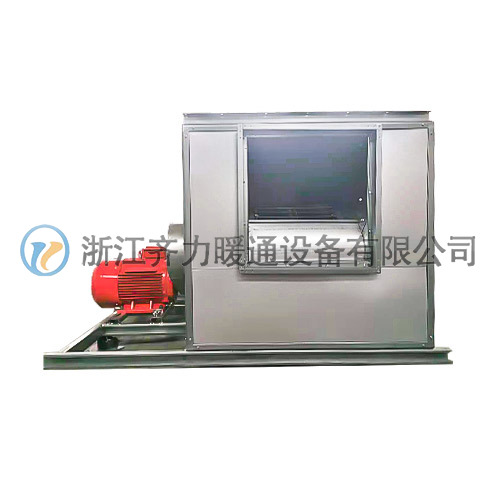
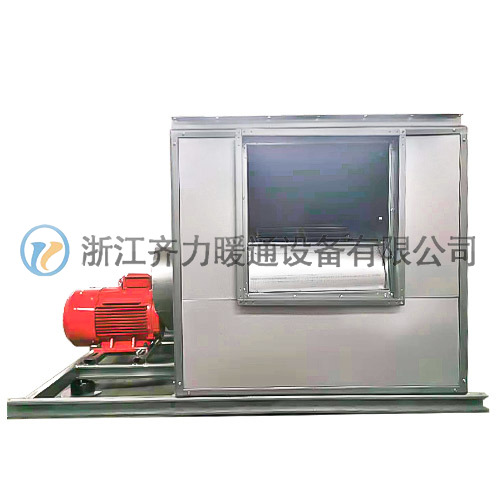
Qili’s centrifugal catalogue lists HTFC cabinet fans, KDF/HTFC-V, GDF duct fans and other centrifugal families separately. The detailed HTFC article describes a forward-curved multi-blade centrifugal assembly with motor, bearings, transmission and a sound-treated cabinet. Its original illustration shows a cabinet on a base with an external red motor; no readable size or rated operating point is visible.
The HTFC publication supplies a family envelope and useful configuration distinctions, rather than one selected airflow/pressure point. It separates external-motor A construction from internal-motor B, single-speed I/III from two-speed II/IV, and standard components from optional accessories. Preserve those boundaries when a duct arrangement, fire duty or filtered cabinet is requested.
This is an equipment family; its range does not identify one orderable configuration.
Swipe the table, or focus it and use arrow keys, to read the conditions and sources.
| Parameter | Published value | Conditions and evidence |
|---|---|---|
| HTFC family envelope | 1650–85000 m³/h; 180–1000 Pa total pressure | Across thirteen published sizes 9–40; maxima are not one operating point. Source |
| Motor placement | A external; B internal | A promoted for smoke extraction and B for ventilation; exact model qualification required. Source |
| Speed type | I/III single; II/IV two-speed | Supplier mapping; selected curves, motor and control schedule still needed. Source |
| Normal environment | −20 to +40°C; humidity below 90%; air | Published ordinary range, separate from special-temperature claims. Source |
| Published supply | Three-phase 380 V / 50 Hz | Family statement; exact selected electrical schedule required. Source |
| Filters and controls | Optional, not automatically included | Filter losses and increased casing length explicitly need allowance. Source |
The catalogue’s separate KDF/HTFC-V and GDF entries are not alternative names proving the same impeller, casing or performance. Select the appropriate family and then request its own complete designation, curve and drawing. For HTFC, identify size, A/B construction, I–IV speed type and the inlet/outlet arrangement.
The article offers twelve inlet/outlet angle arrangements, but no selected arrangement drawing is provided in the reviewed text. Have the supplier label the actual inlet, outlet, handedness and rotation on the approved general arrangement. A large family maximum or the external-motor photo cannot establish a particular flow direction, available pressure or fitting geometry.
Forward-curved cabinet construction with A/B placement and I–IV speed choices; selected model required.
Read the sourceA separately listed family; its actual selection documents must be obtained rather than inherit HTFC ratings.
Read the sourceSeparately listed duct arrangement; no transfer of HTFC construction or qualification.
Read the sourceIssue actual airflow, system resistance and air temperature/density, with minimum/normal/maximum requirements. Ask for the curve and selected operating point with motor loading. The family’s 85000 m³/h and 1000 Pa maxima are not combined into an available rated point; different sizes and speeds produce different selections.
For I/III versus II/IV, obtain each offered speed and duty explicitly. The supplier mentions a variable-frequency motor/controller option and suggests 25–50 Hz operation. That is a published recommendation, not proof that every motor or smoke-qualified assembly permits variable-frequency operation. Agree the exact motor/drive and allowable range, particularly when a separate fire mode changes control requirements.
The article states continuous ordinary operation at −20 to +40°C and air humidity below 90%. It separately claims 100°C for twenty hours and 300°C for sixty minutes, with an earlier description claiming more than sixty minutes at 300°C for A construction. It refers to historical GA211-1999 testing but does not attach the original full test report in this item.
For a required smoke duty, obtain exact-model documentation, covered motor/drive arrangement, installation limitations, temperature-duration requirement and relevant current qualification status. Do not apply the external-motor A claim to a B assembly or equate historical testing with current acceptance. Normal duty, high-temperature operation and emergency qualification need their own approved schedules.
The text says an explosion-protected version can be made and prints “EXdIIBT4”. It does not establish applicable exact-model certification, zone selection or suitability for an arbitrary gas/dust atmosphere. State the real atmosphere and have the responsible designer specify the required protection.
Request documentation for the complete selected assembly and its electrical/mechanical components, with the exact protection marking and operating conditions. The standard cabinet or red motor photograph is not proof of an explosion-protected product. Do not mix this optional protection claim with ordinary ventilation or smoke evidence when comparing offers.
The standard list includes impeller/casing, motor, housed bearings, shaft, pulleys and belt, sound-treated cabinet and inlet/outlet flanges, with a belt guard for A. Optional items include vibration isolation, silencers, filters, a control box, mating flanges and an A motor rain cover. Obtain the actual quoted component list rather than assume all illustrated or named features are included.
For primary/medium/high-efficiency filters, the article specifically calls for additional pressure-loss allowance and increased casing length. Agree the actual filter grade, clean/loaded resistance, removal route and maintenance access. Silencers and thicker cabinets likewise need selected acoustic and dimensional evidence. Reserve motor/belt/bearing access and approved supports; a supplier statement about low noise is not a room sound prediction.
The article distinguishes standard construction from optional isolation, silencers, filters, control and mating components.
Read the sourceFilter/silencer losses, larger casing dimensions, drive access and acoustic performance must be scheduled for the actual offer.
Read the sourceRequire selected dimensions, operating mass, opening orientation, material/coating specification and service instructions. The supplier describes galvanised construction and a cabinet insulation/lining arrangement, but no selected acoustic test or application-specific material result is established. Agree commercial terms and destination service separately.
Issue duty/air conditions, required operating modes, atmosphere, electrical/control interface and accessories.
Match full designation, curves, drawings, motor/drive and any fire/explosion qualification; include filter losses and service clearances.
Verify identification, supports, rotation, measured duty and approved controls; retain maintenance and qualification records with exact-model coverage.
Compiled by HVACDeck Editorial. Source review identifies what the publication states; it is not an independent performance test or certification.
Editorial method and corrections · Report a detail with this page URL
Send the manufacturer your required duty, installation conditions and the unresolved items identified in this brief.