
Ordinary ventilation point
Scheduled airflow/pressure, air conditions, speed, motor loading and applicable acoustics.
 HVAC & REFRIGERATION
A cabinet centrifugal family promoted for two uses: obtain exact model, ordinary-duty curve and model-specific fire evidence before designing the controls and installation.
From Jiangsu Yuhang HVAC Equipment Co., Ltd.
Individual product research · HVACDeck Editorial · Sources checked 2026-10-11
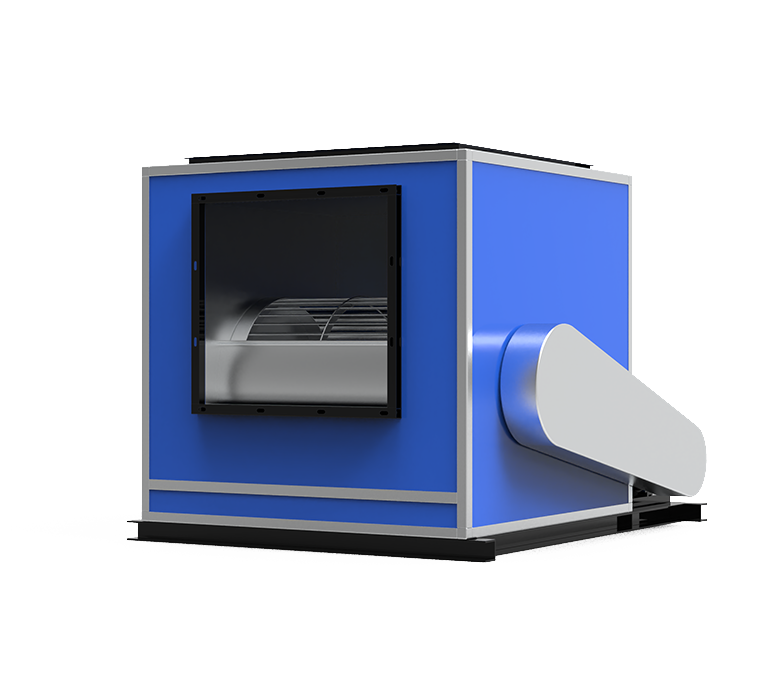
Yuhang’s actual HTFC item calls the product a cabinet centrifugal fan for ventilation and high-rise smoke extraction. It describes low noise, heat resistance, compact construction and convenient maintenance but gives no numerical airflow, pressure, speed, motor, noise or temperature-duration schedule. Opening its “detailed parameters” tab did not reveal a technical table.
The original illustration, viewed while embedded on the official page, shows a blue cabinet, a rectangular opening with a centrifugal wheel visible, a base frame and an external side drive cover. It has no readable exact designation or nameplate. The appearance supports the cabinet-fan description; it does not establish a speed arrangement, fire qualification or interchangeable ratings with another manufacturer’s HTFC range.
This is an equipment family; its range does not identify one orderable configuration.
Swipe the table, or focus it and use arrow keys, to read the conditions and sources.
| Parameter | Published value | Conditions and evidence |
|---|---|---|
| Product family | HTFC cabinet centrifugal fan | Official family wording; exact size, suffix and drive/motor schedule absent. Source |
| Uses promoted | Ventilation and fire smoke extraction | Intended applications in supplier text, not an accepted exact-model fire qualification. Source |
| Numerical selection data | Not recovered from this item | Actual text and detailed-parameters tab checked; no performance table shown. Source |
| Visible construction | Cabinet, centrifugal wheel opening and side drive cover | Actual official embedded image viewed; internal drive/motor details not verified. Source |
| Fire temperature/duration | Not stated in the reviewed item | No borrowed 280°C or 300°C rating from another supplier is assigned. Source |
Issue the required airflow, system resistance and actual air temperature/density basis. Ask for the selected full HTFC designation, fan curve, speed and operating point, with the pressure basis identified as static or total. Obtain the selected impeller arrangement, drive type, motor/input, voltage/frequency and full allowable operating range.
Compare ordinary ventilation selections at the same conditions. A promise of high efficiency or low vibration is not a numerical curve or motor-loading result. The family name does not prove a single/two-speed mapping; require the exact electrical and performance schedules for each offered operating mode. Data from a different company using the letters HTFC are not transferred to Yuhang’s assembly.
Scheduled airflow/pressure, air conditions, speed, motor loading and applicable acoustics.
Separate specified duty and qualified temperature/duration/control arrangement for the exact assembly.
One full model and construction/electrical schedule tying the curves, drawings and evidence together.
If the project needs smoke extraction, state the required operating conditions and have the responsible fire/smoke designer establish the applicable requirements. Request the original model-specific qualification/test documents, model coverage, temperature/duration, installation limitations and current issuing-body status where applicable. The item’s fire-use label does not supply those details.
Keep this fan’s evidence separate from the company’s fire-damper and smoke-valve pages. A 70°C damper fuse or a DC24V valve command is not the fan’s heat-resistance rating or motor supply. The three recommended valve products are separate components, even though their text appears on the same page. Confirm the actual fan, motor/drive and installation covered by any supplied report.
Agree ordinary-operation control, any separate smoke-operation command and the required feedback/interlocks with the project designer. Obtain an exact wiring/control diagram identifying motor supply, starter/protection, any speed selection and permitted drive arrangement. Do not infer variable-speed compatibility or a bypass arrangement from the cabinet image.
Coordinate the fan sequence with the actual dampers and system strategy, retaining a cause-and-effect schedule for acceptance. The related valve’s DC24V signal does not demonstrate the fan’s control interface. Protective functions and fire-mode behaviour should follow the selected equipment documents and approved project design, with commissioning by competent personnel rather than improvised wiring.
The illustration’s side cover and base frame suggest details that need a dimensioned selection drawing. Obtain casing dimensions, opening sizes and orientation, maintenance-panel locations, drive/motor access, operating mass and mounting provisions. Reserve the actual space needed to inspect or remove service parts; the image alone does not establish the clearances.
Coordinate duct transitions and supports so they do not obstruct access or impose unintended loads. Ask for the approved mounting, isolation and flexible-connection arrangements and check their suitability for every intended mode. A claim of small vibration and light weight is not a support-load calculation or a fire-suitable connector specification. Identify the actual installation orientation and protected service route before layout approval.
For ordinary ventilation, request sound data for the selected airflow/pressure/speed, stating the measurement basis and which casing/duct paths are included. Low noise in the description cannot predict sound at an occupied room. Agree any silencer or isolation additions and their effect on system resistance and maintenance access.
State moisture, dust, corrosion or other atmosphere conditions relevant to the installation. Neither a blue cabinet nor a heat-resistance claim establishes a material grade, coating, weatherproofing or explosive-atmosphere suitability. Obtain the selected material/protection schedule and maintenance instructions, including inspection intervals and consumables for the actual drive. Keep these requirements separate from unqualified service-life or energy-saving claims.
Cabinet centrifugal construction and the supplier’s intended ventilation/smoke-use description.
Read the sourceExact performance, motor/drive arrangement, acoustics, dimensions and model-specific fire qualification.
Read the sourceNo exact price, lead time or warranty is published in this item. Evaluate the complete selected offer against the same ordinary and any required smoke-duty schedules, including installation and control scope.
Provide both relevant duties, air conditions, electrical/control requirements, atmosphere, layout and qualification requirements.
Match designation, curves, motor/drive, dimensions and qualification coverage; retain an approved control/cause-and-effect schedule.
Verify identification, mounting/access, measured ordinary duty and approved controls/interlocks; retain qualification, test and maintenance records without claiming an unperformed fire test.
Compiled by HVACDeck Editorial. Source review identifies what the publication states; it is not an independent performance test or certification.
Editorial method and corrections · Report a detail with this page URL
Send the manufacturer your required duty, installation conditions and the unresolved items identified in this brief.
