
Normally open thermal closure
70°C ventilation fire damper and 280°C smoke fire damper descriptions.
 HVAC & REFRIGERATION
Resolve normal position, activation and feedback before relying on a temperature in the title or a historical report cover.
From Yichang Qinye · Ventilation and duct manufacturing
Individual product research · HVACDeck Editorial · Sources checked 2026-10-11
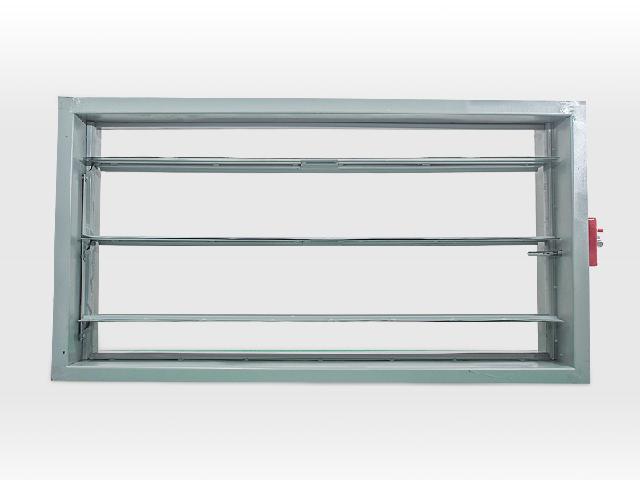
Qinye’s damper catalogue describes two normally open, thermally closing duties: a 70°C fire damper for ventilation/air-conditioning ducts and a 280°C smoke fire damper for smoke-extraction ducts. Their ordered function needs to be identified before choosing an actuator or buying by a photograph. The official 746 page is internally inconsistent: its title says 280°C smoke fire damper, while the body describes a normally closed smoke valve opened manually or electrically for extraction. That title/body conflict remains unresolved.
The pages publish DC24V actuation at no more than 0.7 A, manual reset and position feedback with passive switch signals. Those values describe supplier-presented controls, not a complete cause-and-effect design or verified fire-test result. Current certificate status and full model/size coverage are not established. This consolidated brief helps a buyer distinguish thermal closing from commanded opening and request the exact approved assembly without creating one thin page per temperature label.
This is an equipment family; its range does not identify one orderable configuration.
Swipe the table, or focus it and use arrow keys, to read the conditions and sources.
| Parameter | Published value | Conditions and evidence |
|---|---|---|
| 70°C source duty | Normally open; thermal closure; ventilation/air-conditioning ducts | Official 745 description; full exact-model current test/certificate scope still unverified. Source |
| 280°C source duty | Normally open; thermal closure; smoke-extraction ducts | Official 750 description; not the normal state described on page 746. Source |
| Actual catalogue conflict | 746 title: 280°C smoke fire damper; body: normally closed smoke valve opening on command | No supplier clarification reviewed; do not use its title as an order specification. Source |
| Published actuation | DC24V; rated current ≤0.7 A; manual reset | Supplier values, not system power/fault-state approval. Source |
| Published feedback | Position feedback; passive switch output | Contact rating, wiring, monitoring and controller compatibility not provided. Source |
| Published access references | 350 mm mechanism-side clearance; ceiling access example ≥450 × 450 mm | Supplier installation references, not universal current code or a substitute for the issued project design. Source |
For the 70°C source item, the page describes a normally open valve which closes by its thermal element. The 280°C item on page 750 also describes normally open thermal closure in smoke-extraction ductwork. The project’s approved function must identify the actual valve rather than assuming all smoke-related dampers act alike.
The differently titled 746 item describes normally closed commanded opening. Ask Qinye to correct or explain that mismatch and provide the model, actuator and approved drawing. A photograph showing blades open or closed does not prove the normal state, emergency action or installed orientation.
Request the wiring diagram, actuator model, supply tolerance, current demand and actual controller interface. The published DC24V/≤0.7 A values do not establish cable sizing, shared supply limits or system-wide emergency operation. No undocumented AC actuator or motorised reset is added to the catalogue.
Confirm whether each output indicates fully open or fully closed, its electrical contact rating and monitoring arrangement. Manual reset requires a defined inspection/reset process and physical access. Resolve command, feedback and any associated equipment interlocks through the responsible system designer; passive contacts alone do not constitute a complete cause-and-effect sequence.
The 70°C page describes water-bath action/non-action checks, while the 280°C page describes oil-bath checks. These are supplier-presented element references; they do not establish whole-damper leakage, endurance or fire-integrity results. Do not turn a trigger temperature into a tested duration or pressure rating.
Obtain complete current reports with exact model, actuator, size range, specimen and findings. The supplier’s report gallery includes historical covers, but current issuer validity and approved production coverage are not verified here. No blanket certification or project compliance statement is made for these catalogue items.
Qinye gives mechanism-side and ceiling-access examples and suggests separate support and correct thermal-element positioning. Ask for the current issued installation instructions and approved project detail for the actual size and construction. Those website examples do not replace current applicable rules or the responsible designer’s support/penetration specification.
Check access to the actuator, manual reset, linkage and inspection points against the actual ceiling/service space. Approve connections and support responsibility without altering a tested assembly. Record how inspection and functional checks will be performed after installation rather than merely buying a valve that fits the duct opening.
Require a signed selection identifying normal position, command/thermal action, actuator, feedback, dimensions and current conformity file. For anything offered under the conflicting 746 title, explicitly reconcile the body’s commanded-opening function before purchase. Do not silently correct the source and present the correction as the supplier’s verified specification.
Agree incoming identification, documentation and project-authorised functional checks. Price, delivery and current independently verified certification remain unknown. This page consolidates the related catalogue descriptions around a real control decision, while preserving the exact distinction between closing to isolate and opening for smoke extraction.
70°C ventilation fire damper and 280°C smoke fire damper descriptions.
746 body describes smoke-valve opening; its title conflicts and needs clarification.
Exact action, model, actuator, feedback, installation and current documentary scope.
Compiled by HVACDeck Editorial. Source review identifies what the publication states; it is not an independent performance test or certification.
Editorial method and corrections · Report a detail with this page URL
Send the manufacturer your required duty, installation conditions and the unresolved items identified in this brief.
Qinye aerogel duct: layers, joints and fire-test scope