
Qinye LXPF cabinet fan: A/B duty and transmission access
Approve motor location, the exact selected curve and applicable report before treating a cabinet as smoke-extraction equipment.
From Yichang Qinye · Ventilation and duct manufacturing
Individual product research · HVACDeck Editorial · Sources checked 2026-10-11

Decide the cabinet construction before freezing the fan duty
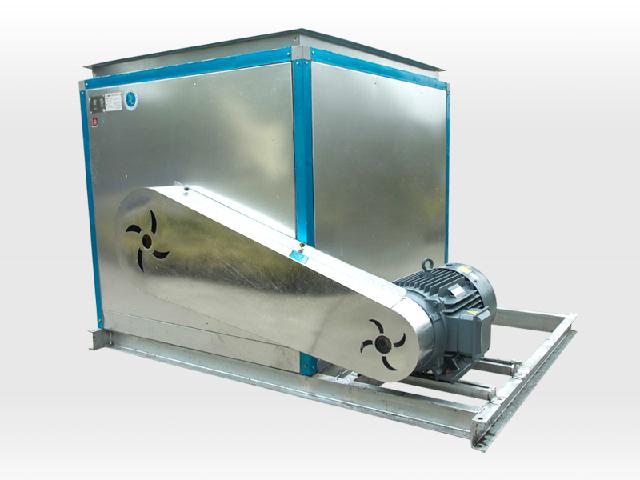
Qinye’s LXPF cabinet family uses a forward-curved multi-blade centrifugal fan with a motor, base, transmission and acoustic enclosure. The actual duty changes with its A/B arrangement: the supplier places the A motor outside the box for smoke extraction, while B places it inside for ordinary ventilation. The original image shows an external motor and guarded transmission beside the cabinet; that does not identify the current selected size or prove its smoke-test coverage.
The page publishes nine nominal 10–30-inch sizes, with separate family limits of 1,650–85,000 m³/h airflow and 180–1,000 Pa total pressure. It claims more than 30 minutes at 280°C for A and offers speed/control and hazardous-area alternatives. The supplier-hosted report cover 2018700152 names LXPF-A-I-30, but its full results and current certification record have not been verified. A covered model, other sizes, B units and optional explosion-protected assemblies require separate documentary matching.
Published parameters and their scope
This is an equipment family; its range does not identify one orderable configuration.
- Family designation
- LXPF A/B
Swipe the table, or focus it and use arrow keys, to read the conditions and sources.
| Parameter | Published value | Conditions and evidence |
|---|---|---|
| A versus B construction | A external motor for smoke extraction; B internal motor for ventilation | Official arrangement distinction, not interchangeable certifications. Source |
| Published nominal sizes | Nine sizes; 10–30 inches | Series envelope; current full drawings and size mapping required. Source |
| Family flow and total pressure | 1,650–85,000 m³/h; 180–1,000 Pa | Independent ranges, not one simultaneous duty. Source |
| Supplier A high-temperature statement | 280°C for more than 30 minutes | Not independently verified here; exact ordered variant and complete test result required. Source |
| Specific original report cover | 2018700152; LXPF-A-I-30 type test | Cover visually inspected; full conclusions/current issuer record not established. Source |
| Original arrangement photographed | Cabinet, external motor/base and transmission guard | Image does not establish complete BOM, current size or service clearances. Source |
Selection and application review
Select the actual A/B purpose and interface
Identify whether the project needs ordinary ventilation or an engineered smoke-extraction mode. Ask Qinye to specify A or B, motor location and exact single/dual-speed arrangement in the issued drawing and quotation. An internally mounted ventilation motor is not covered merely because an external-motor smoke version is sold under the same LXPF family.
Separate normal operation, emergency control and supply requirements through the responsible project designer. The page’s general room/application list does not determine the building’s smoke-control strategy. Obtain the actual control and failure-response file for the ordered equipment.
Require a model and speed-specific duty curve
Issue airflow at the actual system resistance and state total or static pressure. Obtain model, wheel diameter, rpm, curve, density basis and absorbed power. Do not pair 85,000 m³/h with 1,000 Pa as an established duty or derive an exact motor from the family limits.
For dual-speed or VFD options, require each relevant operating point, motor wiring, drive compatibility and allowed settings. The suggested 25–50 Hz interval is not a complete specification for emergency operation. Ask for acoustic data at the selected operating point, not an unsupported noise guarantee from the enclosure description.
Match the complete high-temperature and conformity file
The supplier refers to a 280°C endurance claim and a historical test-method edition. The original cover identifies one exact model and report, not the passed performance, approved family range or current certificate status. Obtain the full report and current issuer verification before relying on the claim.
Do not transfer that scope to all wheel sizes, two-speed variants or B constructions. An optional ExdIIBT4 statement on the page is also not a verified whole-unit certificate. A hazardous-area order needs its own exact assembly, marking, restrictions and documentation; no explosion-protected approval is asserted here.
Review enclosure, transmission and maintainability
The source describes a assembled frame and galvanised panels with internal glass-wool acoustic treatment; aluminium profiles are an alternative. Freeze the actually supplied construction rather than assuming every cabinet has each option. The photograph shows a guarded external transmission but provides no belt, bearing or motor service schedule.
Approve access doors, isolation, guard removal, alignment/tension service, lifting and support loads, and the selected inlet/outlet directions. Obtain complete dimensions and maintenance clearances. The ability to dismantle panels does not prove that a large cabinet can be moved through the project access route.
Compare a complete cabinet delivery
Agree whether the quote includes motor, transmission, controls, guards, vibration isolation and duct connectors. Issue exact power, geometry and access requirements. Current price, delivery and independently verified noise or emergency-operation results are unknown.
Acceptance should reconcile the ordered model with the issued curve/drawing, complete current conformity file and agreed mechanical/control checks. This one family page keeps A/B constructions together while explaining their different purposes instead of padding the site with one page per diameter.
Identify the construction
Confirm A/B, operating purpose and motor/speed arrangement.
Approve the duty and installation
Match real curves, sound, dimensions and transmission service access.
Verify exact scope
Obtain complete current report/certificate evidence for the ordered assembly.
Sources and review scope
Compiled by HVACDeck Editorial. Source review identifies what the publication states; it is not an independent performance test or certification.
- Official LXPF cabinet-fan family pageChecked 2026-10-11 · Complete source read; four original images inspected; A/B and family ranges retained with scope.
- Original supplier-hosted report coverChecked 2026-10-11 · LXPF-A-I-30 / 2018700152 cover read; no full test result or current issuer status verified.
Editorial method and corrections · Report a detail with this page URL
Turn the evidence into an enquiry
Send the manufacturer your required duty, installation conditions and the unresolved items identified in this brief.
Other equipment from this manufacturer
Qinye dampers: thermal closure versus commanded smoke opening