Cabinet arrangement
A/B controls motor location and layout. Check motor/drive access, casing orientation and mounting dimensions.
 HVAC & REFRIGERATION
Read the actual HTFC(DT) technical sheet and historical certificate separately: select a paired airflow/static-pressure point and verify the exact arrangement and current smoke-duty evidence.
From Jiangsu Zhongkai HVAC Equipment Co., Ltd.
Individual product research · HVACDeck Editorial · Sources checked 2026-10-11
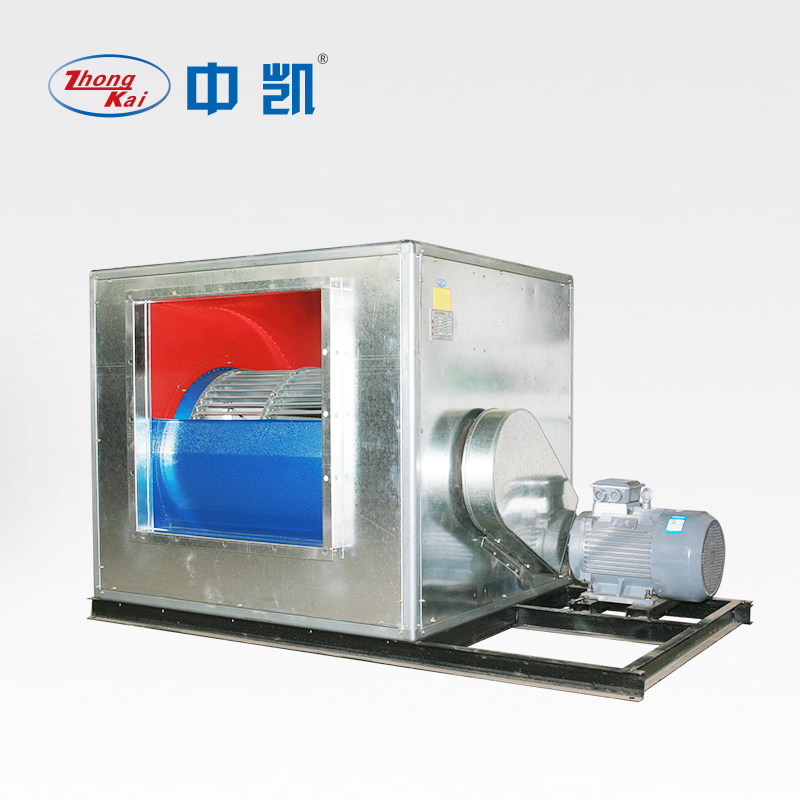
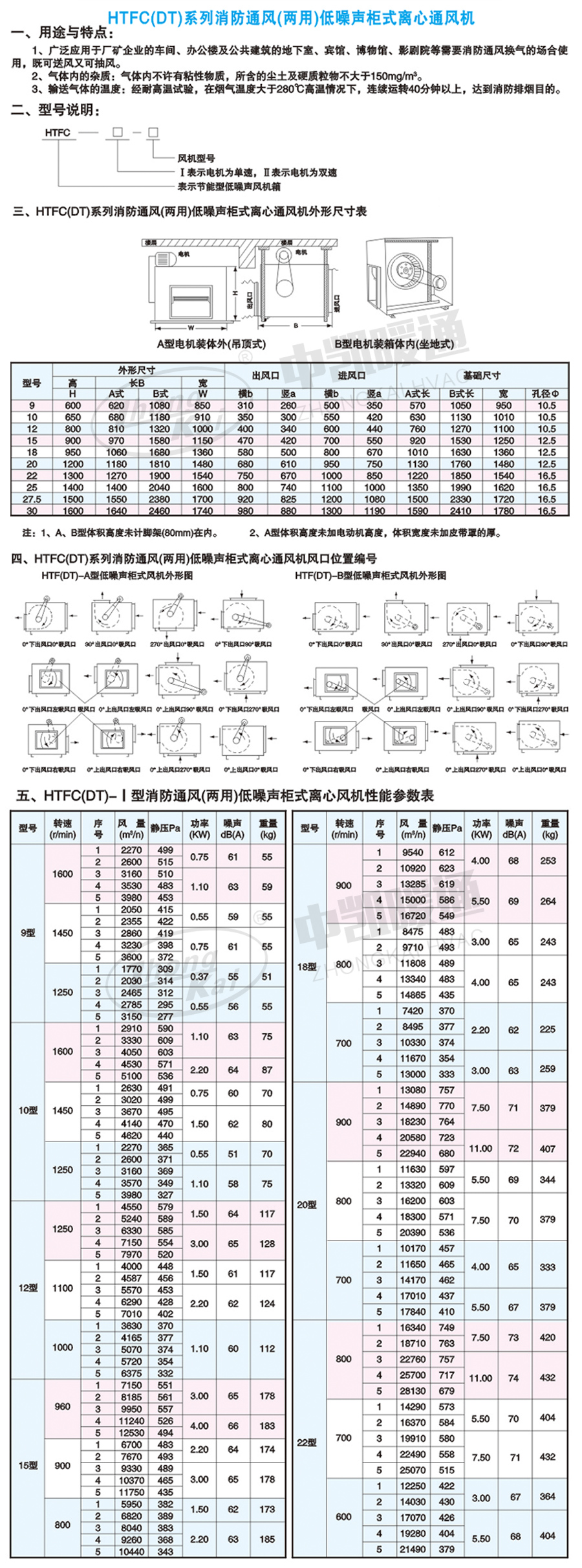
The Zhongkai HTFC webpage distinguishes A with the motor outside the cabinet and B with the motor inside. Its eight original long images add information absent from the short text. The final HTFC(DT) sheet explicitly defines I as single-speed and II as two-speed, shows installation/outlet arrangements, gives dimensions for sizes 9–30 and lists I-type performance points for sizes 9–22. These are supplier catalogue values, not a witnessed selection or a complete II-type performance table.
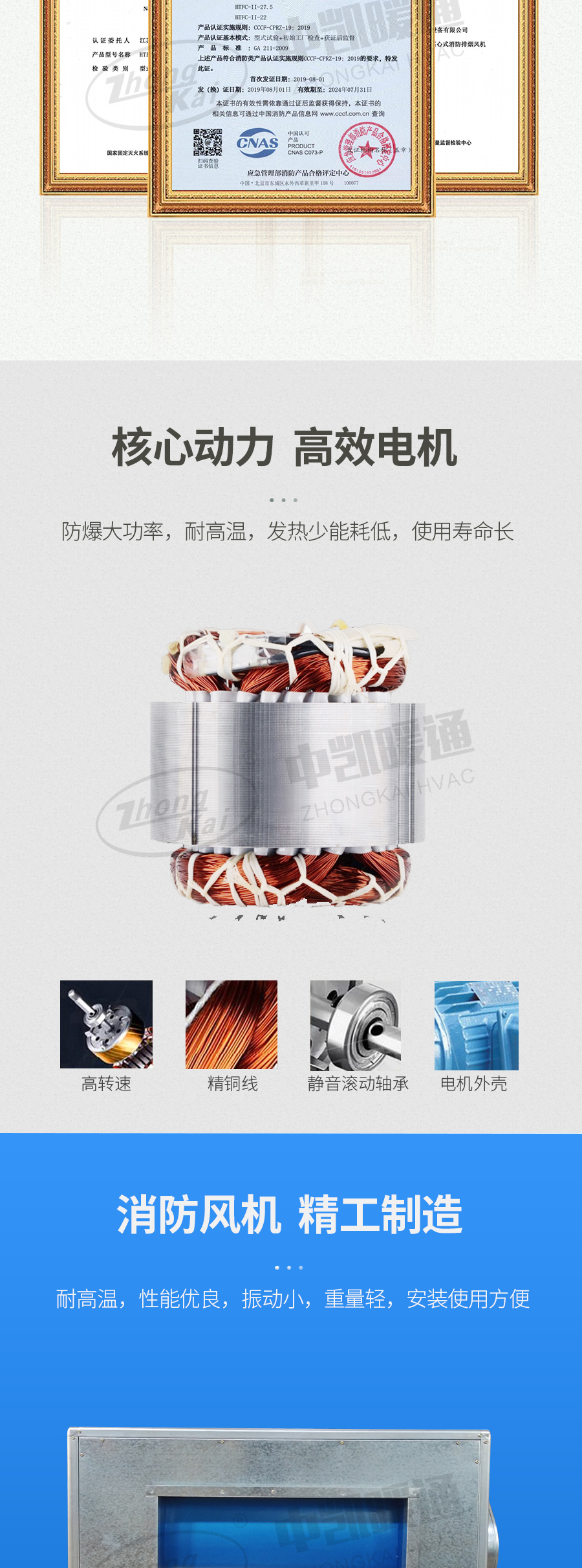
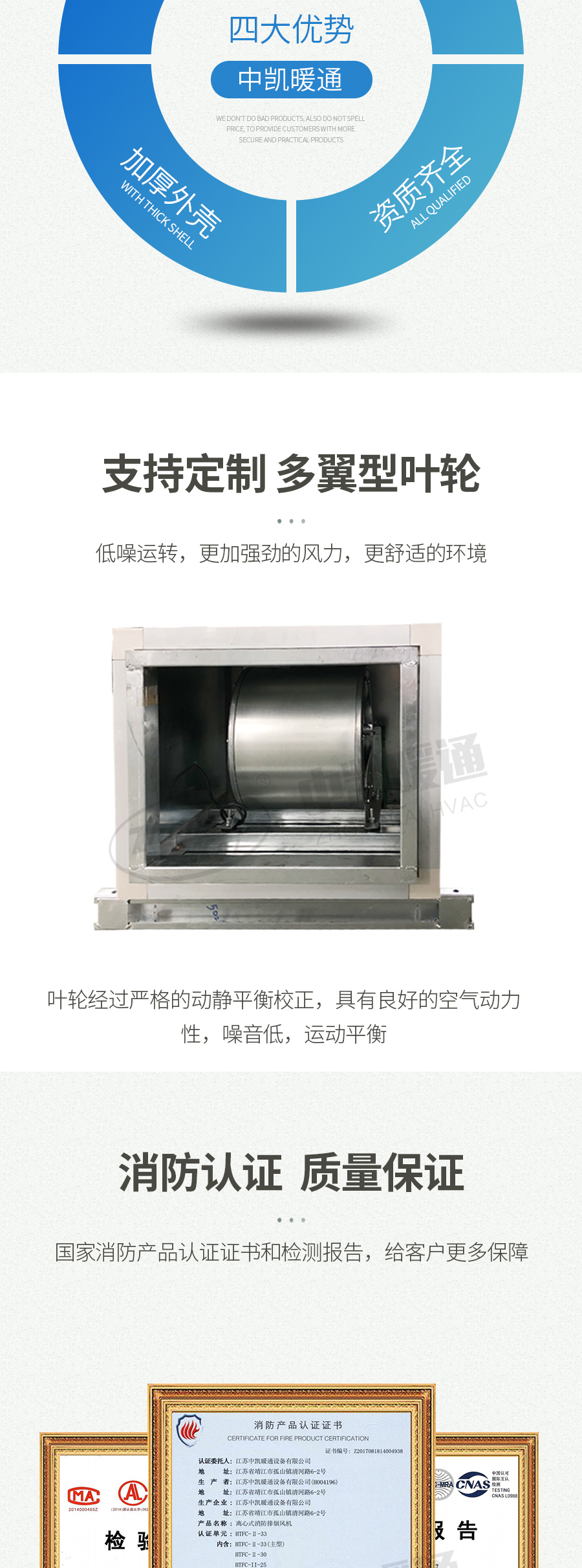
The original illustrated certificate names Zhongkai and an HTFC-II-33 certification unit, with additional II-type sizes. Its printed validity ends on 31 July 2024. It is historical evidence rather than proof of current approval. The sheet’s temperature/duration claim must be supported by a current report matched to the actual fan being ordered.
This is an equipment family; its range does not identify one orderable configuration.
Swipe the table, or focus it and use arrow keys, to read the conditions and sources.
| Parameter | Published value | Conditions and evidence |
|---|---|---|
| A/B arrangement | A: external motor; B: internal motor | Official text and sheet diagrams; sheet illustrates A suspended and B floor-mounted forms, requiring an approved drawing. Source |
| I/II speed definition | I: single-speed; II: two-speed | Explicit legend in the original HTFC(DT) sheet, not inferred from another catalogue. Source |
| Example I-type duty point | Size 9 · 1,600 r/min · 2,270 m³/h at 499 Pa static | One paired table row. Published power column 0.75 kW; not a universal size-9 maximum or absorbed-power test. Source |
| Example size-9 casing schedule | H 600; W 850; B length A 620 / B 1,080 | Drawing dimensions in mm; footframe 80 mm excluded from height and A motor/beltguard allowances excluded. Source |
| Published media limitation | No sticky material; dust/hard particles ≤150 mg/m³ | Supplier sheet limit; not an explosion-proof designation or all-contaminant suitability approval. Source |
| Temperature/duration statement | Smoke above 280°C; continuous operation over 40 minutes | Supplier wording in the sheet; no full model-matched high-temperature report reproduced here. Source |
| Historical certificate dates | 1 August 2019–31 July 2024 | Printed validity in the original montage; renewed/current issuer status not verified. Source |
A/B motor position and I/II speed are different selection dimensions. The table’s I-type heading cannot supply missing two-speed curves. Specify the full designation, fan size, arrangement, rotation, outlet direction and each required operating speed. Confirm the actual motor and drive match that schedule.
The drawings show multiple inlet/outlet configurations and floor/suspended forms. Obtain a project drawing that identifies connection faces, mounting orientation, motor position and servicing space. The picture of an external motor does not prove the quoted internal-motor configuration will have identical dimensions or temperature exposure.
A/B controls motor location and layout. Check motor/drive access, casing orientation and mounting dimensions.
I/II identifies single or two-speed in this specific sheet. Obtain both duty points and motor/control details for a II selection.
Use the catalogue arrangement sketches to agree an unambiguous approved drawing, not an informal front/left description.
For size 9 at 1,600 r/min, the first listed point is 2,270 m³/h at 499 Pa static, and the second is 2,600 m³/h at 515 Pa. They are separate operating points. Taking the largest airflow and highest pressure from different rows would create a rating the sheet does not give.
Issue the project airflow and resistance calculation, including ducts, fittings, dampers, silencers and terminals, with the pressure basis. The original column says static pressure, so do not silently treat it as total pressure or the remaining pressure after external accessories. Request the full curve, air-density/test conditions, stable operating range and motor loading for the selected arrangement. The catalogue power column is not independently measured absorbed input.
The sheet describes dual ventilation/smoke-exhaust use and claims continuous operation over 40 minutes with smoke above 280°C. Preserve the source wording rather than convert it into an independently certified temperature class. Match the required project temperature/duration, size, speed, motor location and accessory arrangement to a complete report and applicable current approval.
The historical certificate montage lists HTFC-II-33 as its unit/main type and II-30, II-25, II-27.5 and II-22 as included models. It does not establish that every I-type table size is covered. Printed validity ended in 2024; a newer document and issuer-status verification are needed if certification is an order condition. Management-system or laboratory logos alone cannot substitute for this model-specific evidence.
Manufacturer-hosted original certificate montage, naming Zhongkai and specified HTFC-II models, with readable issue and expiry dates.
Read the sourceComplete current certificate/report and applicable status, matched to the exact proposed size, speed, arrangement and required smoke duty.
The dimension note excludes an 80 mm footframe from A/B casing height. For A, motor height and beltguard thickness are also excluded from the relevant casing dimensions. A plantroom or support selected from casing H/W/B alone may therefore be too small. Ask for the total installed envelope, weight, centre of gravity, supports and lifting arrangement.
For the size-9 example, the table gives an outlet 310 × 260 mm and inlet 500 × 350 mm. These are catalogue connection references, not a guarantee the project’s chosen outlet orientation has the same accessible transition space. Coordinate flexible connections, transitions, vibration isolation and duct supports without transferring duct load into the fan casing.
The technical sheet limits sticky material and dust/hard-particle content. Application illustrations include garages, tunnels and drying rooms, but those photographs do not establish suitability for corrosive, grease-laden, explosive or continuously hot process exhaust. Agree the medium, temperature, contaminants and relevant materials/protection with the supplier and designer.
The table publishes dB(A) values without a reproduced measurement distance, sound-power/pressure distinction or complete test method. A noise number cannot predict a room boundary level on its own. Obtain the relevant acoustic data and assess ducts, breakout, attenuation and vibration for the installation. The graphic’s explosion-proof wording is not a reproduced motor approval; confirm an appropriate approved motor if that requirement applies.
The eight original images contain useful diagrams and a numerical sheet alongside generic promotional claims. The useful order package is the selected technical schedule and evidence, rather than a promise of high efficiency, long life or a rapid response.
Agree normal/emergency airflow and static-pressure points, full fan designation, operating speeds and applicable smoke duty.
Approve curves/motor loading, complete envelope/connection drawing, controls/interlocks and current model-matched evidence.
Record rotation, speed, airflow/static pressure, current, vibration and control changeover at the agreed conditions; obtain maintenance and spare-drive instructions.
Compiled by HVACDeck Editorial. Source review identifies what the publication states; it is not an independent performance test or certification.
Editorial method and corrections · Report a detail with this page URL
Send the manufacturer your required duty, installation conditions and the unresolved items identified in this brief.