1 published equipment referenceLatest source review 2026-10-11
01 / COMPANY
What this manufacturer offers
Jiangsu Zhongkai HVAC Equipment Co., Ltd. presents itself as a Jingjiang supplier of ventilation equipment, air-conditioning components and duct packages. The reviewed company page describes design, manufacture, installation, commissioning and repair activities. Its published address is No. 66 Wenwei Road, Jishi Town, Jingjiang. These statements establish the scope that the supplier advertises; they do not identify which activities are included in a particular quotation.
The catalogue extends beyond cabinet fans to air-handling equipment, fan-coil units, fresh-air equipment, air outlets, dampers, silencers, plenums and vibration-isolation components. Its duct offer includes fresh-air, supply, exhaust, smoke-exhaust and dust-extraction systems. A buyer coordinating a fan and duct package can therefore ask about both sides of the interface, while still requiring a defined equipment schedule and installation boundary.
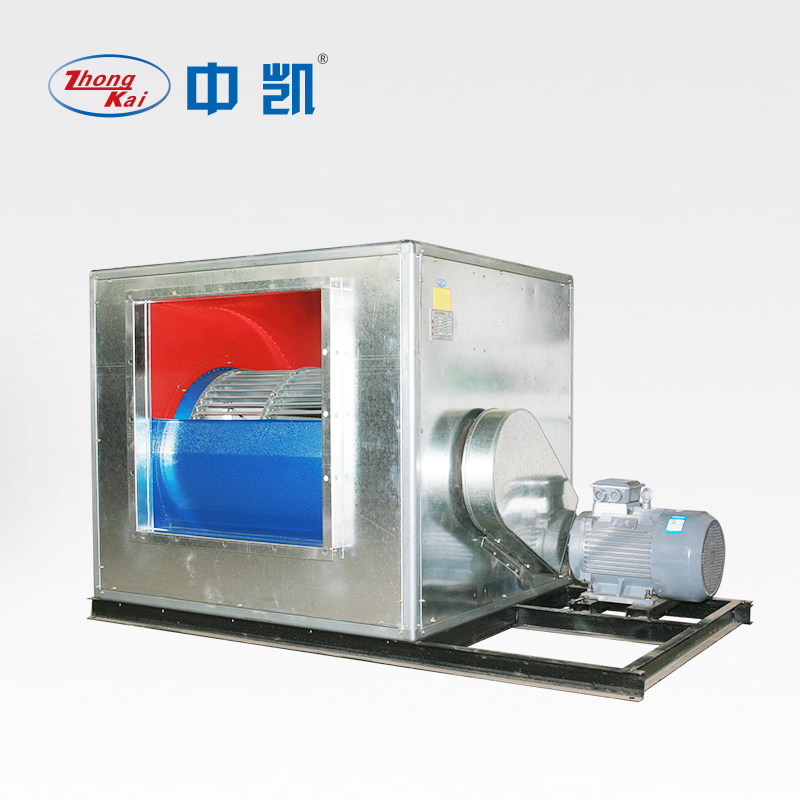
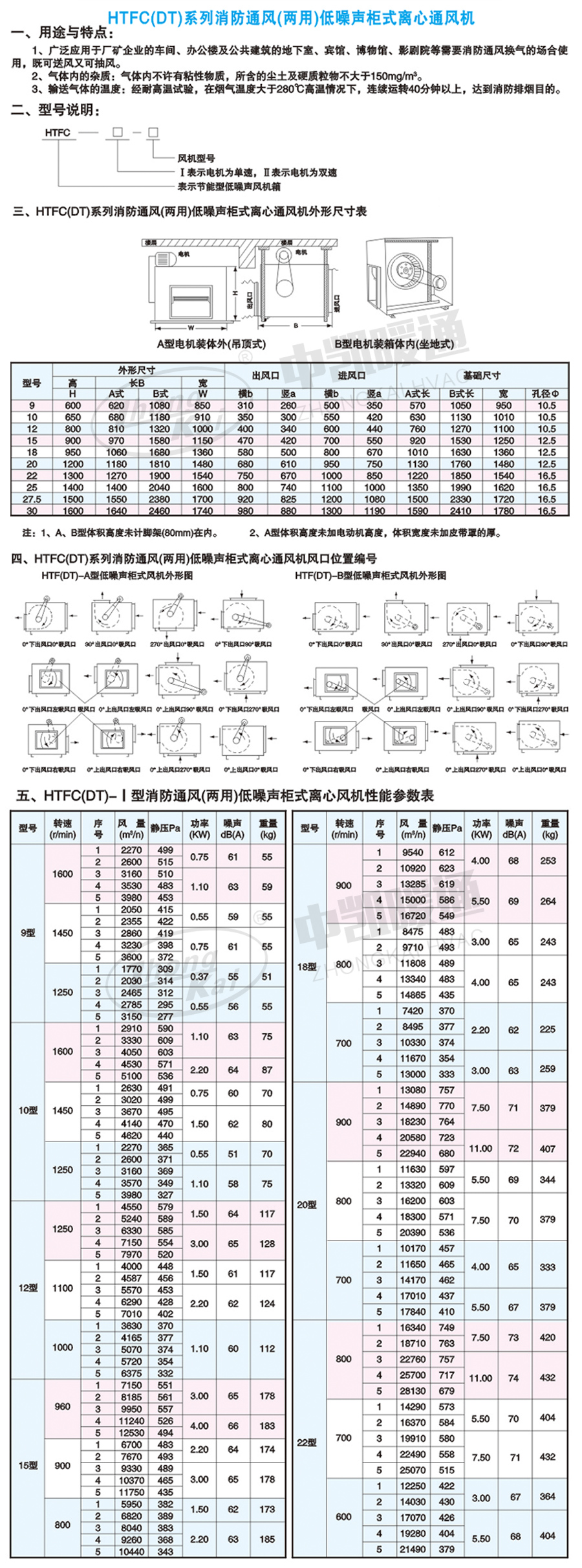
For the HTFC centrifugal cabinet fan reviewed here, the official product text makes one useful distinction explicit: A and B identify where the motor is installed. The original HTFC(DT) image explicitly defines I as single-speed and II as two-speed and provides an I-type numerical performance table. An illustrated historical HTFC-II certificate has a printed expiry in 2024; current model-matched approval remains unverified. The following sections separate those actual descriptions from the information still required for an order.
Published company address
No. 66 Wenwei Road, Jishi Town, Jingjiang, JiangsuAddress on the official company and honours pages; not an independent registration check. Source
Reviewed cabinet-fan family
HTFC centrifugal smoke-exhaust cabinet fanFamily heading on the reviewed official product page. An exact order designation is still required. Source
Duct package advertised
Fresh air, supply, exhaust, smoke exhaust and dust extractionManufacturer-described duct applications. A project quotation must specify the included equipment and site work. Source
Swipe the table, or focus it and use arrow keys, to read conditions and sources.
Manufacturer-published information · HTFC
Parameter
Published value
Conditions and evidence
A/B arrangement
A: external motor; B: internal motor
Official text and sheet diagrams; sheet illustrates A suspended and B floor-mounted forms, requiring an approved drawing. Source
I/II speed definition
I: single-speed; II: two-speed
Explicit legend in the original HTFC(DT) sheet, not inferred from another catalogue. Source
Example I-type duty point
Size 9 · 1,600 r/min · 2,270 m³/h at 499 Pa static
One paired table row. Published power column 0.75 kW; not a universal size-9 maximum or absorbed-power test. Source
Example size-9 casing schedule
H 600; W 850; B length A 620 / B 1,080
Drawing dimensions in mm; footframe 80 mm excluded from height and A motor/beltguard allowances excluded. Source
Published media limitation
No sticky material; dust/hard particles ≤150 mg/m³
Supplier sheet limit; not an explosion-proof designation or all-contaminant suitability approval. Source
Temperature/duration statement
Smoke above 280°C; continuous operation over 40 minutes
Supplier wording in the sheet; no full model-matched high-temperature report reproduced here. Source
Historical certificate dates
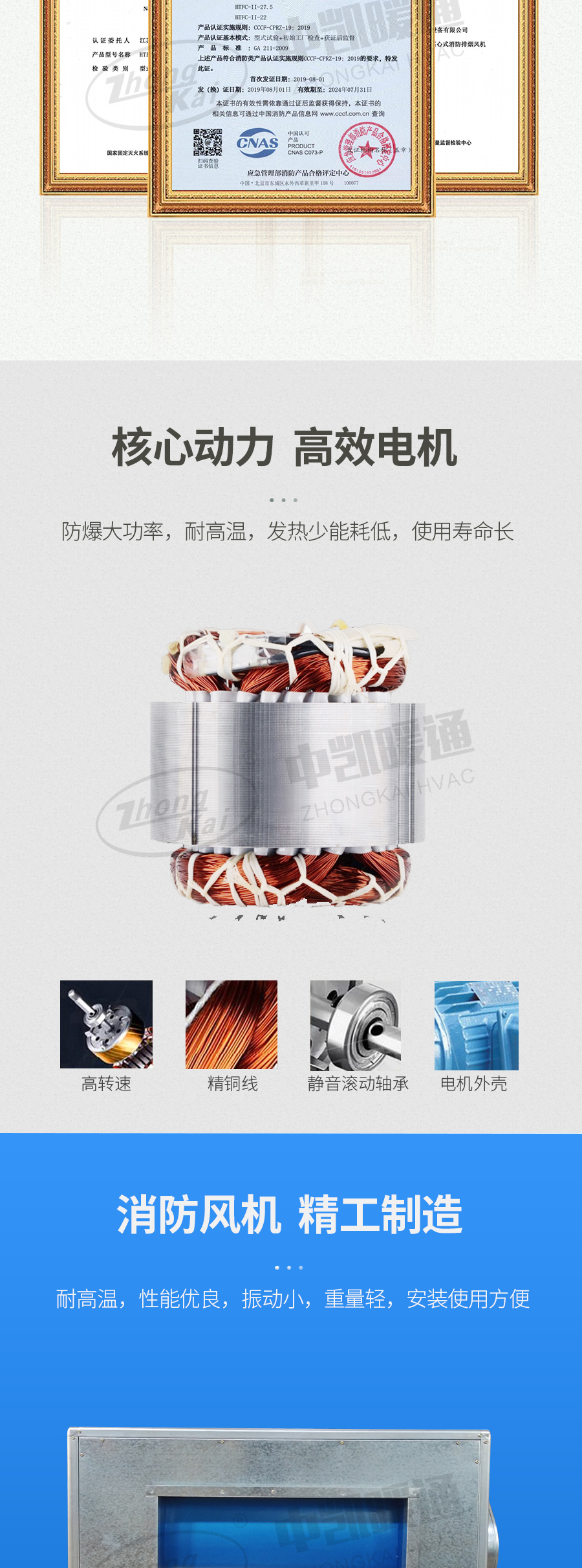
1 August 2019–31 July 2024
Printed validity in the original montage; renewed/current issuer status not verified. Source
03 / PROJECT REVIEW
Zhongkai: reading an HTFC cabinet-fan enquiry correctly
A and B describe motor position
The HTFC publication classifies the cabinet arrangement by motor position. This is a real distinction in the source and should appear in the selected fan designation and arrangement drawing. It should not be silently replaced by a different supplier’s classification. (Source 2.)
A: motor outside the cabinet casing
The official text places the motor outside the cabinet shell. Ask for the selected unit’s drawing to locate the motor, drive, service clearance and connection faces; the brief text does not settle these dimensions.
The official text places the motor inside the cabinet shell. Confirm the selected arrangement and maintenance access. The description alone does not establish the motor’s temperature exposure or its approval for a particular smoke duty.
Original technical sheet defines I and II speed arrangements
The webpage’s short text only describes different performance variants, but the actual original HTFC(DT) image supplies the missing legend: I denotes a single-speed motor and II a two-speed motor. It also provides a dimension table for sizes 9–30, outlet arrangements and I-type airflow/static-pressure rows for sizes 9–22. This is a manufacturer catalogue, not an independent test or a complete II-type curve schedule.
For example, size 9 at 1,600 r/min lists 2,270 m³/h at 499 Pa static on its first row. Preserve that pair and the selected speed instead of mixing maxima from different rows. Request the complete selected curve and motor/loading basis, and a separate pair of operating schedules for a two-speed selection. The dimension notes exclude footframe and some external motor/guard allowances; an approved total-envelope drawing is necessary.
Historical HTFC-II certificate is distinct from the other honours entries
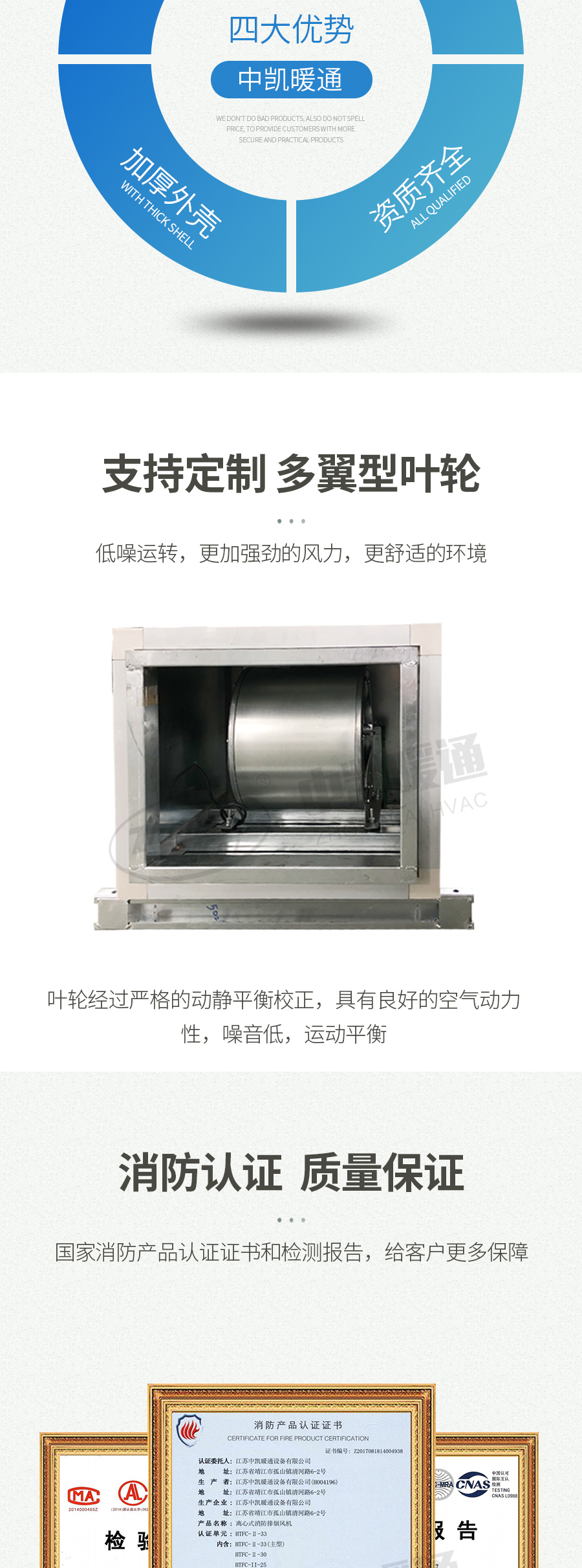
Beyond the honours page’s PYHL-14A, PYF and PFHF items, the product’s original long-image montage shows a certificate naming Jiangsu Zhongkai HVAC Equipment Co., Ltd. It identifies HTFC-II-33 as the certification unit/main type and lists II-30, II-25, II-27.5 and II-22. Its issue date is 1 August 2019 and printed validity ends on 31 July 2024. No renewed/current issuer-status result was verified.
Supported historical document
The actual manufacturer-hosted image contains the named holder, HTFC-II types and readable issue/expiry dates. An expired printed validity is not current approval.
Match a complete current certificate/report and applicable issuer status to the offered designation, speed, motor arrangement and required temperature/duration. Do not transfer II-type coverage to every I-type table size.
Make the fan-to-duct interface explicit
Zhongkai’s company page describes an automated duct production line and a design-to-installation service offer. It also advertises a production-area figure, certificate count and response-time claim. These are supplier statements rather than a verified capacity audit, certification inventory or contractual service commitment. No production throughput or response guarantee is derived from them. (Source 1.)
A combined package should identify which party selects the fan against system resistance, who supplies transitions and vibration isolation, and who confirms the mounting and access arrangement. For smoke-exhaust work, keep the applicable duty and evidence requirements attached to the exact fan, damper and duct schedule. A broad catalogue is useful for discussing interfaces but does not show that all components have been selected together.
The company page’s installation and repair offer also needs a geographical and contractual boundary. Ask which site activities and commissioning records are included for the buyer’s location, and which are supplied by a local contractor. The website’s response-time wording is not evidence of an overseas maintenance team or an agreed spare-parts delivery time.
Documents that would resolve this specific enquiry
For a current enquiry, obtain the full HTFC designation and A/B arrangement, selected I/II speed schedules, curves, motor data and total installation drawing. The original sheet supplies useful family references and a high-temperature/duration claim, but a model-matched report and current approval are still required where the procurement specification relies on smoke-exhaust performance.
This supplier review uses individually read official pages and their actual original technical and certificate images. The historical certificate’s expiry is explicit; no absence of a renewal is inferred from our unresolved current-status check. The catalogue and historical records guide questions without becoming a platform certification.
07 / TRANSPARENCY
Sources and review scope
Compiled by HVACDeck Editorial. Page review: 2026-10-11. Publications are attributed below; their statements are not independent measurements by this platform.
Zhongkai official company page — source 1Checked 2026-10-07 · Individually read: published address, catalogue scope, duct and service claims. Area, certificate-count and response-time marketing are not independently verified.
HTFC centrifugal cabinet-fan publication — source 2Checked 2026-10-07 · Individually read: A/B motor position and I/II performance wording. No numerical curve or matched test report reproduced in readable text.
Zhongkai honours gallery — source 3Checked 2026-10-07 · Visible PYHL-14A, PYF and PFHF entries. Manufacturer-hosted gallery does not independently verify current HTFC certification.