
Published
Named family, heating/air-conditioning use and two heating-medium alternatives.
 HVAC & REFRIGERATION
Specify the heating loop and heating medium together; coil movement is a construction claim rather than a rated duty or a maintenance exemption.
From Beijing Tegao · Heating and hot-water equipment
Individual product research · HVACDeck Editorial · Sources checked 2026-10-11
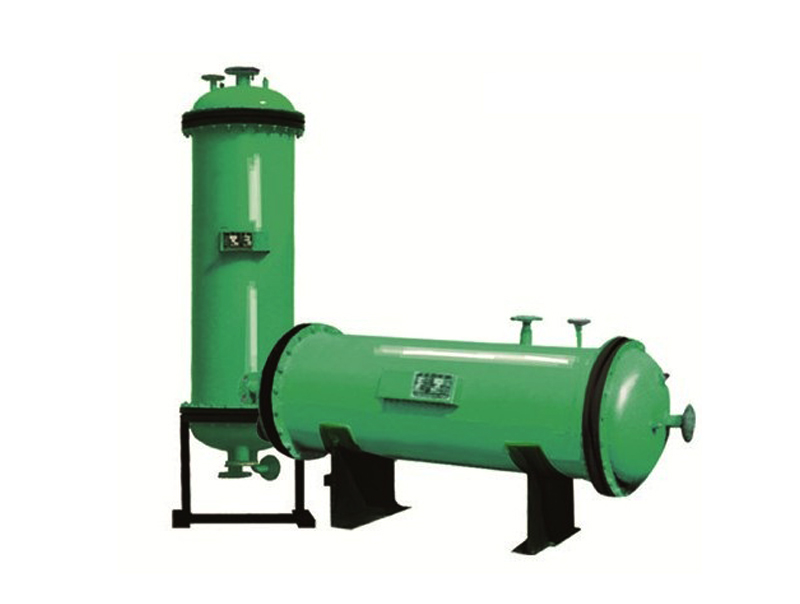
Tegao identifies TGTL and TGTW as a semi-instantaneous floating-coil heat-exchanger family used mainly in heating and air-conditioning systems. The official description distinguishes steam-to-water and water-to-water heating media. It attributes heat transfer and reduced scale adhesion to coil movement under changing heating-medium conditions and water flow. Those are supplier construction claims, not an independently measured duty or a promise that cleaning is unnecessary.
The original family image shows vertical and horizontal green shell arrangements with supports, flanges and connections; the internal coil is not visible. No selected model schedule, heat-transfer area, pressure rating or simultaneous temperature/flow point is supplied on the reviewed page. This brief helps prepare an enquiry for a building heating loop: establish the service, selected output, control behaviour, hydraulic interfaces and service access before treating a family name as a ready-to-install specification.
This is an equipment family; its range does not identify one orderable configuration.
Swipe the table, or focus it and use arrow keys, to read the conditions and sources.
| Parameter | Published value | Conditions and evidence |
|---|---|---|
| Official family identifiers | TGTL / TGTW | Do not infer which suffix maps to orientation without the issued model schedule. Source |
| Published heating-medium alternatives | Steam-to-water / water-to-water | Separate circuits require an actual selected arrangement and interface drawing. Source |
| Published use | Heating and air-conditioning systems | Application statement, not a verified installed reference or output rating. Source |
| Coil behaviour described | Movement/vibration under medium changes and water flow | Supplier mechanism description; no quantified heat-transfer or scaling test supplied. Source |
| Original visible arrangements | Vertical and horizontal shells with supports and flanged connections | Family photo only; internal coil, ordered dimensions and pressure rating not visible. Source |
Define the connected heating service, required output at design conditions and actual supply/return temperatures. Identify which side contains the heated building water and which contains the available steam or hot-water medium. Ask for a thermal selection with simultaneous conditions and stated allowance for the specified water quality.
The reviewed page provides no kW schedule or rated flow. A taller or longer shell in the photograph does not establish capacity or identify the correct model. Do not substitute a storage-tank volume for this family’s selected continuous heat-transfer output.
For the proposed steam arrangement, have the supplier issue the heating-medium connections and complete control/condensate boundary applicable to the ordered unit. For a water heating medium, obtain both water-side flow and pressure-drop schedules. The description’s two media alternatives do not mean that one selected exchanger can be switched between them without engineering review.
Agree who supplies regulating valves, pumps and instrumentation and who checks compatibility with the existing plant. This page does not assign a universal steam pressure, condensate scheme or water temperature. Those values must come from the actual selection and responsible project design.
The supplier describes floating movement in several directions and vibration that disturbs heated water and discourages scale adhesion. The reviewed family photograph cannot show the internals or demonstrate that behaviour under a selected duty. Request the coil assembly drawing, materials, restraint/support arrangement and the supplier’s operating restrictions.
Require written inspection, cleaning and maintenance instructions for the actual fluid quality. Do not translate ‘automatic descaling’ into maintenance-free operation or assume that scale cannot form. Obtain access requirements and a replacement-coil/service plan before approving a tightly enclosed installation.
Request design and working limits separately for each circuit, together with the issued connection schedule, overall dimensions, dry/operating mass and support loads. The original flanges show that interfaces exist; they do not identify a pressure class, bore or material. Confirm the actual selected orientation instead of assigning it from the TGTL/TGTW letters.
Check installation and coil-removal clearance against the supplier’s drawings. Obtain current manufacturing/conformity documents for the exact vessel and site as applicable to the order. Historical certificates or a generic company licence claim do not replace an ordered equipment dossier.
Ask for the control sequence at changing load, sensor locations, protective responses and start/stop instructions. Establish the interface to building controls and which components are included. No outlet-temperature stability, response time or low-load limit was verified on the reviewed page.
Compare quotations against the same selected heat duty, circuit limits, drawings, control boundary and delivered test records. Price, stock, lead time and independently measured efficiency remain unknown. The actual procurement questions here follow this floating-coil heating construction rather than a generated nominal-capacity page.
Named family, heating/air-conditioning use and two heating-medium alternatives.
Simultaneous duty, both circuits, model/orientation and physical interfaces.
Current ordered-vessel documents, maintenance access and agreed performance/control evidence.
Compiled by HVACDeck Editorial. Source review identifies what the publication states; it is not an independent performance test or certification.
Editorial method and corrections · Report a detail with this page URL
Send the manufacturer your required duty, installation conditions and the unresolved items identified in this brief.