
YZDLR-70GXS
A−12/W41: 42 kW heating with 18.2 kW stated input. A7/W45: 45.0 kW heating with 14.5 kW input. A35/W7: 45 kW cooling with 19.5 kW input. Its mild-weather figure is not 70 kW despite the model suffix.
Read the source HVAC & REFRIGERATION
Compare four published models at their stated rating conditions; obtain a confirmed selection schedule before sizing electrical and water systems.
From Bokaqi (Chuzhou) HVAC Energy-Saving Equipment Co., Ltd.
Individual product research · HVACDeck Editorial · Sources checked 2026-10-11
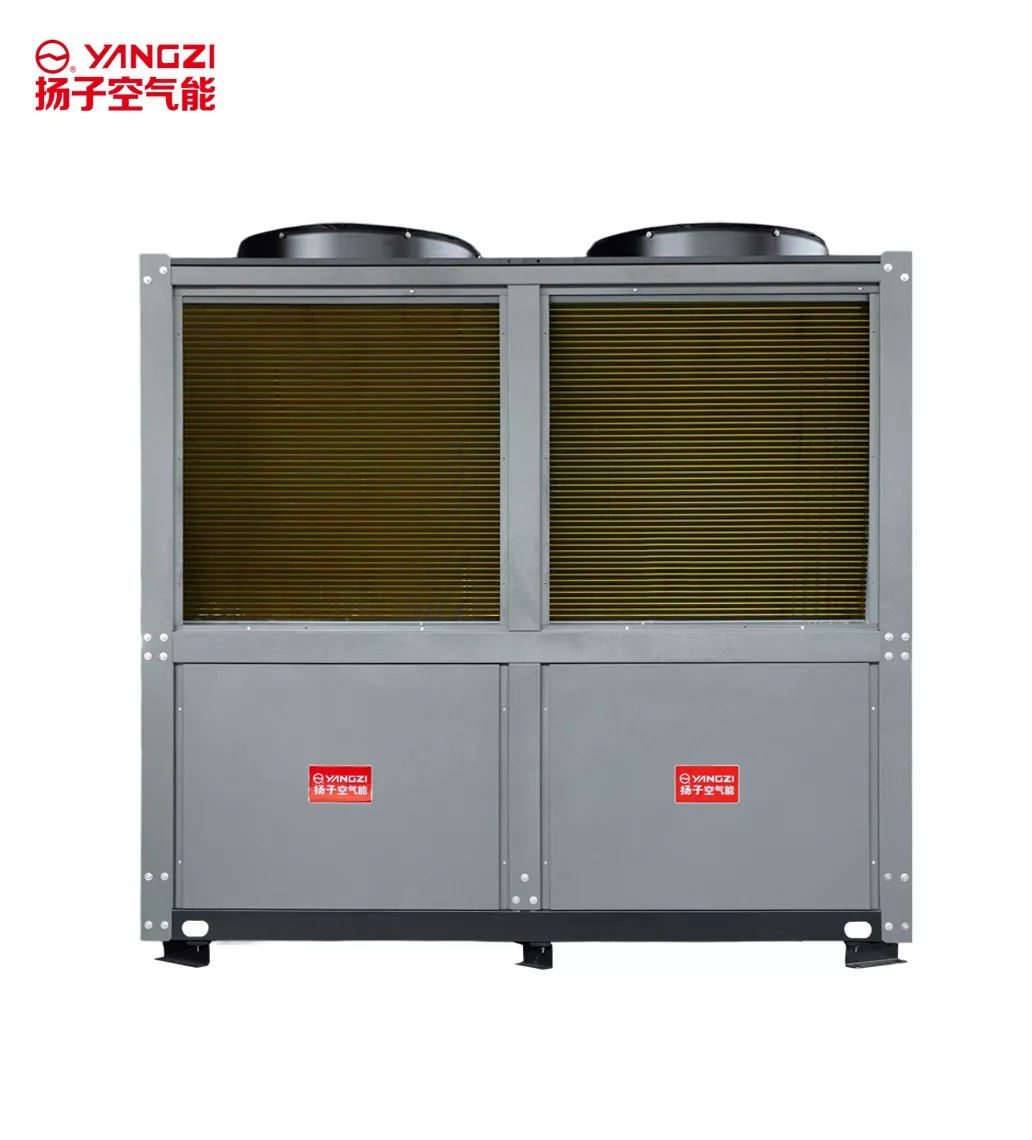
Bokaqi’s commercial low-temperature modular catalogue links four GXS models: YZDLR-70GXS, -80GXS, -90GXS and -160GXS. Each detail page gives heating at A−12/W41, heating at A7/W45 and cooling at A35/W7. Those three conditions belong in separate comparisons. For example, the 80GXS page lists 52 kW at A−12/W41 and 80 kW at A7/W45; the latter is not an 80 kW winter design guarantee.
All four pages state R410a and 380 V, 3N, 50 Hz. The reviewed catalogue photograph shows a two-top-fan outdoor assembly with Yangzi labels, but no legible nameplate or dimensional drawing. The catalogue therefore supports an initial technical enquiry, not a construction-ready selection.
Several entries need the supplier’s confirmation, especially the 90GXS electrical and water-flow figures that repeat the larger 160GXS values. They are preserved as published rather than silently corrected or used to calculate a building load, breaker size or pump selection.
This is an equipment family; its range does not identify one orderable configuration.
Swipe the table, or focus it and use arrow keys, to read the conditions and sources.
| Parameter | Published value | Conditions and evidence |
|---|---|---|
| Electrical supply | 380 V, 3N, 50 Hz | Published on each model page. Neutral, protective earth and final wiring schedule must follow the actual unit documentation. Source |
| Refrigerant | R410a | Common published table entry; charge, circuit arrangement and destination documentation are not specified. Source |
| Cold-weather heating comparison | 42 / 52 / 60 / 108 kW | 70 / 80 / 90 / 160GXS respectively, at the page’s A−12/W41 condition; not capacity throughout the ambient envelope. Source |
| Published ambient envelope | −35°C to 43°C | Listed on all four pages; no full output/defrost/water-temperature operating map was supplied. Source |
| Protection descriptions | Class I; IPX4 | Official model-table wording, not independently checked certification or a complete installation specification. Source |
The paired input powers below are transcribed from the corresponding heating/cooling columns. A/W notation follows the source labels; the pages do not explain the complete inlet/outlet water, wet-bulb, flow or defrost test conditions. Request the full rating method and model report before treating these entries as certified performance. None is a seasonal efficiency figure.
A−12/W41: 42 kW heating with 18.2 kW stated input. A7/W45: 45.0 kW heating with 14.5 kW input. A35/W7: 45 kW cooling with 19.5 kW input. Its mild-weather figure is not 70 kW despite the model suffix.
Read the sourceA−12/W41: 52 kW heating with 22.5 kW stated input. A7/W45: 80 kW heating with 24.3 kW input. A35/W7: 65 kW cooling with 25 kW input. The mild-weather 80 kW figure must not be transferred to the winter design condition.
Read the sourceA−12/W41: 60 kW heating with 24.5 kW stated input. A7/W45: 90 kW heating with 27.3 kW input. A35/W7: 80 kW cooling with 25 kW input. Its maximum electrical and flow entries require separate confirmation below.
Read the sourceA−12/W41: 108 kW heating with 45 kW input. A7/W45: 160 kW heating with 51.8 kW input. A35/W7: 130 kW cooling with 48.1 kW input. Ask for output at the actual project’s outdoor and water temperatures rather than applying 160 kW throughout winter.
Read the sourceThe 70GXS page lists maximum input 28.8 kW / 55 A; 80GXS lists 33.8 kW / 57.8 A. Both the 90GXS and 160GXS pages list 72.6 kW / 152.7 A. The latter two also share the published 22.4 m³/h water flow. These repetitions may be intentional or may reflect a catalogue issue; the pages alone do not settle which.
Do not replace them with an estimated value. Request a revision-controlled table and actual nameplate, plus maximum operating/start current, protective-device requirements, cable/terminal data and any auxiliary-heater load. The nominal input at a rated condition is not the maximum input used for installation design. The reviewed tables do not state a compressor count, inverter range or control protocol; an award for another series cannot fill those gaps.
Ask the supplier to explicitly confirm maximum 72.6 kW / 152.7 A and 22.4 m³/h for this model, with the rating-page revision and actual unit identity.
Read the sourceThe larger model lists those same maxima/flow alongside different nominal outputs, weight and dimensions. Keep each entry with its own model rather than assuming the two units are electrically equivalent.
Read the source70GXS and 80GXS list 9.5 and 11.2 m³/h respectively, with G2—DN50 external-thread wording. 90GXS and 160GXS list 22.4 m³/h, with G2—DN65 internal-thread wording. The latter thread/nominal-size notation needs a marked connection drawing; this review does not normalise it into an assumed pipe standard. No pressure-drop curve, minimum flow, pump duty or water-volume requirement was supplied.
70/80/90GXS all publish 2100 × 1100 × 2180 mm external dimensions, with respective net weights 582, 637 and 700 kg. 160GXS publishes 2400 × 1380 × 2365 mm and 1000 kg. These are unit dimensions, not the full installation footprint. Obtain a drawing showing supports/lifting points, water ports, airflow clearances and maintenance access. The stated ≤69 dB(A) for the three smaller units and ≤73 dB(A) for 160GXS do not include a measurement distance or sound-power basis; they cannot alone predict noise at a neighbour’s boundary.
The −35°C lower ambient limit does not promise rated capacity at −35°C, at an arbitrary water temperature, or during defrost. Likewise, the company introduction’s −45°C laboratory range describes a facility claim rather than a unit operating limit.
Send the design outdoor condition, required supply/return water temperatures, winter load, terminal type and cooling duty. Ask for a selected-unit operating map, defrost behaviour and control sequence, including available output during cold periods and any supplementary-heating responsibility. Agree freeze protection for the actual water system and outage conditions. No glycol suitability, concentration correction, minimum-water-volume rule or anti-freeze accessory package was established by the reviewed model pages.
The original national-standard record identifies GB/T25127.1-2020 as a current recommended standard concerning low-ambient air-source heat-pump/chiller packages for industrial/commercial and similar applications. This is technical context for discussing the declared method and scope, not evidence that these four GXS models were tested to it. Request the supplier’s applicable standard/edition, exact covered configuration and actual test results.
The pages do not supply a seasonal energy label, model-specific compliance certificate, refrigeration charge or fixed warranty duration. Corporate management-system wording and a different series’ supplier-reported exhibition award do not substitute for those documents. Destination requirements and support arrangements must be checked for the actual order.
Use the four-model comparison to establish a shortlist, then seek a confirmed selection rather than purchasing by model suffix. The request should make thermal duty, interfaces and deliverables separately checkable.
Provide design outdoor temperature, heating/cooling loads, supply/return water temperatures, usage schedule and any backup requirement.
Obtain corrected/confirmed model data, performance/defrost map, nameplate electrical schedule, connection drawing, water-side requirements and controls interface.
Agree brand/model revision, included pump/buffer/heater/accessories, model-specific documentation, commissioning tests and written warranty/support at the destination.
Compiled by HVACDeck Editorial. Source review identifies what the publication states; it is not an independent performance test or certification.
Editorial method and corrections · Report a detail with this page URL
Send the manufacturer your required duty, installation conditions and the unresolved items identified in this brief.