1 published equipment referenceLatest source review 2026-10-07
01 / COMPANY
What this manufacturer offers
Jiangsu Hanwei Air Conditioning and Refrigeration Equipment Co., Ltd. publishes an air-treatment portfolio that deserves a closer reading than the label ‘air-conditioning manufacturer’. Its company introduction names shipyard and coating dehumidification, rotary and refrigerated dehumidifiers, liquid-desiccant equipment, direct-expansion air handlers, heat-recovery units and constant-temperature-and-humidity equipment. The website therefore points to both building comfort applications and production environments where moisture control is part of the process. These are manufacturer descriptions, rather than evidence that a particular project has been completed.
The equipment reference reviewed for this profile is titled ‘Direct-expansion air handling units’. Its detailed text, however, describes a configurable combined air handler and includes water-side coil features. That distinction matters: the page gives useful information about sections and construction, but it does not identify a complete refrigerant-system arrangement for an exact DX selection. This profile keeps that ambiguity visible instead of turning the page’s entire combined-air-handler range into a single DX specification.
For a buyer approaching Hanwei, the first useful discussion is the required air process: what enters the unit, which treatment stages are needed, and what must leave it. The sections below explain which details the official publication actually provides, how they affect a quotation, and which evidence remains missing. They do not claim a factory inspection, quantified energy savings or independently confirmed manufacturing capacity.
Published air-handler range
2,000–200,000 m³/hRange stated in the combined-air-handler description on the DX-titled page. Not the airflow or static pressure of a selected unit. Source
Treatment-section choices
Mixing, cooling, heating, filtration, electric heating, humidification, sound attenuation, heat recovery, secondary return air, fan and flow-equalisation sectionsCatalogue choices. The quoted arrangement and section order must be specified. Source
Declared dehumidification scope
Shipyard and coating applications; rotary, refrigerated and liquid-desiccant equipmentCompany-published portfolio, not model-specific dew-point or moisture-removal ratings. Source
Parameters and source limits · Direct-expansion air handling units
Swipe the table, or focus it and use arrow keys, to read conditions and sources.
Manufacturer-published information · Direct-expansion air handling units
Parameter
Published value
Conditions and evidence
Published airflow range
2,000–200,000 m³/h
Combined-air-handler range in the DX-titled description; not a selected unit duty. Source
Selectable sections
Mixing, cooling, heating, filtration, humidification, attenuation, recovery, fan and flow equalisation
Catalogue choices; section inclusion/order and final size require an approved selection. Source
Fan description
Forward- or backward-curved double-inlet centrifugal fan
Supplier says impeller/pulley balancing; no selected curve, drive or acoustic rating. Source
Drain construction
Sloped insulated condensate pan; coil header drain and vent valves
Construction text includes water-side features; exact DX coil/package remains to be confirmed. Source
Casing description
Colour-coated steel exterior and aluminium-profile frame
No casing leakage, thermal-bridge or insulation classification published on the item. Source
03 / PROJECT REVIEW
Hanwei research: sectional air treatment and the DX selection boundary
The DX title and the detailed construction describe different levels of scope
The product page’s heading and body do not establish one complete refrigeration arrangement. Keep that unresolved scope visible when comparing a quotation.
Heading: direct-expansion air handling
The publication names a DX air-handling unit. It does not identify an exact refrigerant circuit, compressor arrangement or outdoor-unit selection in the readable specification.
The details describe selectable treatment sections and water-side coil features, including drain and vent valves. These do not by themselves prove which sections and refrigeration equipment belong to a quoted DX package.
Define the air process before selecting the section arrangement
Hanwei lists mixing, cooling, heating, filtration, humidification, acoustic, heat-recovery and fan sections. The publication gives choices; it does not supply the final arrangement for the buyer’s project. (Source 2.)
State the entering air and moisture duty
For coating or industrial humidity control, describe outdoor air, return-air allowance, moisture entering the space and the required leaving-air condition. Do not replace that process description with a single cooling-capacity figure.
Specify which treatment stages are included
Ask for an arrangement showing the selected filters, coils, heating, humidification and recovery sections in their actual order. Available catalogue choices are not a promise that every option is included in the price.
Review the coil, fan and access drawings together
Obtain the proposed coil duty and fan pressure with the casing, drain and service-access arrangement. Resolve the DX circuit and the supply boundary before treating the quotation as a complete package.
The fan and casing details tell a buyer what to inspect next
The official page describes forward- or backward-curved double-inlet centrifugal fans, balanced impellers and pulleys, inspection doors at the functional sections, and a coloured-steel outer surface with an aluminium-profile frame. It also describes a sloped, insulated condensate tray. These are construction statements from Hanwei; they are not measured sound levels, leakage classes or corrosion test results. (Source 2.)
The important next evidence is specific to the proposed build: a fan curve at the required external pressure, its drive arrangement, casing dimensions and the clearances needed to remove filters and coils. Ask how the drain connection and trap will be arranged at the selected operating pressure. The statement about a sloped tray does not independently establish drainage performance at your installation. A general description of inspection doors also does not prove that the available plantroom access is adequate.
Dehumidification needs a different selection conversation from comfort cooling
The company introduction explicitly groups shipyard dehumidifiers, coating dehumidifiers, rotary equipment, refrigerated dehumidification and liquid-desiccant units with its wider HVAC range. This is the most useful reason to examine Hanwei for a moisture-control project rather than to assume every enquiry should start with a cooling-capacity figure. The introduction does not give exact dew-point capability or moisture-removal performance for those products. (Source 1.)
Our procurement interpretation is to identify whether the process is limited by relative humidity, absolute moisture content or dew point, and to specify the entering-air conditions behind that requirement. When considering a rotary or liquid-desiccant alternative, obtain its separate technical selection rather than applying the combined air-handler airflow range. No regeneration-energy figure, corrosion allowance or contaminant-handling capability is inferred from the fact that those product categories appear in the company portfolio.
What is still unverified for Hanwei
The company introduction mentions applications such as industrial premises, hospitals, schools, commercial buildings and other projects, but the reviewed introduction does not identify project names, delivery scope or acceptance documents. It also does not give a current production-output figure or a model-specific certificate. Those statements have therefore not been expanded into invented case studies, customer logos or production statistics. (Source 1.)
A separate government-platform search was made using the Chinese legal name. A document-access attempt did not yield a complete readable primary record for review, so no qualification or current credit conclusion is drawn from the search excerpt. This remains an evidence gap, alongside the exact DX arrangement, a project selection schedule and independent factory or order inspection. The company and equipment information above remains attributed to Hanwei’s own publications.
07 / TRANSPARENCY
Sources and review scope
Compiled by HVACDeck Editorial. Page review: 2026-10-07. Publications are attributed below; their statements are not independent measurements by this platform.
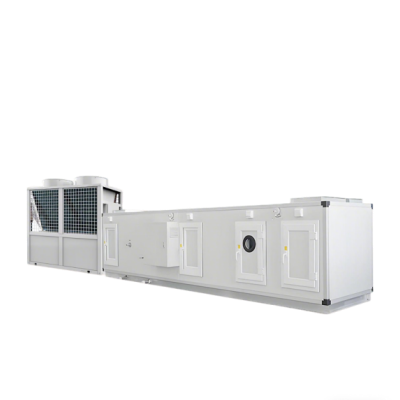
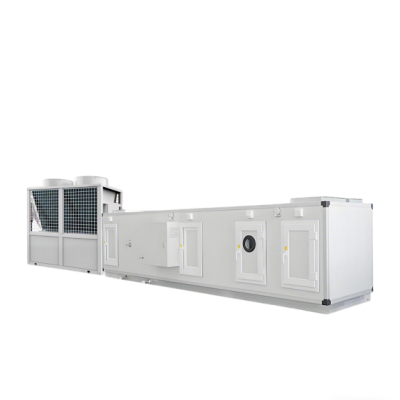
Original main construction illustrationChecked 2026-10-11 · Viewed actual cabinet/outdoor-style illustration; does not define supplied circuit or rated model.