

Circulation objective
Define where room air must move, what obstacles interrupt the jet and what distribution result will be checked.
 HVAC & REFRIGERATION
Nozzle-based room-air circulation for large spaces; separate unit airflow, stated throw and a complete supply/exhaust design.
From Sihe HVAC and ventilation fan manufacturing
Individual product research · HVACDeck Editorial · Sources checked 2026-10-11
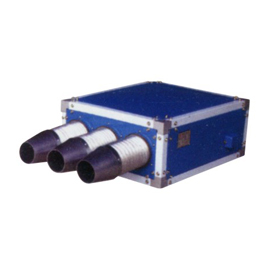
Sihe's YDF catalogue describes an induction fan that uses discharged-air momentum to entrain surrounding room air without distributing the flow through a conventional duct network. It lists underground car parks, warehouses, sports buildings and workshops as application examples. The inspected sheet's actual parameter and installation schedules are labelled YDF-B, with nominal 250 and 300 mm impellers and alternative nozzle arrangements.
This is a room-air movement component, not evidence that a particular building meets fresh-air, contaminant or smoke-control requirements. Its own flow and a printed throw distance do not define the effective ventilation rate of the entire space. Before ordering, establish supply and exhaust openings, room geometry, obstacles, nozzle directions and the project's air-quality or circulation objective. Then request the exact YDF-B selection and the evidence behind the stated throw and motor schedule.
This is an equipment family; its range does not identify one orderable configuration.
Swipe the table, or focus it and use arrow keys, to read the conditions and sources.
| Parameter | Published value | Conditions and evidence |
|---|---|---|
| Reviewed schedule scope | YDF-B, under the general YDF item | The technical and installation tables explicitly identify the B arrangement; not every YDF version. Source |
| Impeller sizes | 250 and 300 mm | Two printed nominal schedules; these do not supply the full unit external dimensions. Source |
| Nozzle alternatives | 100 mm × 2 or 80 mm × 3 | Published nozzle arrangements; selected arrangement and its flow/throw must be confirmed together. Source |
| Printed airflow schedules | Size 2.5: 630–350 m³/h; size 3: 985–1,350 m³/h | The first range is printed in descending order. No replacement value or corrected range inferred. Source |
| Published noise / motor notation | Size 2.5: 58 dB(A), 120–4; size 3: 60 dB(A), 300–4 | Power column uses W–P notation; confirm motor power/poles, supply and acoustic conditions in the current schedule. Source |
| YDF-B-2.5 fixing symbols | A 525, B 625, C 275, a 555, b 600; c × d: 2 × 198 | Actual fixing-size table symbols; confirm dimensions, units, suspension detail and drawing revision for the ordered assembly. Source |
The manufacturer's description is about entraining surrounding air with a nozzle discharge. Air moved within a room is not automatically outside air introduced or contaminated air exhausted. For a car park or workshop, establish the actual fresh-air and extract paths, design contaminants or heat load, and operating modes. For a warehouse circulation task, define the intended distribution result rather than treating the jet's own flow as a whole-building ventilation rating.
The sheet does not specify a dilution ratio, room dimensions, detector/control strategy or a verified contaminant-removal result. It also provides no smoke-duty temperature/time classification. Those requirements belong to a designed system and the applicable assembly evidence; they cannot be inferred from the application list.
Define where room air must move, what obstacles interrupt the jet and what distribution result will be checked.
Define outside-air supply and extract rates, routes and contaminant criteria; the induction unit supports distribution but does not alone establish replacement air.
The YDF-B sheet offers two 100 mm nozzles or three 80 mm nozzles and prints different throw figures alongside the schedules. It does not state a terminal-velocity criterion, measuring height, obstruction arrangement or environmental conditions for those throws. Have the supplier identify the exact nozzle option and the tested or calculated basis, including the velocity criterion used to define throw.
Provide a plan showing beams, racks, walls, parked vehicles or other relevant obstacles, together with the supply/exhaust points and mounting height. Request a proposed direction and spacing based on that layout. A throw distance from an unobstructed test cannot automatically be used as spacing in a cluttered building, and changing nozzle count is not just a cosmetic option.
The size-2.5 line prints 630–350 m³/h. This review retains it rather than changing it to a plausible-looking value. The size-3 line prints 985–1,350 m³/h. Ask Sihe for a corrected current sheet and the flow associated with each actual nozzle/motor configuration, together with any pressure or installation condition.
The power column is headed W–P and entries are 120–4 and 300–4. Confirm their interpretation, actual supply/frequency, running current and control method in the motor schedule. Neither the motor notation nor the published 58/60 dB(A) figure establishes measured system energy or a boundary-noise result. The sheet supplies no acoustic distance or complete measurement method.
The YDF-B-2.5 schedule gives A/B/C as 525/625/275 and a/b as 555/600, while the larger YDF-B-3 has a different envelope and hole pattern. Match these symbols to the fixing sketch instead of treating impeller diameter as the unit size. Request a controlled drawing with dimensions, mass, suspension/support instructions and the service envelope.
Coordinate the nozzle direction and support position so that installation does not compromise jet clearance or maintenance access. Obtain electrical isolation and cleaning instructions for the actual unit, and identify how it can be removed or serviced after other building services are installed. The catalogue photograph is a representative illustration, not an as-built room layout or a structural design.
A useful offer identifies the YDF-B size, corrected airflow document, nozzle option, motor/control and fixing revision, and proposed placement on the supplied room plan. If the procurement objective is air quality or distribution, state the measurement locations, operating modes and required result before comparing offers. A test of the unit alone does not prove the completed room meets that result.
Separate shipment checks from commissioning: confirm identification, nozzles, dimensions and specified running records, then verify the installed supply/exhaust arrangement and project-specific distribution or contaminant criteria. Current certification, hazardous-duty suitability, price, lead time and warranty remain unconfirmed. The source supports a nozzle-based product brief, not an assurance that a number of units selected only by floor area solves the building.
Compiled by HVACDeck Editorial. Source review identifies what the publication states; it is not an independent performance test or certification.
Editorial method and corrections · Report a detail with this page URL
Send the manufacturer your required duty, installation conditions and the unresolved items identified in this brief.
Sihe SHG two-speed plastic duct fans