


DKT component
Provide both inlet clearances, outlet interface, mounting frame and air-handling-unit integration requirements.
 HVAC & REFRIGERATION
DKT is a double-inlet component; SDKT adds a cabinet and acoustic lining. Read the actual configuration and dimension tables before selecting either package.
From Sihe HVAC and ventilation fan manufacturing
Individual product research · HVACDeck Editorial · Sources checked 2026-10-11
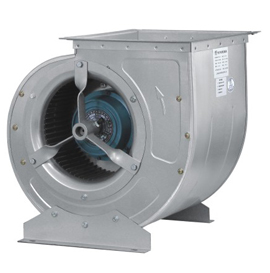
Sihe's DKT/SDKT sheet describes DKT as a double-inlet centrifugal fan with an external-rotor motor, forward-curved pressed-sheet blades and a casing made by specialised forming equipment. SDKT is a cabinet arrangement incorporating DKT and sound-absorbing wall lining. This is a real package distinction: the bare component's integration task is different from mounting, accessing and connecting an enclosed cabinet.
The original performance table covers multiple sizes and configurations, while the inspected SDKT drawing table supplies inlet, outlet, support and external-envelope dimensions. However, the performance column labelled rotational speed contains entries such as 11–45 and 12–63, which also appear as configuration labels in the dimension schedule. It cannot safely be treated as a verified rpm column. Obtain the precise ordering code, current performance curve, motor data and matching cabinet drawing instead of silently repairing the catalogue heading.
This is an equipment family; its range does not identify one orderable configuration.
Swipe the table, or focus it and use arrow keys, to read the conditions and sources.
| Parameter | Published value | Conditions and evidence |
|---|---|---|
| DKT construction | Double-inlet centrifugal fan; forward-curved blades; external-rotor motor | Supplier's technical-sheet description of the component, including static/dynamic balancing claims. Source |
| SDKT construction | Cabinet containing DKT with sound-absorbing wall lining | A separately packaged arrangement; lining material, thickness and acoustic test are not specified. Source |
| Example performance row | Size 2, printed 11–45 configuration: 0.25 kW / four poles; 900–1,500 m³/h; 315–295 Pa total pressure; noise ≤64 dB(A) | Original row under the ambiguous rotational-speed heading. Ranges do not establish a guaranteed joint point or noise distance. Source |
| SDKT size-2 / 11–45 drawing | A1 323, A2 253, A3 390, A4 320; B1 194, B2 124, B3 300, B4 300 | Original fixing-size symbols; use the sketch and supplier-confirmed dimensional units, flange details and drawing revision. Source |
| Example external/support symbols | Size-2 / 11–45: G 380, M 443, L 470, E 440, F 300, N 241.5, C 570 | Separate envelope/support table; these symbols are not all connection dimensions or performance values. Source |
The sheet says DKT has an external-rotor motor integrated with the fan, forward-curved stamped blades and static/dynamic balancing. SDKT encloses that fan and adds acoustic wall lining. A price for one should not be compared with a price for the other without identifying the casing, panel access, lining and connection scope. The document does not give a complete bill of materials or prove a measured insertion loss for the cabinet.
Provide both inlet clearances, outlet interface, mounting frame and air-handling-unit integration requirements.
Provide duct connections, support or suspension, access/removal space and the specified cabinet/lining scope.
Entries such as 11–45 in the performance table cannot responsibly be used as rpm when the SDKT dimension table labels matching entries as models/configurations. The reviewed page supplies no explanation of the code or correction to the heading. Keep the printed code and ask Sihe for the actual impeller speed, supply frequency, motor and ordering designation.
The size-2 / 11–45 row lists 0.25 kW and four poles, airflow 900–1,500 m³/h and total pressure 315–295 Pa. A motor-pole figure does not correct the ambiguous speed column, and the ranges do not define one simultaneous maximum duty. Require a marked curve with speed, density and pressure basis. If another row or motor is selected, obtain its own current document and matching drawing.
The SDKT fixing-size drawing separates inlet dimensions A1–A4 from outlet dimensions B1–B4, then adds external/support symbols in a second table. For size 2 / 11–45, A1 is 323 and B1 is 194; these describe different connection features. The same size also has a 12–63 drawing with different inlet dimensions. Do not choose a flange pattern from nominal size alone.
Request a controlled outline with units, hole spacing, supports, mass and service-side clearances. Match the selected code to both tables and the offered cabinet. Reserve access for removing panels and the DKT assembly after ducts and ceilings are installed. The image's dimensions are useful coordination evidence, but do not replace the supplier's order drawing or a structural support design.
The sheet says SDKT has sound-absorbing wall lining and claims lower noise and favourable flow/pressure compared with HTFC at the same nominal size. No matched operating points, acoustic method or comparative test report accompany that statement. It is not a basis for promising a particular reduction against any other manufacturer's HTFC.
The performance table prints noise in dB(A) without a clear measuring distance or sound-power basis. Specify the selected operating point, cabinet/lining construction, inlet/outlet arrangement and test method, then request the actual acoustic result. A hospital or hotel application mentioned in the catalogue does not itself demonstrate a room-noise target, fire classification of lining or hygiene approval.
The technical description permits air or harmless non-self-igniting gas, excludes particulate matter and also states a dust-content limit of 150 mg/m³. Ask for the intended distinction between dust and particles if the stream contains solids. Temperature, corrosive service, hazardous-area suitability and ingress protection are not established by the reviewed DKT/SDKT material.
The external-rotor construction is not proof of compatibility with an arbitrary controller. Obtain the exact motor/supply, wiring, permissible control range and protection, particularly for a variable-air-volume application. Agree controller, guards, isolation and electrical installation responsibilities. Bare motor rating is not a measured cabinet electrical input at the project duty.
The response should identify DKT or SDKT, nominal size, corrected ordering code and speed, motor/control schedule, marked total-pressure curve and matching dimension revision. For SDKT, include cabinet materials, lining, panels, connections, supports and service access. Clarify the dust wording and provide test records for the actual assembly where required.
Agree delivery and installed acceptance separately: identification/dimensions and specified running records at shipment, then airflow, pressure basis, current/input and controls under the approved installed conditions. No MOQ, lead time, price, current model certification or warranty was established. The original two inspected sheets support these questions; they do not document a completed test on your order.
Compiled by HVACDeck Editorial. Source review identifies what the publication states; it is not an independent performance test or certification.
Editorial method and corrections · Report a detail with this page URL
Send the manufacturer your required duty, installation conditions and the unresolved items identified in this brief.
Sihe YDF-B induction ventilation fans