
Sihe SHG two-speed plastic duct fans
Small oblique-flow duct fans with removable centres, distinct supply versions and a noise column explicitly measured at 3 m.
From Sihe HVAC and ventilation fan manufacturing
Individual product research · HVACDeck Editorial · Sources checked 2026-10-11

Choose the SHG electrical version and close the duct operating point
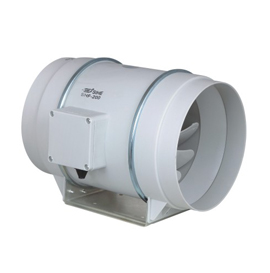
SHG is Sihe's plastic oblique-flow duct-fan range for exhaust and fresh-air applications. The inspected sheet lists nominal sizes 100, 110, 125, 160 and 200 mm, a polypropylene casing and ABS impeller, two speed settings, and a removable centre assembly intended to allow maintenance without removing the whole duct or fan installation. The sheet identifies an operating-environment temperature of −20 to 60 °C. It does not provide an IP rating or confirm unrestricted wet-room installation.
The electrical schedules distinguish 220/230 V at 50 Hz from 115 V at 60 Hz, and high from low speed. Keep those choices attached to the fan's current, input power and speed. Although the table lists airflow and static pressure in the same row, it supplies no pressure-flow curve establishing that both listed values occur together. A selected duct operating point and an actual wiring/control document are still needed before ordering.
Published parameters and their scope
This is an equipment family; its range does not identify one orderable configuration.
- Family designation
- SHG
Swipe the table, or focus it and use arrow keys, to read the conditions and sources.
| Parameter | Published value | Conditions and evidence |
|---|---|---|
| Published materials | One-piece polypropylene casing; ABS impeller | Supplier's construction statement; chemical resistance, fire classification and IP rating are not established. Source |
| Sizes / speed modes | 100, 110, 125, 160 and 200 mm; high/low speed | Family schedule; confirm the actual connection dimension and delivered electrical version. Source |
| SHG-125 example | 230 V/50 Hz, high: 0.14 A, 33 W, 2,250 r/min; airflow 284 m³/h, static pressure 159 Pa; 31 dB at 3 m | One printed catalogue row. Airflow/pressure are listed values, not a confirmed simultaneous duty point; noise weighting not specified by the 3 m column. Source |
| SHG-125 low-speed row | 230 V/50 Hz, low: 0.13 A, 30 W, 1,850 r/min; airflow 248 m³/h, static pressure 106 Pa; 26 dB at 3 m | Separate speed mode, not a continuous modulation guarantee or a selected operating curve. Source |
| Operating environment | −20 to 60 °C | Printed environmental-temperature range; air-stream temperature, moisture exposure and continuous-duty restrictions require confirmation. Source |

Selection and application review
Keep supply and speed versions separate
For SHG-125, the 230 V/50 Hz high-speed row lists 33 W and 0.14 A at 2,250 r/min, while the 115 V/60 Hz high-speed row lists 32 W and 0.30 A at the same printed speed. Low-speed schedules differ again. Do not turn those rows into a universal dual-voltage fan or infer that any delivered motor can be wired to either supply. Ask for the exact voltage/frequency variant, terminal diagram and nameplate.
The sheet offers high/low settings, not an established continuously variable control range. Confirm how the speeds are selected, whether both can ever be energised together, the required switch or controller and protection. If another controller is proposed, obtain the manufacturer's compatibility statement. Compare energy use at an agreed actual operating point rather than assuming table power applies to any duct resistance.
The printed airflow and pressure need a curve
The SHG-125 high-speed row lists 284 m³/h and 159 Pa static pressure; low lists 248 m³/h and 106 Pa. The sheet has no curve or clear joint-duty explanation. Request pressure-flow curves for both modes, with test arrangement and density, and mark the resistance of the installed duct, terminals and accessories. The published numbers may not be simultaneous operating values.
For a fresh-air or exhaust project, define the design flow and the resistance encountered in each required mode. The sheet describes using two or three units in parallel or series where needed, but provides no design for your system. Ask the designer and supplier to address the combined curves, controls, balancing and failed/stopped-fan condition. Do not simply multiply airflow or pressure and treat that as the installation result.
Plan maintenance around the removable centre
The catalogue says the motor/impeller centre can be removed and cleaned without taking out the whole fan or duct. Its fixing-size sketch is useful for coordination, but the removable assembly still needs free space and reachable clamps, fasteners and electrical isolation. Ask for the actual maintenance removal envelope and mounting instructions. Keep access reachable after ceilings and other services are installed.
For SHG-125 the dimension table labels a 258 mm A dimension and a 123 mm D diameter; those are drawing symbols, not interchangeable catalogue size descriptions. Approve a current drawing with the mating duct and supports rather than treating nominal 125 mm as every physical diameter. Cleaning method, chemical compatibility and whether the motor can be exposed to wash water are not established by the maintenance statement.
Approve the connections
Match the chosen size to the actual drawing symbols, mating duct and supports.
Reserve centre-removal access
Keep the manufacturer's removal route and fasteners accessible after installation.
Confirm safe cleaning
Obtain isolation, cleaning and motor/moisture restrictions rather than assuming the whole unit can be washed.
Do not convert wet-room applications into an IP claim
The sheet lists offices, apartments, homes, shops and other spaces, and also mentions kitchens and bathrooms. Its polypropylene shell, ABS blades and −20 to 60 °C environmental range do not establish electrical ingress protection, extract-air contamination limits or a permitted bathroom installation zone. Obtain the actual protection marking and installation instructions for the supplied version.
Identify condensation, grease, chemical exposure and access for cleaning. Ask whether the air-stream conditions are allowed and what ancillary duct or drainage arrangements are required. Smoke exhaust, fire resistance, explosive atmospheres and aggressive chemicals have not been established for this plastic duct-fan item.
Use the 3 m noise figure on its stated basis
SHG's table labels noise at 3 m, unlike several other Sihe sheets that print only dB(A). It prints 31 dB for the SHG-125 high mode and 26 dB for low. The column does not fully establish weighting, direction, room conditions or background correction. Report the figures on the catalogue's basis and ask for the measurement method before comparing them with sound-power or another measuring distance.
A useful quotation includes the supply version, speed/control method, marked curves, dimensional/removal drawing, protection and installation instructions, acoustic conditions and the supplied accessories. Agree installed-flow and electrical checks at acceptance. Prices, lead time, current conformity documents and warranty remain unconfirmed; the product image and sheet are manufacturer evidence rather than platform tests.
Sources and review scope
Compiled by HVACDeck Editorial. Source review identifies what the publication states; it is not an independent performance test or certification.
- Official SHG itemChecked 2026-10-11 · Actual product page displaying an image-based technical schedule.
- Original SHG construction and scheduleChecked 2026-10-11 · Inspected construction, supply/mode rows, 3 m noise and fixing sketch; no selected performance curve.
Editorial method and corrections · Report a detail with this page URL
Turn the evidence into an enquiry
Send the manufacturer your required duty, installation conditions and the unresolved items identified in this brief.
Continue the selection
Other equipment from this manufacturer
Sihe YDF-B induction ventilation fans