
Grand LYS transformer oil/water cooling systems
Separate the transformer oil circuit from the site cooling-water circuit; select the exchanger and leakage response against the actual transformer duty.
From Wenling Grand · Industrial fluid-cooling systems
Individual product research · HVACDeck Editorial · Sources checked 2026-10-11

Close the LYS oil/water boundary before quoting a transformer cooler
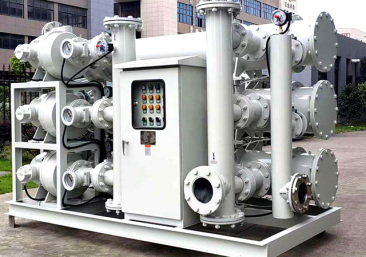
Grand’s LYS family uses forced oil circulation and water cooling for power, furnace and rectifier transformers. The official page positions it for demanding transformer heat rejection, particularly higher ambient-temperature sites. The original photograph shows a skid with several exchanger sections, fluid connections and a control panel; it does not identify a thermal rating or establish which configuration will be quoted.
This is an oil-to-water interface, not an oil-to-air fan cooler and not an independently rated chilled-water machine. No current model schedule, fluid design temperatures, cooling-water quality requirement or leakage-control design was supplied on the reviewed page. Those are necessary parts of selecting a unit for a specific transformer.
Published parameters and their scope
This is an equipment family; its range does not identify one orderable configuration.
- Family designation
- LYS
Swipe the table, or focus it and use arrow keys, to read the conditions and sources.
| Parameter | Published value | Conditions and evidence |
|---|---|---|
| Heat-rejection method | Forced oil circulation to cooling water | Official family description; exact exchanger construction and pump arrangement not issued. Source |
| Published loads | Power, furnace and rectifier transformers | Supplier application scope, not proof of a specific delivered transformer rating. Source |
| Site positioning | Higher ambient-temperature applications | Air ambient alone does not establish the available cooling-water temperature or duty. Source |
| Original pictured package | Multiple exchanger sections, oil/fluid connections and control panel | Family photograph inspected; actual size, model, redundancy and scope unknown. Source |
| Required thermal schedule | Oil and water inlet/outlet conditions, losses, flows and pressure drops | No quantitative current values published in the inspected family page. Source |
Selection and application review
Size for transformer losses and the actual cooling water
Obtain the transformer manufacturer’s losses and permitted oil temperatures for the intended operating conditions. Send cooling-water inlet temperature, available flow, quality and pressure together with the oil requirements. Ask Grand for a selected heat-transfer duty and pressure-drop schedule with all conditions stated.
A transformer’s electrical MVA rating is not the cooler’s kW heat-rejection capacity. General statements about low noise or efficient cooling do not settle the oil temperature at a chosen loading. Compare quotations only when the same oil/water conditions, fouling allowance and package boundaries have been agreed.
Resolve separation and leakage consequences
Request the selected exchanger’s construction, materials, pressure ratings and leakage-detection or separation provisions. Define the permitted pressure relationship and the response to suspected crossover with the transformer OEM and cooling-system supplier. The family page does not establish double-wall construction, a leakage barrier or automatic detection.
Agree pressure/leak tests, monitoring and alarm responsibilities, isolation and recovery procedures for the actual design. Do not label the pictured unit safe against oil/water contamination solely because it is presented as a transformer cooler. The order needs explicit construction and acceptance evidence.
Specify the oil circulation arrangement
Obtain pump selection against oil viscosity/temperature, required flow and transformer/cooler circuit resistance. Require the oil-loop schematic, flange orientation, permissible pressure, filling/venting/draining procedure and mechanical drawing. Coordinate the pump and cooler controls with the transformer’s cooling stages and protection.
Multiple exchanger sections in the photo do not prove N+1 duty or continuity during maintenance. Determine which failure the specified standby arrangement covers, what transformer operation is allowed with a section isolated, and whether the supplied pipework permits the agreed changeover.
Make site-water condition and cleaning part of the contract
Identify the source of cooling water and its chemistry, solids, seasonal temperature and treatment. Ask for wetted-material compatibility, strainers, fouling assumptions and the cleaning method for the chosen exchanger. The page provides no numerical water-quality tolerance or cleaning interval to reuse.
Reserve removal/cleaning space and define the plant-side water equipment, valves and services excluded from the skid. Agree how the unit is isolated and returned to service without contaminating the oil circuit. A headline claim of water-cooled efficiency does not eliminate site-water maintenance or utility constraints.
Request transformer-specific acceptance evidence
The purchase file should contain an approved thermal/hydraulic selection, oil and water drawings, component schedule, control sequence, construction conformity and test plan. Specify who witnesses pressure/leak, pump and thermal tests and the conditions for acceptance.
The Zhejiang standard declaration reviewed for Grand concerns oil/air coolers under JB/T 8315-2022; it is not adopted here as LYS oil/water conformity evidence. Current LYS price, delivery and independently tested performance remain unverified. Close the applicable design and test documents with the actual seller rather than extending another product family’s standard to this one.
Freeze the duty
Issue transformer losses and concurrent oil/water operating conditions.
Approve the interfaces
Resolve hydraulic design, circuit separation, leakage response and controls.
Agree the test file
Record the actual ordered unit’s documents, test conditions and acceptance criteria.
Sources and review scope
Compiled by HVACDeck Editorial. Source review identifies what the publication states; it is not an independent performance test or certification.
- Official Grand LYS family pageChecked 2026-10-11 · Full oil/water application description read; original skid photograph inspected, without inferring capacity or safety construction.
- Official industrial-cooling overviewChecked 2026-10-11 · Confirms forced-oil water-cooling manufacturing scope, not an issued LYS selection.
Editorial method and corrections · Report a detail with this page URL
Turn the evidence into an enquiry
Send the manufacturer your required duty, installation conditions and the unresolved items identified in this brief.
Continue the selection
Other equipment from this manufacturer
Grand LYF transformer oil/air coolers