

Sample point
At 1,088 m³/h the 0.18 kW schedule pairs 255 Pa total with 232 Pa static, two ways of expressing one point.
Read the source HVAC & REFRIGERATION
Forward-curved double-inlet fans on external-rotor motors, supplied as components for cabinet air conditioners and VAV equipment.
From Laienke ventilation fan manufacturing
Product guide · HVACDeck Editorial · Sources checked 2026-10-11
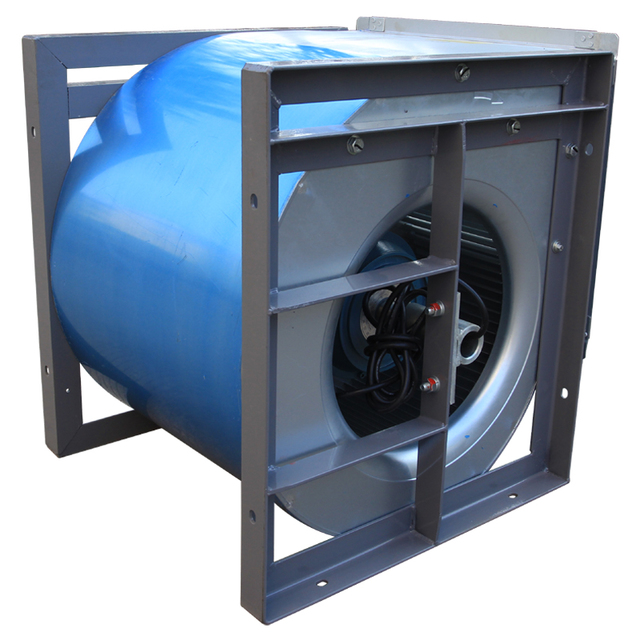
LKB is Laienke's direct-drive double-inlet fan: a forward-curved centrifugal impeller mounted on an external-rotor motor, built into cabinet air conditioners, variable-air-volume equipment and other HVAC and purification units. Nine nominal sizes run from 200 to 500 mm, and the family covers 1,000–20,000 m³/h, 200–850 Pa total pressure and 60–84 dB(A) sound-pressure level.
The product page carries curve sheets. On the first LKB-200 sheet, the 200I with a 0.18 kW four-pole motor delivers 1,088 m³/h at 255 Pa total and 232 Pa static, drawing 0.48 A at 61.2 dB(A). The same sheet prints 200I over two motor schedules and shows currents above the nominal value on the 200II, so each order needs an exact ordering code and a current curve. Send your airflow, pressure basis and chamber layout to Laienke for a selection.
This is an equipment family; ask the manufacturer to select the model that matches your duty.
Swipe the table, or focus it and use arrow keys, to read the conditions and sources.
| Parameter | Published value | Conditions and sources |
|---|---|---|
| Construction | Forward-curved centrifugal fan; external-rotor motor, direct drive | Direct-drive double-inlet category; other LKB pages may differ. Source |
| Nominal sizes | 200, 225, 250, 280, 315, 355, 400, 450 and 500 mm | Impeller sizes; outline and motor options come per selection. Source |
| Family pressure and noise | 200–850 Pa total pressure; 60–84 dB(A) sound-pressure level | No measuring distance or operating point given for the overview. Source |
| Sample LKB-200 point | 1,088 m³/h · 255 Pa total · 232 Pa static · 0.48 A · 61.2 dB(A) | First 200I table: 0.18 kW four-pole motor, 15 kg, nominal current 0.64 A. Source |
| Repeated model label | 200I printed with both 0.18 and 0.25 kW motor schedules | Ask for the exact ordering code and sheet revision. Source |
In the 0.18 kW four-pole 200I schedule, the 1,088 m³/h row gives 255 Pa total pressure, 232 Pa static pressure, 0.48 A and 61.2 dB(A). These five values describe one operating point of one configuration. Read the row as a set; the sheet's highest pressure, lowest current and lowest noise sit on other rows. The sheet prints current, so electrical input power needs a separate figure.
Total and static pressure are separate columns, so state the basis your project uses before Laienke marks a point. Voltage, air density, acoustic distance and the full test set-up are not fully stated on the sheet; ask for them with a current controlled sheet when this point is near your duty.
At 1,088 m³/h the 0.18 kW schedule pairs 255 Pa total with 232 Pa static, two ways of expressing one point.
Read the sourceVoltage, air density and acoustic distance, needed before comparing input power or room noise.
Read the sourceThe first sheet labels a 0.18 kW schedule 200I and prints 200I again above a 0.25 kW schedule. The 200II schedule lists a 0.32 kW four-pole motor with 1.05 A nominal current, while its 1,958 and 2,032 m³/h rows show 1.06 and 1.10 A.
Ask Laienke for the motor, ordering code, voltage and frequency, rated current and continuous operating limit, and which part of the curve the motor supports. Give your variable-airflow range if you have one. A motor change needs a revised curve, and a nominal diameter alone settles none of these points.
LKB is a component, and the coils, filters and cabinet resistance come from the air-handling unit it goes into. Send the chamber size, inlet clearances, outlet connection and nearby coil and filter arrangement, and ask for the outline and mounting points of the exact motor and fan version. Both inlets need free air once panels, motor and filters are in place. For a fan already housed in its own cabinet, Laienke offers the BKB/BKBS cabinet fans.
Plan access for removal and wiring before signing off the unit. Decide whether isolation, flexible connections, inlet guards, controller and wiring come from Laienke or from the unit builder. Weather protection, washdown and special atmospheres need separate confirmation.
VAV equipment is a listed application, and the page names no control protocol or approved speed controller for the external-rotor motors. Ask for the control method, usable speed range, motor cooling at low speed, protection and wiring, and match them to the unit controls and any filter or damper interlocks.
Compare offers at the same installed flow, pressure, density and control cases. Where electrical input matters, ask for measured input power with its supply conditions, since a current reading alone gives no power figure.
Laienke says LKB was tested by a mechanical-industry general-machinery testing institute; the report, date and model coverage are not on the page. Ask for the original report and check that it covers the size and motor you are buying.
Laienke's laboratory procedure covers measured speed, stable points, instrument calibration and acoustic conditions, which you can cite when agreeing tests for your order. A complete order file holds the corrected ordering code, selected curve, motor and control data, dimensional drawing, agreed inspections and the report where required, along with price and lead time.
Ask Laienke to confirm in writing: the exact ordering code and sheet revision, settling which 200I schedule applies; motor power, voltage, rated current and the curve section it may run on; flow at your static or total pressure; sound level with its measuring distance; the speed controller approved for the motor; the outline with inlet clearances; and whether the testing-institute report covers your size.
Compiled by HVACDeck Editorial. Figures are as published by the manufacturer; ask for test records for the unit you select.
Editorial method and corrections · Report a detail with this page URL
Send the manufacturer your required duty, installation conditions and the points listed above to confirm.
Laienke T35 general-ventilation axial fans