
Air-side system
Select actual supply/return distribution, duty and humidity functions.
 HVAC & REFRIGERATION
Define container air duty, installation side and master/standby behaviour before comparing the advertised AEER.
From Shenzhen Envicool Technology Co., Ltd.
Individual product research · HVACDeck Editorial · Sources checked 2026-10-11
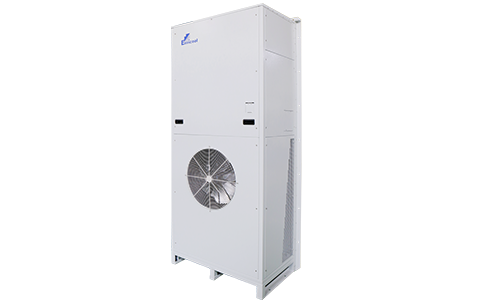
BattCool-AC is Envicool's air-conditioning offer for energy-storage containers, although the browser title retains an MC-series label. The actual product heading and description identify BattCool-AC. The source describes an integrated unit with upper air supply, inverter operation, master/standby linkage and rotation, RS485/MODBUS, operation records and preserved settings/alarm history after power loss. It permits inside or outside installation and positions the cabinet air as isolated from the outside.
The page's AEER at least 4.8, 55°C upper operating range and long-life statements are supplier claims without an inspected selected air-side capacity or test envelope. This is an air-temperature-control architecture, distinct from the battery liquid chiller, and no capacity or coolant circuit is transferred between them. A selection needs container heat distribution, rack air paths, humidity limits and the actual ordered standby/control arrangement. It does not establish certified energy-storage-system safety simply because components are described as certified.
This is an equipment family; its range does not identify one orderable configuration.
Swipe the table, or focus it and use arrow keys, to read the conditions and sources.
| Parameter | Published value | Conditions and evidence |
|---|---|---|
| Product identity | BattCool-AC heading; browser title retains MC wording | Use actual product heading without inventing equivalence to other MC families. Source |
| Architecture | Integrated air conditioner with upper supply; inside/outside installation | No liquid-loop or air-side capacity rating issued. Source |
| Control features | Master/standby linkage, switching and rotation | Selected unit count, thresholds and remaining duty required. Source |
| Communications/history | RS485 MODBUS, operating records, settings/alarm preservation | Actual registers and retention behaviour not inspected. Source |
| Efficiency/environment statements | AEER ≥4.8; upper range 55°C | Supplier values without reviewed rating conditions. Source |
| Equipment isolation wording | Inside completely isolated from outside | Actual seal/enclosure/air-path evidence needed. Source |
| Safety/life boundary | Certified components and >10-year continuous use claimed | No inspected complete-system certificate or life test. Source |
Provide battery/equipment heat distribution, rack airflow, permitted temperatures and humidity plus the design climate. Ask for selected cooling capacity/input and upper-supply/return paths at those conditions. A container application name does not determine capacity or uniformity at every rack.
Confirm inside or outside placement with the selected drawing, structural support and service access. No model dimensions or air volume is inferred from the original cabinet-unit image.
Obtain the cabinet openings, seals and intended internal/external air circuits. The completely-isolated wording is a source description without an inspected enclosure test. Request the actual installation rating and condensate/drainage arrangement.
Define humidity control requirements independently of air-temperature duty. The page does not publish a numerical humidity tolerance or moisture-removal schedule. No battery-life or condensation-free guarantee is adopted.
Choose actual operating and standby unit count and required duty after a selected fault. Obtain linkage, rotation, changeover thresholds and the expected temperature transient. A capability for switching does not provide a complete redundancy plan.
Identify power/control dependencies and the battery/site supervisory response to cooling alarms. Commission communication loss, fault and restart behaviour against the approved system requirements. No complete energy-storage safety certification is inferred from component-certification wording.
Request registers, alarm history and operation-record storage details and the power-loss preservation sequence. Agree clock/time handling and how historical data is retrieved for operations. The source names these functions without supplying retention capacity or a register map.
Verify actual air-temperature/cell interface sensors and alarm outputs on the selected order. Real-time cell-sensing language needs an issued responsibility split with the battery management system.
Request the rating/weighting method and included energy loads behind AEER at least 4.8. Compare selected equipment at matched air/load/climate points. The 55°C operating limit does not establish full rated capacity there or a particular seasonal result.
Acceptance should verify delivered air/thermal duty, complete input, humidity functions and agreed standby/control states. Current price, lead time and independently verified lifecycle are unknown.
Select actual supply/return distribution, duty and humidity functions.
Approve unit/power arrangement, transfer sequence and remaining cooling.
Commission MODBUS, retained settings/alarms and measured acceptance boundaries.
Compiled by HVACDeck Editorial. Source review identifies what the publication states; it is not an independent performance test or certification.
Editorial method and corrections · Report a detail with this page URL
Send the manufacturer your required duty, installation conditions and the unresolved items identified in this brief.
Envicool MC power-container cooling · Heating, humidity and dry contacts
Envicool BattCool-C / EMW chillers · Battery coolant and fault duty
Envicool EMA cabinet air conditioners · Air path and filter service
Envicool HC combo cabinet cooling · Heat-pipe and compressor modes
Envicool DC / EC outdoor cabinet cooling · Power and selected duty
Envicool EIX air/water cabinet exchangers · Water and group controls