
Envicool BattCool-C / EMW chillers · Battery coolant and fault duty
Select the actual cooling/heating circuit and seasonal modes against battery OEM limits; model digits and AEER do not establish a selected rating.
From Shenzhen Envicool Technology Co., Ltd.
Individual product research · HVACDeck Editorial · Sources checked 2026-10-11

Specify container-battery liquid cooling at its actual load and climate
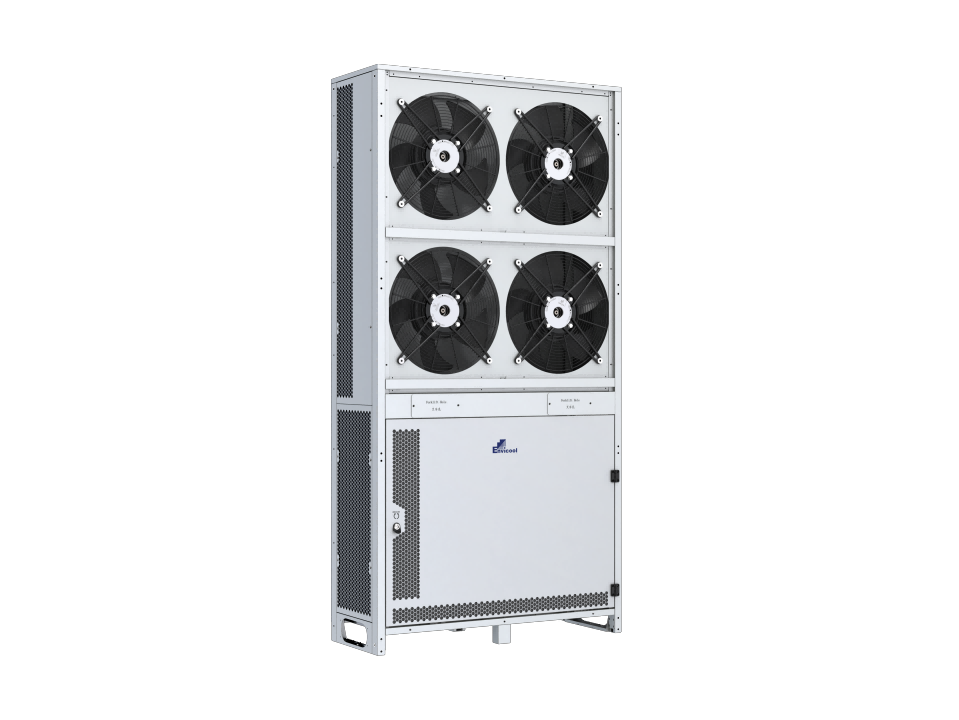
Envicool's BattCool-C is an air-cooled chiller for energy-storage container batteries, with cooling and heating described on the official page. The browser title also uses the EMW name and lists EMW150, EMW200, EMW400, EMW450 and EMW600. Its stated construction combines full inverter control, XFreecooling and closed coolant circulation, with dual detection, circulation and refrigeration systems. The original rendering shows a floor-standing assembly with four visible fans; it does not identify the rated model or confirm that all configurations have that fan count.
The quoted AEER up to 4.62, 55°C upper operating limit, real-time cell sensing and ten-year continuous-use statements lack inspected selected duty and test conditions. This brief does not derive kW from EMW model numbers or turn cooling into a battery safety or lifetime guarantee. Selection starts with the battery OEM's coolant/temperature limits and operating heat map, then defines each circuit, seasonal mode and fault-state duty. The source's full-chain zero-risk reference is not adopted as a platform claim.
Published parameters and their scope
This is an equipment family; its range does not identify one orderable configuration.
- Family designation
- BattCool-C / EMW family
Swipe the table, or focus it and use arrow keys, to read the conditions and sources.
| Parameter | Published value | Conditions and evidence |
|---|---|---|
| Reviewed offer | BattCool-C air-cooled chiller, EMW family names | Cooling/heating battery-fluid role; no selected capacity schedule. Source |
| Model names | EMW150, EMW200, EMW400, EMW450, EMW600 | No kW inferred from naming. Source |
| Architecture features | Inverter control, XFreecooling and closed circulation | Selected mode thresholds, fluid and circuit drawing needed. Source |
| Resilience statement | Dual detection, circulation and refrigeration systems | No independently reviewed full-duty fault test. Source |
| Efficiency/environment claims | AEER up to 4.62; upper operating limit 55°C | Supplier figures without inspected selected conditions. Source |
| Service features | Exhaust/venting, replenishment and disassembly-free maintenance described | Actual fluids, isolation and procedures required. Source |
| Evidence gaps | Capacity, coolant limits, cell-sensor scope and lifecycle tests | No battery safety/life or zero-risk guarantee. Source |
Selection and application review
Obtain the battery OEM coolant and heat-load file
Issue heat generation across charging/discharging and idle conditions, permitted cell/coolant temperatures, fluid chemistry, flow and pressure limits. Ask for selected cooling and heating duties at the simultaneous site ambient and coolant points. The EMW model names do not provide a numeric rating.
Clarify which battery sensors and interfaces are supplied by the chiller versus the battery system. Real-time cell-temperature sensing wording does not prove direct access to every cell or validation of the battery's thermal safety performance.
Select refrigeration and free-cooling modes together
Request the actual circuit and mode map for mechanical cooling, XFreecooling and any heating mode. Obtain switching thresholds, available capacity and complete input at the required seasonal conditions. A 55°C upper limit is not a full-capacity rating at that ambient.
Define outdoor air recirculation, installation location and required supports/clearances using issued drawings. The original rendering's fan count is not assigned to every model. Agree frost, shutdown and restart arrangements within the selected manufacturer's operating limits.
Make dual systems a documented fault-state selection
Ask how the two detection, circulation and refrigeration systems are arranged and which components, controls and supplies are shared. Agree remaining flow and heat duty after each relevant selected fault and the permitted battery temperature transient. Dual hardware wording is not an independently tested full-system N+1 result.
Obtain alarm and shutdown responsibility across the chiller, battery management and site controls. Cooling supports the battery thermal design; it is not a standalone guarantee against every battery hazard or lifetime loss.
Control coolant filling, replenishment and service
Specify compatible fluid and materials and obtain flushing, venting, filling and sampling procedures. Closed circulation does not eliminate fluid-quality management. Identify the automatic replenishment source and limits and how leakage or low-level conditions are detected.
Request the exact maintenance isolation and component replacement procedure behind disassembly-free wording. Confirm access, consumables and temporary derating. No universal maintenance-free interval or unrestricted online intervention is inferred.
Assess AEER on the complete selected boundary
Request weighting, conditions and included equipment loads behind AEER up to 4.62. Use a matched battery load and climate profile, including pumps, fans, refrigeration and heating inputs. Supplier annual metrics are not a platform-measured energy result.
Acceptance should verify selected fluid duty, temperature control, alarms, mode changes and agreed fault states. Current price, lead time and independently verified ten-year life remain unknown.
Issue battery limits
Obtain actual heat map, fluid specification and acceptable thermal transients.
Approve modes and faults
Select cooling/heating/free-cooling circuits and documented remaining duty.
Accept thermal integration
Commission fluid quality, cell-interface scope, controls and measured duty/input.
Sources and review scope
Compiled by HVACDeck Editorial. Source review identifies what the publication states; it is not an independent performance test or certification.
- Official BattCool-C / EMW chiller pageChecked 2026-10-11 · Complete model-name, architecture, efficiency and service description plus original floor-standing rendering read; no selected rating table issued.
Editorial method and corrections · Report a detail with this page URL
Turn the evidence into an enquiry
Send the manufacturer your required duty, installation conditions and the unresolved items identified in this brief.
Other equipment from this manufacturer
Envicool MC power-container cooling · Heating, humidity and dry contacts
Envicool BattCool-AC container cooling · Air paths and standby control
Envicool EMA cabinet air conditioners · Air path and filter service
Envicool HC combo cabinet cooling · Heat-pipe and compressor modes
Envicool DC / EC outdoor cabinet cooling · Power and selected duty
Envicool EIX air/water cabinet exchangers · Water and group controls