
Envicool MC power-container cooling · Heating, humidity and dry contacts
Specify cooling/heating and moisture duty, then separate standard alarm contacts from optional signals and condensate equipment.
From Shenzhen Envicool Technology Co., Ltd.
Individual product research · HVACDeck Editorial · Sources checked 2026-10-11

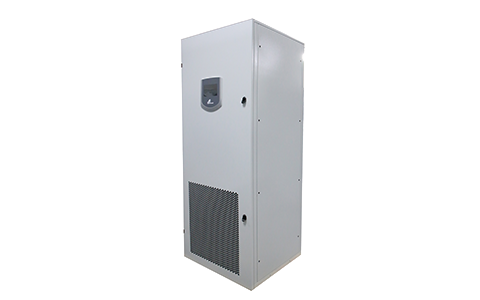
Define the prefabricated power container’s environmental-control schedule
Envicool's MC family is described for prefabricated power containers, outdoor substations and similar equipment spaces. The actual page names MC30, MC50 and MC90 and describes upper air supply, electric heating, dehumidification and fan-speed regulation. It specifies R134a in the reviewed source and uses RoHS wording without an inspected declaration. Independent dry-contact outputs for equipment fault and high/low temperature or humidity are distinguished from optional smoke, access and water-leakage alarm outputs.
The optional condensate-evaporation device is not assumed to be standard or to eliminate every drainage requirement. The 55°C ambient operating limit and ten-year continuous-use claim lack selected model ratings and life evidence. This brief treats the three model names as one family, with no kW inferred from their digits. The important procurement questions are the actual substation/container thermal and humidity loads, heater/power scope and control responsibility, rather than a generic cabinet-cooling comparison.
Published parameters and their scope
This is an equipment family; its range does not identify one orderable configuration.
- Family designation
- MC prefabricated power-container family
Swipe the table, or focus it and use arrow keys, to read the conditions and sources.
| Parameter | Published value | Conditions and evidence |
|---|---|---|
| Model names | MC30, MC50, MC90 | No capacity inferred from naming; no individual rating table inspected. Source |
| Described functions | Upper air supply, electric heater, dehumidification and fan regulation | Actual heating/latent/airflow capacities required. Source |
| Source refrigerant | R134a | Selected charge/type and current ordered documentation required. Source |
| Standard described dry contacts | Unit fault; high/low temperature; high/low humidity | Actual wiring and signal logic not inspected. Source |
| Optional outputs | Smoke, access-control and water-leakage alarms | Not assumed included; no fire/safety-system approval inferred. Source |
| Optional condensate feature | Built-in condensate evaporation | No universal drain-free operation established. Source |
| Operating/life claims | Ambient limit up to 55°C; >10-year continuous use | No selected derating, lifecycle report or guaranteed warranty. Source |
Selection and application review
Issue cooling, heating and humidity duties separately
Provide equipment heat, container geometry/envelope, permitted temperatures/humidity and design climate. Ask for model-specific sensible/latent cooling and electric-heating capacities and complete input at the relevant conditions. One family name does not establish moisture removal or winter heating duty.
Obtain selected airflow and upper-supply/return layout. No capacity is derived from MC30/50/90 digits. Check any required 55°C operating point with actual thermal/input data rather than treating the upper limit as a nominal-capacity guarantee.
Approve power, refrigerant and environmental documents
Request the selected power supply, heater load, protection and wiring schedule. Confirm actual refrigerant and charge on the order documents and obtain the relevant handling/service requirements. The webpage names R134a but does not provide a selected charge or regulatory declaration.
Ask for the applicable RoHS documentation if it is part of the order requirement. Environmental-friendly wording and a named refrigerant do not establish a universal compliance or environmental-impact claim.
Map dry contacts to the power-site monitoring system
Obtain independent fault, high/low temperature and high/low humidity contact logic, ratings and wiring. Specify thresholds, delays and the site's response. Dry-contact availability is an interface feature, not a validated protective function for every substation condition.
Confirm which optional smoke/access/leakage outputs are ordered and which external sensors/systems provide them. Do not treat optional alarm contacts as an inspected fire-detection or safety certification. Obtain MODBUS registers for the actual remote-monitoring configuration.
Select condensate handling and maintenance access
Request dehumidification water removal and drainage requirements across operating conditions. If condensate evaporation is ordered, obtain its capacity, control and any overflow/drain obligations. Optional built-in evaporation does not prove all moisture can disappear without a drain.
Approve selected mounting/support, dimensions, air clearances and front-service access. The original slim-unit photo does not supply a footprint, weight or a power-container installed rating.
Commission environmental modes and recovery
Agree cooling/heating/dehumidification mode transitions, sensor locations, power restoration and alarm tests. Verify actual temperatures/humidity and complete inputs using defined loads and ambient conditions. Document monitoring responsibilities and issued maintenance/spare scope.
Current price, lead time and independently verified ten-year life are unknown.
Issue environmental loads
Separate sensible, latent and winter-heating duties plus climate limits.
Freeze ordered interfaces
Approve power/heater, refrigerant, dry contacts, optional outputs and drainage.
Accept operating modes
Verify air distribution, thermal/humidity control, recovery and alarms with measured conditions.
Sources and review scope
Compiled by HVACDeck Editorial. Source review identifies what the publication states; it is not an independent performance test or certification.
- Official MC prefabricated power-container air conditionerChecked 2026-10-11 · Complete model/function/refrigerant/alarm text and original cabinet-unit rendering read; optional condensate and signals distinguished.
Editorial method and corrections · Report a detail with this page URL
Turn the evidence into an enquiry
Send the manufacturer your required duty, installation conditions and the unresolved items identified in this brief.
Other equipment from this manufacturer
Envicool BattCool-AC container cooling · Air paths and standby control
Envicool BattCool-C / EMW chillers · Battery coolant and fault duty
Envicool EMA cabinet air conditioners · Air path and filter service
Envicool HC combo cabinet cooling · Heat-pipe and compressor modes
Envicool DC / EC outdoor cabinet cooling · Power and selected duty
Envicool EIX air/water cabinet exchangers · Water and group controls