
Production
Daily mass generated at an agreed ambient, water and operating condition.
 HVAC & REFRIGERATION
Design the daily production, buffer storage and peak conveying duty separately, then approve the stacked assembly and site interfaces.
From Xinwuxin · Wuhan process-refrigeration equipment
Individual product research · HVACDeck Editorial · Sources checked 2026-10-11
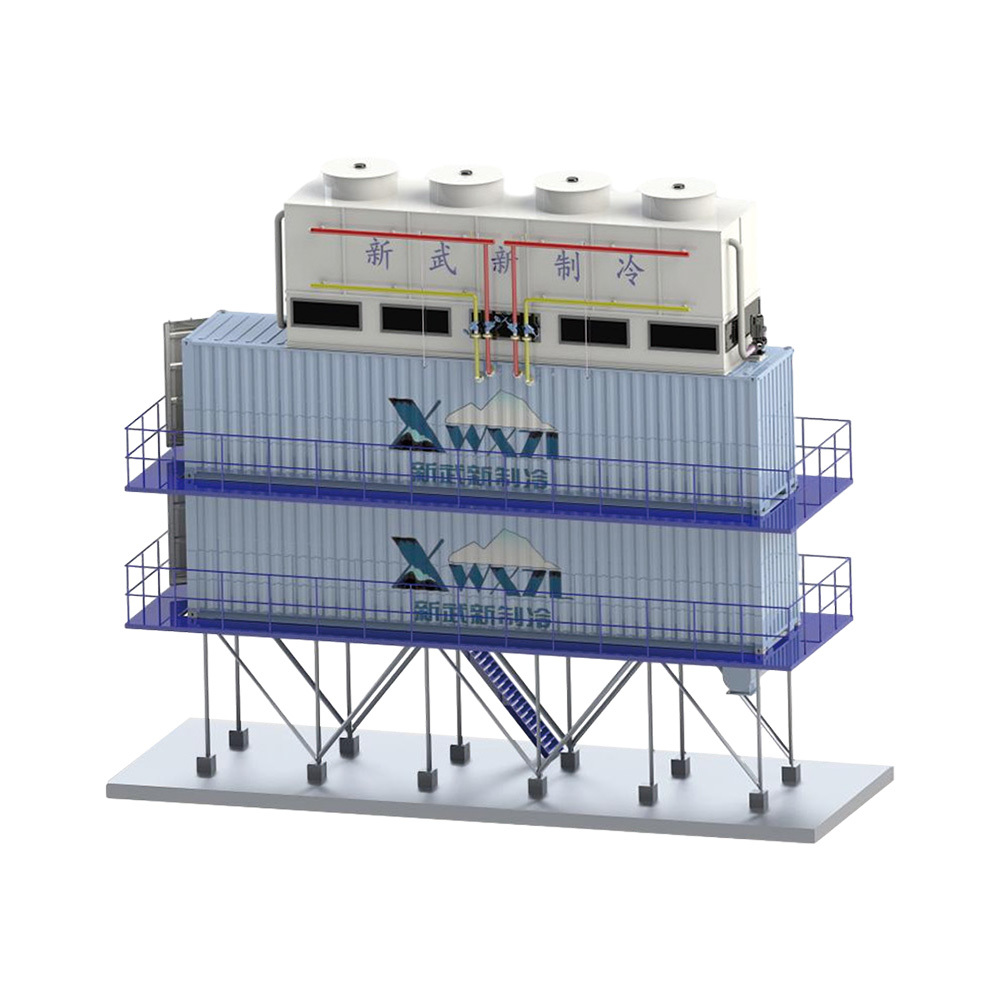
Xinwuxin’s container ice system combines flake-ice generation, automatic storage and screw conveying. Its official body describes a double-insulated storage structure with a top-mounted cooler, a raking mechanism and ice-level sensing. The supplier illustration shows stacked container-like enclosures, an upper heat-rejection assembly, elevated supports, access platforms and stairs. Those features describe an assembled process system, not simply an XIL ice generator enclosed in one freight container.
The original XIL MS table separates daily ice production from refrigeration capacity, electrical input and storage mass. It spans listed 5–100 t/day systems with storage values that do not rise in step with daily output. Several dimensions are unusually large and lack a issued general-arrangement boundary; they are not silently corrected to standard container heights. This brief helps specify the production/storage/conveyor interfaces and site installation. The website’s ‘ISO certified container’ wording is not supported here by a reviewed certificate or a current shipping/safety plate.
This is an equipment family; its range does not identify one orderable configuration.
Swipe the table, or focus it and use arrow keys, to read the conditions and sources.
| Parameter | Published value | Conditions and evidence |
|---|---|---|
| Documented system functions | Flake-ice generation + raked storage + screw conveying | Supplier body describes three functions; actual purchased package and throughput need confirmation. Source |
| XIL MS-10T published row | 10 t/day output; 10 t storage; 64 kW refrigeration; 66 kW input | Original table; matching ambient/water rating conditions and total-input boundary are absent on this page. Source |
| XIL MS-70T published row | 70 t/day output; 20 t storage; 417 kW refrigeration; 256 kW input | Catalogue values, not verified site output. Storage mass is distinct from daily production. Source |
| Storage temperature description | Approximately −10°C | Supplier storage-air description, not ice-generator evaporation or a witnessed hold test. Source |
| Conveying description | Sealed screw conveyance; supplier states up to 60° inclination | No selected conveying rate, distance, drive duty or demonstrated geometry supplied. Source |
| Size and weight boundaries | Table prints 6058/12192 mm lengths and 8591/9540 mm heights | Published assembly dimensions need issued GA and transport/module confirmation; no guessed corrections. Source |
| Container certification status | Supplier claim only | No certificate number, holder/scope, structural plate or current transport approval independently verified. Source |
A daily production requirement does not identify the required storage capacity or conveying rate. The XIL MS-10T row lists 10 t/day production and 10 t storage, while XIL MS-70T lists 70 t/day production and 20 t storage. Those are different quantities with different time boundaries. The larger daily output does not mean the storage bin can hold a whole day’s production.
Give the supplier an ice-consumption schedule, expected production hours, reserve strategy and maximum withdrawal rate. Request a selected production/storage balance and the actual conveying duty to each destination. The container page lacks simultaneous water/ambient production conditions, so this brief does not borrow the bare XIL machine’s 25°C/20°C conditions and declare them valid for every MS system.
Daily mass generated at an agreed ambient, water and operating condition.
Usable ice inventory with a stated temperature and hold/withdrawal profile.
Peak delivered mass rate over the actual distance, elevation and destination geometry.
The body describes double insulation, a top cooler maintaining about −10°C, a rake that moves ice towards the outlet and sensing intended to keep the rake above the ice. These are specific system leads. The reviewed source does not establish usable versus gross storage capacity, guaranteed dryness, hold losses or a demonstrated automatic recovery sequence.
Ask for the storage layout, insulation/construction schedule, rake travel and discharge arrangement, ice-level sensing and maintenance access. Agree responses to ice-full, no-water, power-loss, pressure and compressor-temperature conditions described on the page. Establish how the storage refrigeration, generator and conveyor stop or restart together, with responsibility for safe service access under the actual order.
The official description claims sealed screw conveying and an inclination up to 60°. It does not state the mass rate, maximum route length, ice condition or motor duty that accompanies that limit. Do not treat a single angle as permission to use any conveyor geometry at full daily-output rate.
Issue the plant route, vertical lift, intake/discharge positions, peak delivery rate and expected ice condition. Require the selected screw/conveyor arrangement, supports, drives, access/cleaning points and control interlocks. The supplier’s hygiene wording does not establish food-contact compliance; material and cleaning evidence must be requested for the buyer’s particular application.
The supplier illustration shows a stacked elevated structure with access platforms and stairs, and the table prints heights 8591 or 9540 mm alongside lengths 6058 or 12192 mm. These figures may describe a larger assembly boundary, but the reviewed page does not define it reliably. They are recorded as unresolved source values rather than corrected to a familiar freight-container height.
Request the issued general arrangement, assembled height, transport-module envelopes, lifting points, support/foundation reactions and site assembly sequence. Confirm airflow, maintenance removal, operating access and the conveyor discharge elevation. The ‘ISO certified container’ statement requires actual certificate/plate and scope evidence; it does not establish that the complete stacked process assembly is ready for international shipment or site approval.
The source collage labels installations at Tanzania’s Rufiji hydropower project, a Ganjiang project and Chongqing Panlong pumped storage, with different stated daily quantities. The original pictures show actual container assemblies and conveying at construction sites, but ownership, contract scope and delivered performance were not independently confirmed from a purchaser record.
Ask for a dated reference that separates generation, storage and conveying supplied under one contract. For acceptance, record actual ice output and delivery rate at the agreed conditions, storage operation, total included electrical input and integrated protective behaviour. Price, delivery and independent measured results remain unknown. This page addresses one complete ice-handling system family; it does not create an extra URL for each daily capacity.
Set daily generation, usable reserve and peak consumption instead of one nominal tonnage.
Close storage/rake, conveyor geometry, contact materials and integrated controls.
Confirm module dimensions, supports, certification scope and measured generation/conveying acceptance.
Compiled by HVACDeck Editorial. Source review identifies what the publication states; it is not an independent performance test or certification.
Editorial method and corrections · Report a detail with this page URL
Send the manufacturer your required duty, installation conditions and the unresolved items identified in this brief.
Xinwuxin integrated centrifugal chillers · Surge, oil and site scope
Xinwuxin air-cooled screw chillers · Ambient and circuit selection
Xinwuxin parallel screw packages · Compressor and oil-system scope
Xinwuxin XIL flake-ice machines · Output, power and discharge
Xinwuxin integrated chillers · Package and site interfaces
Xinwuxin screw chillers · Water and secondary-fluid selection