
Ice generation
The XIL schedule gives production, refrigeration and machine utility data.
 HVAC & REFRIGERATION
Size daily ice demand at the stated water and ambient conditions, then close utilities, discharge and hygiene requirements.
From Xinwuxin · Wuhan process-refrigeration equipment
Individual product research · HVACDeck Editorial · Sources checked 2026-10-11
Xinwuxin’s XIL flake-ice machine produces thin ice for process cooling and preservation applications. The official description identifies an internal ice blade, automatic water supply and modular assembly. It lists meat and aquatic-product processing, chemical/dyeing work, biological/pharmaceutical use and construction among possible applications. Those are supplier application statements; food-contact, potable-water and pharmaceutical compliance of a chosen unit have not been established by this directory.
The two original parameter images distinguish daily ice production from refrigeration capacity and total electrical input. Their accompanying conditions are 25°C ambient and 20°C entering water, with 1.6–2.3 mm ice thickness stated. The reviewed model tables cover XIL-1T through XIL-25T entries. The broader marketing claim of output up to 100 tonnes per day is not accompanied by a matching bare-machine schedule here and is not substituted for the actual reviewed rows. A separate container ice system adds storage and conveying, so its production claims cannot automatically be assigned to this machine.
This is an equipment family; its range does not identify one orderable configuration.
Swipe the table, or focus it and use arrow keys, to read the conditions and sources.
| Parameter | Published value | Conditions and evidence |
|---|---|---|
| Stated production test conditions | 25°C ambient; 20°C entering water | Accompanies both original model-table images; no independent witnessed test. Source |
| Stated flake thickness | 1.6–2.3 mm | Supplier family description; actual selected operating envelope needs confirmation. Source |
| XIL-5T example | 5 t/24 h ice; 32.5 kW refrigeration; 20.39 kW total input | Original row at the stated ambient/water conditions; not a promise at hotter site conditions. Source |
| XIL-10T example | 10 t/24 h ice; 65 kW refrigeration; 40.72 kW total input | Original second schedule; compressor input separately listed as 36.8 kW. Source |
| XIL-10T physical row | 3200 × 2050 × 1870 mm; 1980 kg | Original unit-size and weight columns; shipping/operating boundary and final GA must be issued. Source |
| Published refrigeration conditions | −28°C evaporation; 36°C condensation | Image-table temperatures, distinct from ice, ambient or inlet-water temperatures. Source |
| Electrical and refrigerant alternatives | Several three-phase 50/60 Hz supplies; R404A with listed alternatives | Alternative order configurations, not one unit approved for all supplies or refrigerants. Source |
The machine table expresses ice output in tonnes per 24 hours; cooling capacity is a separate kW column. For XIL-5T it lists 5 t/24 h, 32.5 kW refrigeration and 20.39 kW total electrical input. For XIL-10T it lists 10 t/24 h, 65 kW refrigeration and 40.72 kW total input. These are supplier schedule values at 25°C ambient and 20°C entering water, not measured site output.
Tell the supplier the amount of ice actually required, its demand by time of day, planned running hours and the hottest simultaneous air/water conditions. Ask for a selected production schedule at those conditions, including start-up, cleaning and downtime assumptions. Do not substitute refrigeration kW for daily ice mass or assume that the full nameplate daily quantity will always be available when the process needs it.
The original schedule gives evaporation −28°C and condensation 36°C. Those are refrigeration-cycle conditions; they are not the final flake temperature or the inlet-water/ambient temperatures. The body lists three-phase supply alternatives including 380 V/50 Hz, 220 V/60 Hz, 380 V/60 Hz and 460 V/60 Hz. Have the quotation identify one selected supply and starting/control arrangement.
The XIL-10T row separates 36.8 kW compressor input from 40.72 kW total input. Request the complete load schedule for pumps, drives, condenser auxiliaries and any remote equipment. Some table rows have inconsistent Chinese/English pump/reducer labels, so the directory does not guess which motor a disputed label means. R404A and listed R22/R717/R507 alternatives likewise need an issued refrigerant selection and destination-specific engineering review; they are not field-interchangeability instructions.
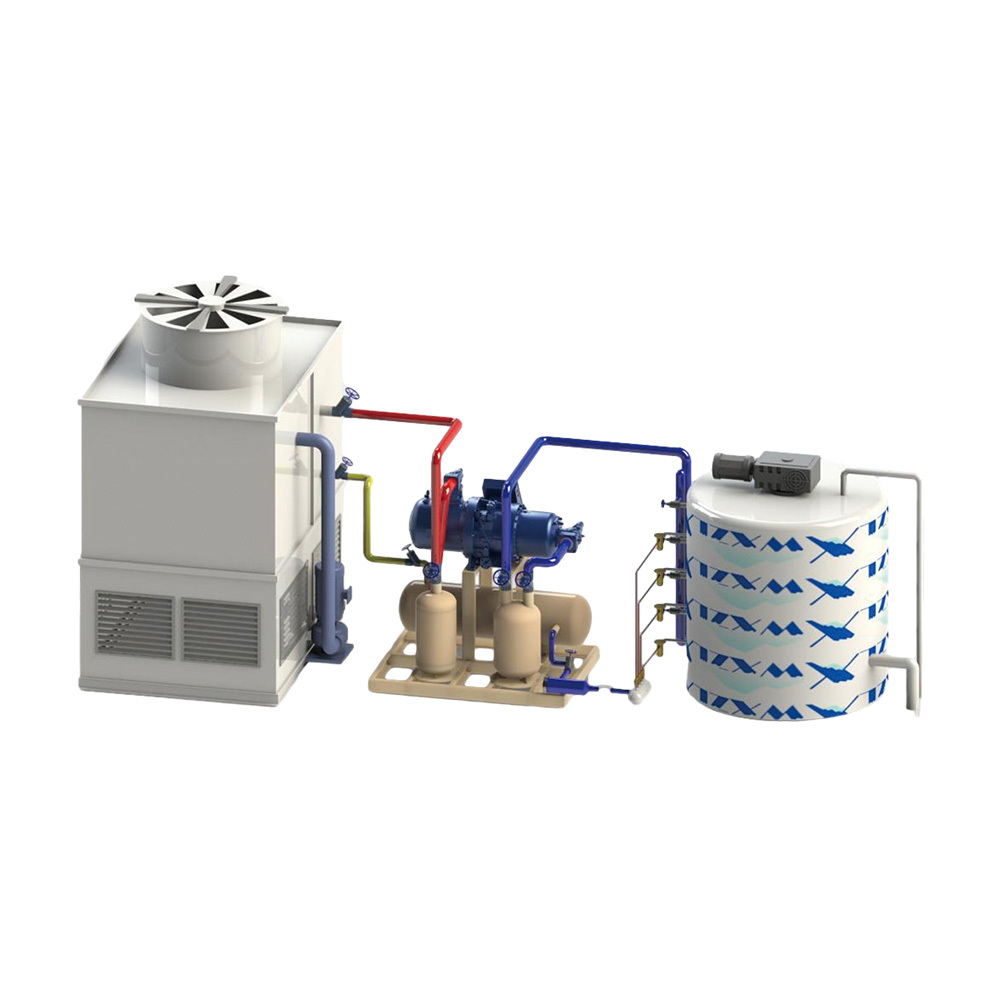
The original supplier illustration shows a separate heat-rejection enclosure, refrigeration assembly and vertical ice-making drum connected by pipes. It is a family illustration, not proof that every model price includes those components. The body describes an internal blade and automatic water supply, but it does not provide a complete piping diagram or identify the compressor and evaporator maker for each row.
Request the exact refrigeration package, condenser option, water-feed equipment, drain connections and ice-discharge interface. Specify whether the order includes a bin, delivery conveyor or only the ice generator. Xinwuxin’s separate container system describes raked storage and screw conveying; those functions must not be assumed from the basic XIL machine page.
The XIL schedule gives production, refrigeration and machine utility data.
A selected bin and storage refrigeration boundary are separate from daily production.
Confirm discharge height, conveying rate and destination interface; no conveyor duty is provided by the bare-machine table.
The website promotes thin, smooth flakes and use with foods or pharmaceutical processes, but no reviewed material declaration, hygienic design dossier or independently checked certification establishes suitability for a specific product. Ask for water-quality limits, actual product-contact materials, cleaning/disinfection instructions and any evidence required by the buyer’s process. The marketing word ‘clean’ is not a compliance finding.
Confirm blade/drum inspection, wear-part replacement, access around the generator and condenser maintenance. The XIL-10T size row gives 3200 × 2050 × 1870 mm and 1980 kg. Require an issued model drawing, discharge elevation, dry/filled mass and lifting plan before fitting the equipment into a process line. No universal maintenance interval or spare-part lead time was verified.
Measure ice mass over an agreed duration while recording water temperature, ambient/heat-rejection conditions, selected supply and all included electrical loads. Establish flake quality/thickness and discharge behaviour under the chosen operating point, plus the required protective and restart tests. The source’s 1.6–2.3 mm statement should be confirmed for the selected unit, not treated as an independently tested result.
The reviewed tables contain eight model entries through XIL-25T; size variants remain together on this family page. Current price, availability, delivered daily output and independently verified customer results are unknown. A comparable enquiry includes the actual production duty and utility/package boundary instead of asking only for the cheapest ‘tonnage’.
Specify water and air conditions, operating hours and the process consumption profile.
Select supply, refrigerant, heat rejection, bin/conveyor boundary and product-contact requirements.
Agree measured production, total electrical input, ice condition and protective tests at a documented operating point.
Compiled by HVACDeck Editorial. Source review identifies what the publication states; it is not an independent performance test or certification.
Editorial method and corrections · Report a detail with this page URL
Send the manufacturer your required duty, installation conditions and the unresolved items identified in this brief.
Xinwuxin integrated centrifugal chillers · Surge, oil and site scope
Xinwuxin air-cooled screw chillers · Ambient and circuit selection
Xinwuxin parallel screw packages · Compressor and oil-system scope
Xinwuxin container ice systems · Production, storage and conveying
Xinwuxin integrated chillers · Package and site interfaces
Xinwuxin screw chillers · Water and secondary-fluid selection