
Gerui T35 axial fans · Operating point and total-pressure selection
Use a complete size/speed/motor row and a selected curve rather than combining the table’s largest flow and pressure.
From Gaobeidian Gerui · General and process-air fan manufacture
Individual product research · HVACDeck Editorial · Sources checked 2026-10-11

Select the axial fan against the actual system resistance
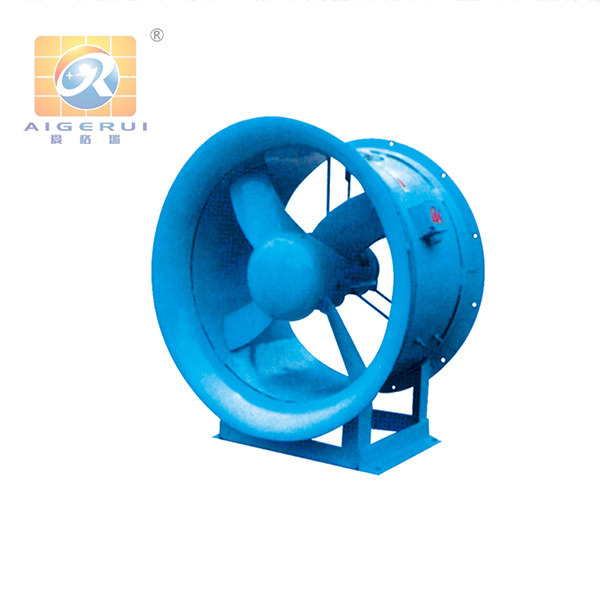
Gerui identifies T35 as an axial fan for general factory, warehouse, office and residential ventilation, also mentioning heat distribution. Its original family image shows an axial rotor in a cylindrical flanged casing on a support base. The webpage supplies two schedules covering smaller sizes and a second block headed No.5.6C–7.1. Unlike a photograph-only listing, these tables support specific row examples, provided their speed and total-pressure labels remain attached.
The published numbers are supplier catalogue values, not a fresh witnessed performance test. No air-density/temperature reference, sound schedule, dimensioned installation drawing or current conformity report was reviewed. This brief consolidates the sizes and speeds into one T35 family and focuses on how to select a point against the actual ventilation system. It does not treat the source's casing-removal or serial-installation suggestions as approved instructions for an arbitrary site.
Published parameters and their scope
This is an equipment family; its range does not identify one orderable configuration.
- Family designation
- T35; size and speed alternatives consolidated
Swipe the table, or focus it and use arrow keys, to read the conditions and sources.
| Parameter | Published value | Conditions and evidence |
|---|---|---|
| Published application | General factory, warehouse, office and residential ventilation | Supplier scope; not a smoke-exhaust, explosive-gas or corrosion approval. Source |
| Original family construction | Axial rotor, cylindrical flanged casing and support base | Supplier family photograph inspected; selected guards, dimensions and drive remain to be issued. Source |
| Actual No.5.6C example | 1450 r/min; YSF-7124 motor 0.37 kW; 6025 m³/h; total pressure 140.9 Pa | Exact row in the second official table; reference air condition and independent test basis absent. Source |
| No.5.6C higher motor row | 1450 r/min; YT90S-4 1.1 kW; 11110–12239 m³/h; total pressure 182.1–206 Pa | Published operating-range row, not an arbitrary combined maximum point. Source |
| Motor-power meaning | Listed 配用电机 kW is the selected motor column | Not established as measured fan/package electrical input. Source |
| Remaining selection evidence | Curve, air-reference conditions, static/total convention, sound and dimensions | No inferred pressure reserve, efficiency or room-area performance. Source |
Selection and application review
Read one selected row with its speed and motor
The No.5.6C block gives a 1450 r/min row with YSF-7124, 0.37 kW, 6025 m³/h and 140.9 Pa total pressure. Another 1450 r/min row uses a 1.1 kW YT90S-4 and a flow/pressure range. They are alternatives in the supplier schedule, not proof that a single unchanged unit delivers every point by switching an unspecified control.
Ask for the ordered blade/rotor construction, motor and speed plus its full curve. The first table has malformed unit typography and the second block's title contains a C suffix; no transmission meaning is assigned to that suffix without a supplier drawing. Motor labels and unresolved source text remain part of the selection review.
Keep total pressure distinct from the installation requirement
The official column says 全压, or total pressure. Issue the project's required flow and clearly defined pressure, including the losses and measurement boundary used by the ventilation designer. Obtain a supplier selection on the same convention. Do not read catalogue total pressure as guaranteed available external static pressure.
Specify entering-air conditions and site altitude so the supplier can state the rating basis. No density or thermal correction is calculated from an absent reference. A table row without a complete curve also cannot prove stable operation over every duct/filter condition.
Treat the medium and mechanical protection explicitly
The T35 body describes ordinary ventilation; it provides no reviewed combustible-gas, high-temperature smoke or aggressive-chemical qualification. Give the actual medium, temperature and contamination to the supplier. If the application is outside ordinary air duty, request the appropriate documented construction rather than extending the T35 name.
The family image exposes the rotor opening. Confirm supplied inlet/outlet guards, access protection, support and vibration arrangement for the installed configuration. The catalogue's suggestion to remove the casing is not an instruction endorsed here; require the manufacturer's issued configuration and responsible designer's installation approval.
Compare airflow, sound and complete electrical scope
The source mentions serial placement in a long duct, but supplies no joint-system curve, spacing instructions or controls for that arrangement. Do not promise additional pressure or coordinated operation from the sentence alone. Obtain a designed selection if multiple fans are proposed.
Request sound data with speed and measurement basis, supply/starting or speed-control compatibility, complete electrical input and service access. Agree the actual balance/run and fan-performance checks with the order. Price, delivery and independent efficiency results remain unknown. The same size/speed table stays on this single family page rather than becoming dozens of artificial model URLs.
Issue the ventilation point
Provide flow, pressure convention, medium and air conditions.
Name the ordered assembly
Select rotor/blades, motor, speed, guards and an issued drawing/curve.
Agree installed verification
Set electrical, sound, vibration and operating checks at the accepted configuration.
Sources and review scope
Compiled by HVACDeck Editorial. Source review identifies what the publication states; it is not an independent performance test or certification.
- Official Gerui T35 family and schedulesChecked 2026-10-11 · Full body and both HTML tables read; exact No.5.6C examples quoted with motor/speed/total-pressure scope and missing air-reference basis.
Editorial method and corrections · Report a detail with this page URL
Turn the evidence into an enquiry
Send the manufacturer your required duty, installation conditions and the unresolved items identified in this brief.
Other equipment from this manufacturer
Gerui G6-41 boiler air fans · Role and operating-point evidence
Gerui XQ air-slide process fans · Air duty and interface selection
Gerui 9-19 high-pressure centrifugal fans · Correct schedule and duty
Gerui 4-72 centrifugal fans · Duty, transmission and catalogue consistency
Gerui GD30K2 axial fans · Motor arrangement and medium review