
Cling CM160 narrow-body Jeepney cooling
Select the narrow roof, passenger load and drive interfaces together; the page omits rating temperatures and complete input.
From Zhengzhou Cling · Vehicle HVAC and thermal management
Individual product research · HVACDeck Editorial · Sources checked 2026-10-11

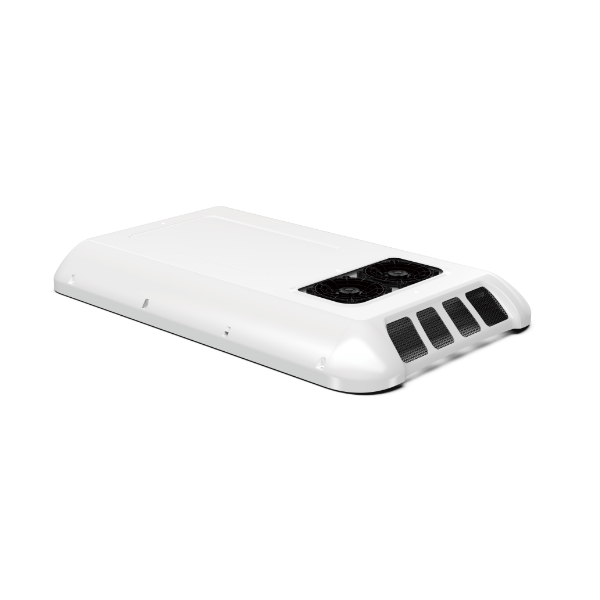
Approve CM160 on a narrow Jeepney/PUV body
Cling’s CM160/CM160S narrow-body cooling family is aimed at roughly 6 m Jeepney/PUV applications, especially the Southeast Asian market. Its distinguishing evidence is the 1,360 mm-wide roof assembly and model-specific mass/height, not simply a smaller nominal capacity. The source provides R134a, airflow and compressor references but no thermal test-temperature footnote on this page. Do not inherit another Cling roof family’s rating conditions.
CM160 lists 14 kW, 90 kg and 2,200 × 1,360 × 210 mm; CM160S lists 16 kW, 96 kg and a 215 mm height. Both rows give 313 cc compressor displacement and a 55 A entry under a maximum-power heading. Confirm the actual compressor speed, voltage and roof/air interfaces. The promotional comparison with an older 139 kg product has no complete matched performance or installation file in the reviewed material.
Published parameters and their scope
This is an equipment family; its range does not identify one orderable configuration.
- Family designation
- CM160 / CM160S
Swipe the table, or focus it and use arrow keys, to read the conditions and sources.
| Parameter | Published value | Conditions and evidence |
|---|---|---|
| Narrow-body reference | CM160: 2,200 × 1,360 × 210 mm; 90 kg | Official body dimensions/mass; installed mount/support envelope still required. Source |
| CM160S alternative | 16 kW; 96 kg; 2,200 × 1,360 × 215 mm | Same family, different selected configuration; not a separate nominal-capacity page. Source |
| CM160 thermal row | 14 kW; R134a | No air-temperature/humidity or compressor-speed test footnote on reviewed page. Source |
| Shared air/drive references | Evaporator 3,200 m³/h; condenser 4,000 m³/h; 313 cc compressor | No delivered duct flow or complete compressor-drive selection provided. Source |
| Electrical row | 55 A beneath maximum-power heading | No defined voltage or total input; not 55 W or complete system energy. Source |
| Historical comparison | Source compares 90 kg unit with a previous 139 kg product | No complete matched old-model duty/test/installation file; no independently verified equivalence. Source |
Selection and application review
Prove that the narrow roof assembly fits the actual body
Obtain the Jeepney/PUV roof section, supports, mounting points and return/discharge openings. The 1,360 mm body width is a useful shortlist criterion, but it is not the required structural opening, support span or installed service clearance. Confirm body-builder approval and vehicle-clearance limits.
Select CM160 or CM160S using the actual 210/215 mm height and 90/96 kg entries, together with the ordered mount and accessories. The suggested 6 m use and market label do not establish fit on every local chassis or converted body.
Request cooling duty at the tropical route conditions
Provide ambient/humidity, solar exposure, occupancy, door use and idle/driving operation. The page has no thermal test footnote; obtain the air conditions and compressor speed behind 14/16 kW before comparing another family’s nominal number.
Ask for pull-down, idle capacity and input at the route’s actual climate. The supplier’s older-product comparison does not provide an independent matched-duty test. Do not promise equal cooling, a weight-derived fuel saving or improved passenger comfort solely from the promoted mass reduction.
Close the compact vehicle’s drive and electrical budget
Require the actual 313 cc compressor model, mounting/drive ratio, control and speed-dependent selection. A displacement entry is not enough to approve mechanical demand or cooling at idle. Clarify all refrigerant-side included components and installation responsibilities.
The shared 55 A row lacks voltage and operating basis. Obtain fan/control current, protection and startup requirements; do not describe it as complete refrigeration power. Check the vehicle’s alternator/auxiliary architecture with the body builder using the approved schedule.
Check air delivery and maintainability in the narrow cabin
Obtain return/discharge layouts, duct resistance allowance and air distribution to the occupied seating zones. Catalogue airflow is not proof of delivered cooling after narrow-ceiling ducts and grilles are installed. Request comparable acoustic and vibration evidence if the project specifies limits.
Approve drainage, filter access and the route for fan/refrigerant service. The source promotes easy maintenance but supplies no measured task time or removal drawing. Reserve access before roof and ceiling finishes are frozen, and obtain the destination service and spare-parts responsibilities.
Approve one current narrow-body configuration
Issue vehicle drawings, climate/passenger loads, drivetrain/power limits and destination requirements. Obtain the selected CM160/CM160S configuration with conditioned performance, complete drive/electrical data and installation instructions. Hold the missing rating conditions as an explicit approval question.
Acceptance should include roof/support fit, idle/driving cabin cooling, delivered air, controls and leak/service checks at agreed conditions. Current price, stock, delivery and independently verified old-model comparisons remain unknown. The brief keeps both size variants in one real application page.
Approve the narrow roof
Freeze body-builder supports, openings and service space.
Close thermal/drive conditions
Obtain climate, speed, compressor and current/voltage schedules.
Test the route configuration
Verify cabin/air/control performance and maintenance access.
Sources and review scope
Compiled by HVACDeck Editorial. Source review identifies what the publication states; it is not an independent performance test or certification.
- Official CM160/CM160S pageChecked 2026-10-11 · Full two-model table, Jeepney/PUV application, weight comparison and update warning read; no test-temperature footnote supplied.
- Original narrow-body family imageChecked 2026-10-11 · Original compact roof-family image visually inspected; actual vehicle installation/approval not shown.

Editorial method and corrections · Report a detail with this page URL
Turn the evidence into an enquiry
Send the manufacturer your required duty, installation conditions and the unresolved items identified in this brief.
Continue the selection
Other equipment from this manufacturer
Cling EFDR independent glycol cooling
Cling EDDR roof-mounted liquid battery cooling
Cling DFDD independent-drive vehicle cooling
Cling FFND/XFND internal bus cooling