
EFDR standalone unit
Internal pump and glycol interfaces with the outline of the model chosen.
 HVAC & REFRIGERATION
Self-contained units that chill a 50% ethylene-glycol loop with an internal pump, sized from 3 to 10 kW.
From Zhengzhou Cling · Vehicle HVAC and thermal management
Product guide · HVACDeck Editorial · Sources checked 2026-10-11
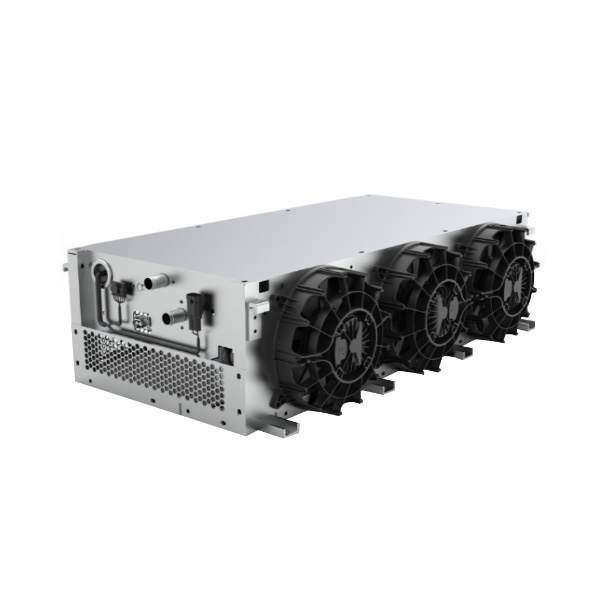
EFDR is Cling's standalone liquid thermal-management unit. It chills a 50% by-volume ethylene-glycol loop through an internal pump, in four sizes of 3, 5, 8 and 10 kW (EFDR-01 to -04). Cling lists it with its vehicle refrigeration products, yet the duty is a coolant circuit for a component such as a battery; cargo-box cooling is a different product. Power comes from a 600 V nominal high-voltage bus plus a 24 V nominal low-voltage supply, with R134a or R1234yf and an IP67 statement.
Cling's capacity pages disagree on two points. The 10 kW page gives pump powers of 100/240/240/300 W, while the 3–5 kW page shows a single 100 W cell across the series, and the body-size layouts differ too. No coolant temperatures, flow or pressure-loss curve is printed. With your heat load and coolant set points in hand, Cling can give the current pump selection, curve and outline drawing for your model; get these before fixing the installation.
This is an equipment family; ask the manufacturer to select the model that matches your duty.
Swipe the table, or focus it and use arrow keys, to read the conditions and sources.
| Parameter | Published value | Conditions and sources |
|---|---|---|
| Cooling sizes | EFDR-01/02/03/04: 3/5/8/10 kW | Ask for the coolant inlet and outlet, flow and ambient behind each rating. Source |
| Pump power | 10 kW and 8 kW pages: 100/240/240/300 W; 3–5 kW page: merged 100 W | Request the pump for your model with its curve; motor watts do not give head. Source |
| Body sizes on the 10 kW page | 01: 685 × 600 × 280 mm; 02/03: 818 × 600 × 280 mm; 04: 1,005 × 557 × 280 mm | The 3–5 kW page shows the smaller outline across models; get the drawing for your order. Source |
| Power supply | 600 V nominal high voltage; 24 V nominal low voltage; low-voltage demand 450/800/800/1,000 W | The demand row is the low-voltage side; ask for compressor and total input. Source |
| Coolant, protection and refrigerant | 50% V/V ethylene glycol; IP67 claim; R134a/R1234yf alternatives | Ask for the IP test report, coolant compatibility and which refrigerant is fitted. Source |
| Options and EMC | PTC 5/10/14/24 kW, expansion tank/DC supply options; EN50487:2010 named | Options are priced separately; ask for the exact EMC standard and report. Source |
Give the component heat-load profile, the coolant set points and the temperature and flow range it can accept. EFDR cools a secondary glycol circuit, so cargo airflow, box temperature or transport pull-down are outside its rating. Agree the thermal application and its limits with the integrator.
Ask for performance at your coolant and ambient conditions. The efficiency entry of 2.2 comes without a test basis, and −20°C to +60°C is the operating range; ask how capacity changes toward either end.
The 10 kW and 8 kW pages give different pump powers across the models, and the 3–5 kW page merges 100 W. Ask Cling for a current written pump part list and curve for the model you order, and keep both page versions on file until it arrives.
Work out the head left at your glycol concentration and temperature after circuit losses and at the flow you need. A 300 W motor rating gives none of that. Settle circulation control, vent and fill, expansion and low-flow protection against your circuit.
On the 10 kW page the two middle models share 818 × 600 × 280 mm and the largest is longer and narrower. The 3–5 kW page spreads one smaller outline across models. Ask for a current assembly drawing with mounts, connection projections, ventilation and removal access.
Φ25 connections and alternative connector brands need fixing on the order interface. Confirm coolant compatibility, whether R134a or R1234yf is fitted and the service procedure. The product photo shows the fan and connection side; the model, piping diagram and expansion tank are defined by the order documents.
The 450 to 1,000 W row is labelled low-voltage demand. Ask for the high-voltage compressor demand, auxiliary loads, start-up and protection limits and the wiring and connector file, and find out whether the unit or the vehicle provides low-voltage conversion. Calculate any COP only from figures Cling defines.
Optional PTC heaters, DC supply, a tube-fin condenser and an expansion tank belong on a selected bill of materials. Set heater duty and interlocks separately from cooling. Cling names EN50487:2010 for EMC; ask for the exact standard and the model test report before stating conformity.
Request the CAN message list, fault handling, isolation and protection interfaces and a commissioning sequence. Ask for the IP67 test report and the protocol file behind the CAN self-diagnosis, and state the installation environment. Accept the unit on coolant cooling, flow and pressure, input, control faults and any heater at agreed points, after the pump and outline questions are settled. Cling's quotation sets price, availability and shipping.
Internal pump and glycol interfaces with the outline of the model chosen.
Optional pump and a roof-mounted envelope; select it on its own drawing.
Needs air and box-temperature ratings, which this unit does not carry.
Ask Cling to confirm: capacity at your coolant temperatures, flow and ambient; the pump fitted to your model with its power and curve; the body size of that model; high-voltage and total input; the IP67 test report; the refrigerant fitted; which options are in the price; the EMC standard and report; and the CAN identifiers and fault codes.
Compiled by HVACDeck Editorial. Figures are as published by the manufacturer; ask for test records for the unit you select.
Editorial method and corrections · Report a detail with this page URL
Send the manufacturer your required duty, installation conditions and the points listed above to confirm.
Cling EDDR roof-mounted liquid battery cooling
Cling DFDD independent-drive vehicle cooling
Cling FFND/XFND internal bus cooling
Cling GZHD/EZHS rear-mounted bus HVAC
