
GZHD conventional rows
R134a cooling and a selected compressor/drive package.
 HVAC & REFRIGERATION
A common rear-mounting family contains different refrigerant and drive/heating architectures; approve air paths and interfaces per order.
From Zhengzhou Cling · Vehicle HVAC and thermal management
Individual product research · HVACDeck Editorial · Sources checked 2026-10-11
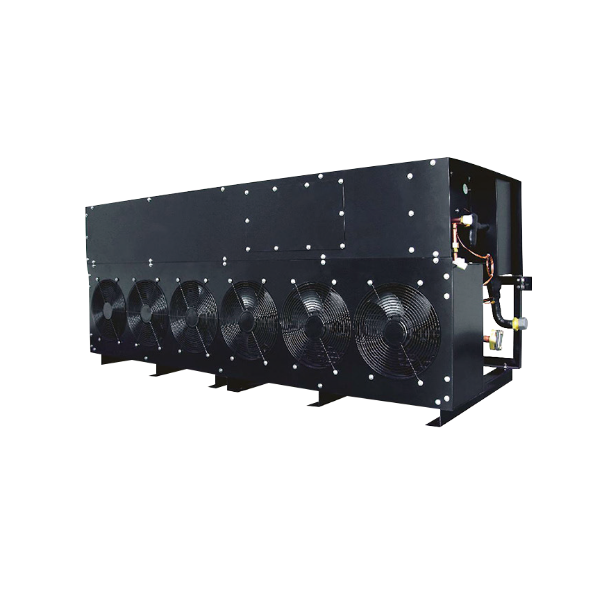
Cling’s rear-mounted GZHD/EZHS family is described for double-deck or large fuel-powered and electric buses. The common page combines conventional GZHD R134a cooling rows with an EZHS-08 R410A cooling/heating row. Mounting location and passenger-zone distribution are shared buying tasks, but the refrigerant, compressor and power/control configuration cannot be merged across the two architectures.
GZHD-08 lists 56 kW cooling, 10,000 m³/h evaporator airflow and 830 cc compressor displacement, while EZHS-08 lists 60 kW cooling and 58 kW heating with no displacement entry. Their body heights are 1,230 and 1,167 mm respectively. The shared footnote gives indoor 40°C/outdoor 35°C without separate heating, drive-speed or humidity definitions. Obtain rear-compartment, air-path and electrical/drive selections for the actual vehicle rather than adopting the common family label as a complete system.
This is an equipment family; its range does not identify one orderable configuration.
Swipe the table, or focus it and use arrow keys, to read the conditions and sources.
| Parameter | Published value | Conditions and evidence |
|---|---|---|
| GZHD-08 cooling reference | 56 kW; R134a; 830 cc compressor displacement | Published schedule; no heating value supplied for GZHD rows. Source |
| EZHS-08 reference | 60 kW cooling; 58 kW heating; R410A | Separate architecture; no complete heating conditions or electrical platform supplied. Source |
| Rear body comparison | GZHD-08: 2,000 × 750 × 1,230 mm; EZHS-08: 2,000 × 750 × 1,167 mm | Source outlines, not a complete compartment/support/service envelope. Source |
| Airflow references | Both large rows: evaporator 10,000 m³/h; condenser GZHD-08 12,000/EZHS-08 14,000 m³/h | Delivered passenger-zone flow and external pressure condition not defined. Source |
| Current-unit entries | GZHD-08 85 A; EZHS-08 103 A under maximum-power heading | Voltages/input boundaries not supplied; neither is a complete watts rating. Source |
| Distribution claim | Balanced upper/lower air supply advertised | No zone split, duct-resistance or independent installed balance result reviewed. Source |
Identify whether the order is a GZHD conventional cooling configuration or an EZHS electric cooling/heating configuration. Obtain the exact compressor/refrigerant circuit, power or drive interfaces and conditioned performance map. Shared mounting location does not make their R134a and R410A assemblies interchangeable.
The GZHD table leaves heating blank; do not transfer EZHS heating to it. For EZHS heating, request the actual outdoor/indoor conditions, input and defrost behaviour. The common air-temperature footnote does not define a complete heating map or vehicle electrical specification.
Supply the double-deck or large-bus duct layouts, seating-zone loads, return paths and damper/control requirements. Request delivered flow and pressure selection for each zone. The advertised balanced supply is not a measured upper/lower split at the body builder’s actual duct resistance.
Agree zoning, temperature sensors and operation at different occupancy levels. Verify access and noise paths from a rear assembly to the occupied cabin. No zone-by-zone sound, airflow or thermal acceptance result was supplied in the reviewed source.
Use the selected row’s height and connection envelope, not a roof-family drawing. Close supports, lifting/removal space, return/discharge openings, pipe/electrical routes and maintenance access with the vehicle builder. The two large rows have different heights even though their length/width entries match.
Check condenser air supply/discharge, recirculation and the interface with adjacent vehicle equipment under idle and driving conditions. Catalogue condenser flow does not by itself prove suitable heat rejection after installation in a confined rear compartment. Obtain current installed-layout instructions and the relevant climate validation.
The maximum-power row uses A but omits the exact supply and load boundary. Obtain the wiring, startup/input limits and protective/control requirements for EZHS and the electrical/drive scope for GZHD. A slash in the EZHS displacement row is not a licence to infer an absent compressor or reuse a conventional displacement.
Approve refrigerant service procedures, charge, leak-testing and spare identification for the exact assembly. Request current model/destination conformity evidence. A rear-family photograph showing a fan bank does not identify every included compressor, control or heat-exchanger component.
Provide passenger-zone loads, compartment/duct drawings, climate and drivetrain/electrical architecture. Obtain the selected model, thermal/input schedule and upper/lower airflow/control plan, together with the current installed drawing. Retain the supplier’s configuration/update warning.
Acceptance should verify cabin zones, condenser airflow, idle/driving and applicable heating modes, controls and accessible service. Current price, stock, delivery and independent balanced-air results remain unknown. One individually written rear-family brief covers the real architectural choices without spinning capacity rows into extra URLs.
R134a cooling and a selected compressor/drive package.
R410A cooling/heating with separately approved electrical/defrost data.
Compartment supports, condenser airflow and passenger-zone distribution.
Compiled by HVACDeck Editorial. Source review identifies what the publication states; it is not an independent performance test or certification.
Editorial method and corrections · Report a detail with this page URL
Send the manufacturer your required duty, installation conditions and the unresolved items identified in this brief.
Cling EFDR independent glycol cooling
Cling EDDR roof-mounted liquid battery cooling
Cling DFDD independent-drive vehicle cooling
Cling FFND/XFND internal bus cooling
