
AIRSYS EXCOOL indirect evaporative data-centre cooling
Separate primary and secondary air streams with a polymer exchanger and two spray arrangements; the hall interface, leakage, water use and auxiliary cooling need project evidence.
From AIRSYS precision and process cooling
Individual product research · HVACDeck Editorial · Sources checked 2026-10-11

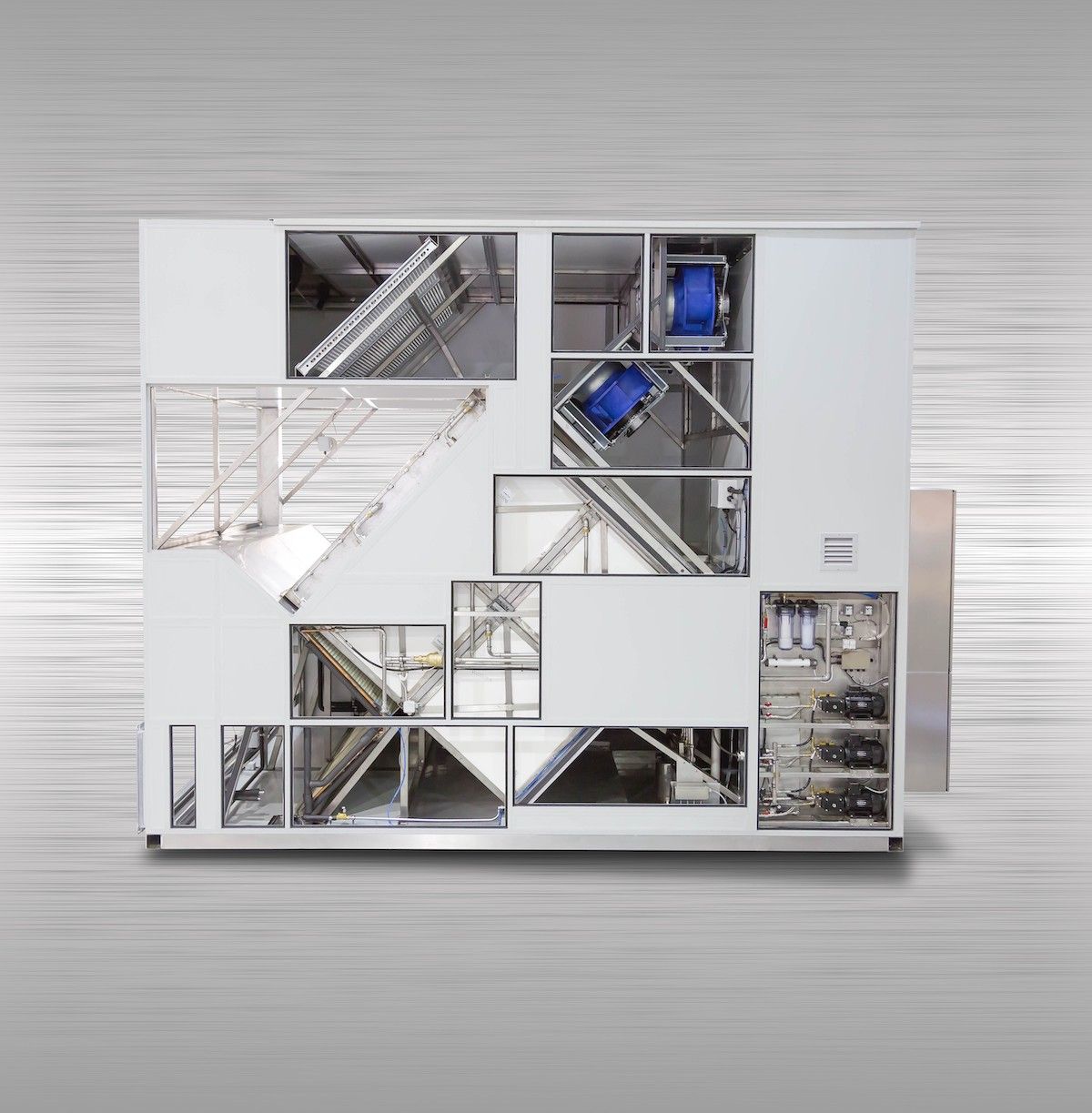
Evaluate EXCOOL's separated air paths and complete cooling-system boundary
AIRSYS describes EXCOOL as an indirect evaporative data-centre cooling approach. Outdoor secondary air is evaporatively cooled and exchanges heat with the primary air through a non-contact exchanger, so the primary stream is described as cooling without intentional moisture addition. This differs from a direct outside-air evaporative unit such as FREECOOL-AD.
The official page identifies a polymer heat-exchange core, welded stainless-steel unit construction, a high-pressure mist system and a separate recirculating-water spray system. It also markets low cooling-system pPUE and reduced indoor terminal equipment. The inspected page contains no selected model, air-volume/capacity schedule, exchanger leakage result or project calculation. This brief explains what must be specified at those boundaries rather than converting the system's marketing claims into a rated unit.
Published parameters and their scope
This is an equipment family; its range does not identify one orderable configuration.
- Family designation
- EXCOOL
Swipe the table, or focus it and use arrow keys, to read the conditions and sources.
| Parameter | Published value | Conditions and evidence |
|---|---|---|
| Cooling process | Indirect evaporation across separated primary/secondary air streams | Manufacturer's process description; actual leakage, pressure relationships and hall air conditions require a selected design. Source |
| Exchanger / unit materials | Polymer heat-exchange core; welded stainless-steel unit construction | Published descriptions; grades, details and allowed chemical exposure not provided. Source |
| Water arrangements | High-pressure mist and recirculating-water spray with separate pipework | Supplier says the systems can run independently and provide backup; no complete common-dependency diagram reviewed. Source |
| Drainage concept | Drain pump plus high-water-level overflow structure | Published construction; drainage capacity, discharge connection and failure response need project documents. Source |
| System efficiency claim | Website markets data-centre cooling-system pPUE below 1.2 | Supplier statement without a buyer-specific measurement boundary, weather/load calculation or verified site result. Source |
Selection and application review
Mark the primary, secondary and building air interfaces
The official description keeps the two streams apart at the exchanger. Obtain a schematic that identifies hall return/supply, outdoor intake/exhaust, dampers, fans and every building opening. Define the primary/secondary pressure relationship and request leakage information for the selected core and assembly. Non-contact heat transfer is not proof of zero leakage under every fault or operating condition.
Agree the delivered primary-air temperature/humidity, air volume and available pressure across the required climate and IT load envelope. Obtain the designer's containment, bypass and air-distribution analysis. A statement about avoiding indoor terminal equipment does not establish that every hall can omit all local distribution or backup equipment.
Distinguish the two spray systems from whole-plant redundancy
The manufacturer says its high-pressure mist and recirculating spray circuits have separate pipework and can operate independently. Request the actual sequence, performance in each available mode and common dependencies such as water source, electrical supplies, controller, exchanger and fans. Independent sprays do not automatically duplicate the entire cooling plant.
Define required remaining duty during spray, pump, fan or water-supply loss and planned maintenance. Include the means of meeting the hall's cooling requirement when evaporation cannot provide the selected supply condition. Redundancy and expansion should be specified as delivered arrangements, not inferred from a two-system paragraph.
Close make-up water, treatment and drains
No water-consumption table was available on the reviewed page. Obtain make-up, evaporation, recirculation, purge and drainage figures for the selected weather/load profile. Specify supply pressure/quality, treatment scope, monitoring and freeze/seasonal operating arrangements using the supplier's current installation and maintenance documents. A recirculation system's flow is not the site's consumed water.
The drain pump and overflow structure need a coordinated discharge route and failure response. Agree inspection/cleaning access for water trays, nozzles, mist equipment and the core, and identify who maintains water-system controls. No hygiene certification or site water assessment was established in this review.
Approve materials, core maintenance and site layout
The supplier attributes corrosion resistance to the polymer core and describes all-stainless welded construction. Request the actual material grades, air/water exposure limits, coating/fastener details and chemical-cleaning restrictions. The broad pollutant-resistance wording is not an unlimited chemical-compatibility guarantee.
Obtain the selected enclosure, weight, lifting/support details, exchanger removal route and service clearances. Outdoor intake/exhaust positions need coordination to avoid recirculation and to suit the building's weather exposure. The page's small-footprint and flexible-layout claims are not a project general arrangement.
Use a defined pPUE calculation and control deliverables
The page markets pPUE below 1.2 and refers to a mature UK-origin control strategy and open software interfaces. Ask for the system energy boundary, IT load/annual weather input, fan/pump/control/auxiliary power and operation under backup conditions. The platform has no measured site data establishing the claim for this buyer.
For integration, require the actual controller/version, point map, protocols, alarm priorities, mode transitions, access/licensing and cybersecurity responsibilities. Identify which controls and monitoring are included in the quotation. Factory and site acceptance should verify the selected air conditions, air paths and alarm/fault response. Exact capacity, price, current availability and warranty remain to be confirmed.
Sources and review scope
Compiled by HVACDeck Editorial. Source review identifies what the publication states; it is not an independent performance test or certification.
- Official EXCOOL process and system pageChecked 2026-10-11 · Complete live page read: separated air paths, polymer core, spray/drain construction and scoped efficiency claims. No model duty table or independent performance report supplied.
Editorial method and corrections · Report a detail with this page URL
Turn the evidence into an enquiry
Send the manufacturer your required duty, installation conditions and the unresolved items identified in this brief.
Continue the selection
Other equipment from this manufacturer
AIRSYS MOBILECOOL-OUTDOOR wall-mounted telecom cooling
AIRSYS DATACOOL-PACKAGE integrated room cooling
AIRSYS CYBERCOOL-MOD CW chilled-water room terminals
AIRSYS CYBERCOOL-MOD DXA air-cooled room cooling