
AIRSYS FREECOOL-HD high-density direct-air cooling
A larger split ventilation family for small and medium data centres, with upflow/downflow layouts and cooling stated against indoor/outdoor temperature difference.
From AIRSYS precision and process cooling
Individual product research · HVACDeck Editorial · Sources checked 2026-10-11

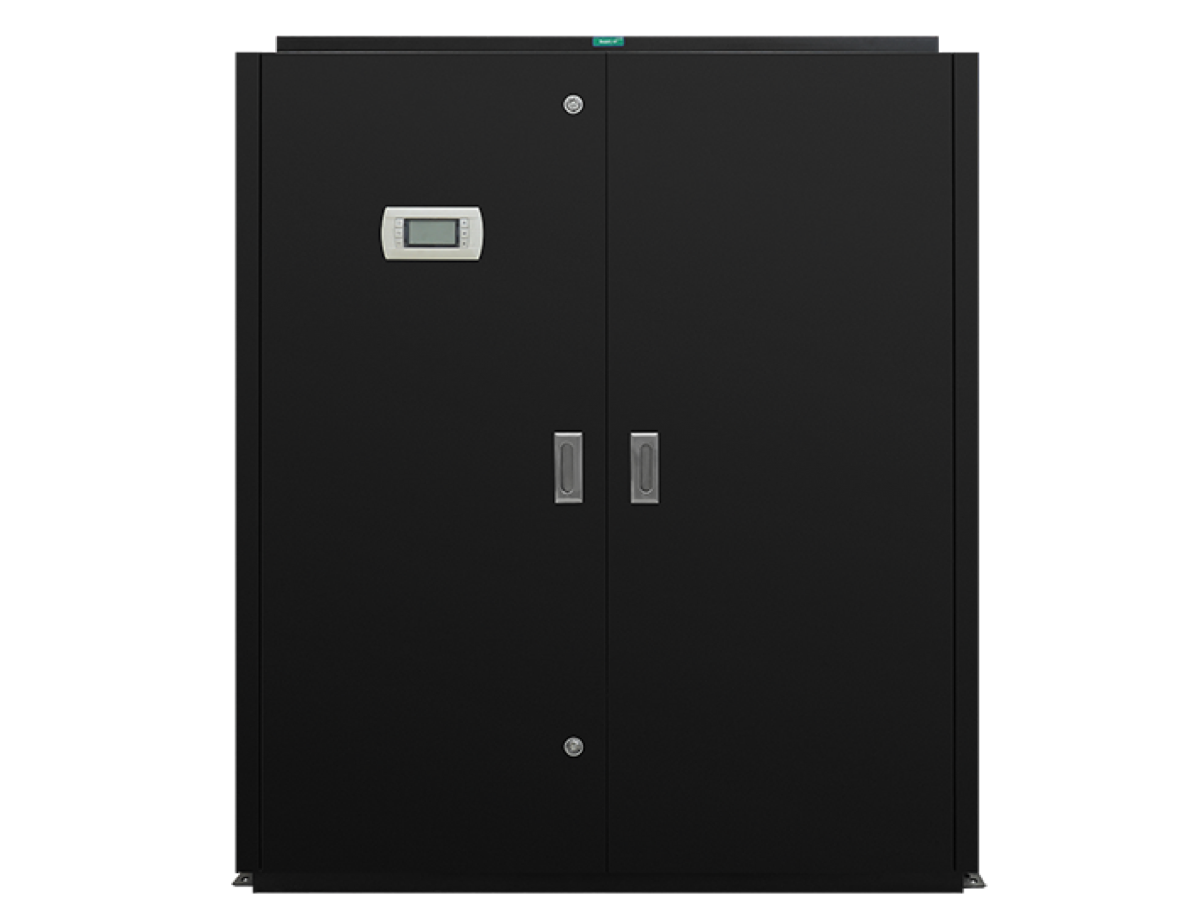
Select FREECOOL-HD around the air path, climate and remaining mechanical duty
FREECOOL-HD uses cooler outdoor air directly to remove heat from a small or medium equipment room. The official E1805V01.3 catalogue lists split indoor units in upflow and downflow forms and describes coordinating existing air conditioning when ventilation is insufficient. It has no refrigeration system of its own; the remaining hot-weather or outside-air-restricted duty therefore needs a separate cooling provision.
For the 48F2 column, the inspected technical spread states 4,750 m³/h with 7.9, 15.8 and 19 kW at temperature differences of 5, 10 and 12 °C. The code explanation calls 48 a nominal 4,800 m³/h; it should not overwrite the actual table. This family brief uses a selected column as an illustration and does not create separate near-identical pages for every fan count.
Published parameters and their scope
This is an equipment family; its range does not identify one orderable configuration.
- Family designation
- FREECOOL-HD
Swipe the table, or focus it and use arrow keys, to read the conditions and sources.
| Parameter | Published value | Conditions and evidence |
|---|---|---|
| Published installation | Indoor split construction; UP or DN supply | Catalogue says contact the supplier for outdoor-installed equipment. Indoor ratings do not establish an outdoor offer. Source |
| 48F2 listed airflow / capacity | 4,750 m³/h; 7.9 / 15.8 / 19 kW at Δt 5 / 10 / 12 °C | PDF page 6 technical table; delivered airflow and site thermal suitability still require selection. Source |
| 48F2 electrical entry | 230 V / 1Ph / 50 Hz; 1.0 kW; 6.1 A; two fans | Source table, not a 48 V DC supply despite the nominal model number and another section's DC wording. Source |
| 48F2 unit / shipping size | 1,150 W × 450 D × 1,320 H mm, 89 kg; packed 1,240 × 540 × 1,480 mm, 99 kg | Technical table explicitly distinguishes equipment dimensions and packaging. Source |
| Operating / storage range | −30 to +55 °C operation; −40 to +70 °C storage | Catalogue environment entries, not proof of full useful free-cooling capacity throughout either range. Source |
Selection and application review
Resolve the UP/DN air route and separate discharge section
The selected split unit includes a main intake unit and air-discharge section. UP and DN describe different supply paths, so coordinate the rack/room plan, penetrations, ducts, louvers and return/exhaust route with the actual design. Published airflow alone does not establish the temperature at the IT inlet or an acceptable room pressure.
Obtain a fan selection at the installed resistance and required dirty-filter condition, with the delivered discharge assembly included. For an outdoor installation, obtain a separate documented offer: the catalogue asks customers to contact AIRSYS for that arrangement rather than providing an outdoor schedule. Retain actual installation drawings for the ordered model.
Use the temperature-dependent table to define air-conditioner assistance
The 48F2 cooling figure nearly doubles when the temperature difference rises from 5 to 10 °C; it is not a constant 19 kW source. Have the designer select the room temperature limit and usable outdoor-air range against load and weather. Request the controls that enable ventilation, call the air conditioner for missing duty and block outside air when needed.
The broad family table reaches 21,600 m³/h on 216F3, but that does not make its larger airflow useful in every room. Evaluate air distribution, pressure, noise and full/partial load rather than selecting the largest figure. The advertised 30–90% saving remains a supplier claim until an annual weather/load/energy calculation or measured project evidence supports it.
Define usable outside-air hours
Set temperature, humidity and contamination conditions with the room designer.
Select delivered airflow
Include ducts, intake/discharge hardware and filter loading in the fan duty.
Prove the remaining cooling duty
Close the assistance, blocked-air and failed-component operating states with the mechanical system.
Do not transfer the brochure's DC emergency paragraph into an AC model
The feature text contains wording about FREECOOL.DC and operation during AC power failure. The FREECOOL-HD performance table instead lists 230 V single-phase for 24F1/48F2 and 400 V three-phase for the larger units. No tested DC emergency capability for the selected 48F2 is established by that paragraph.
Require the exact supply, protection, start/restart loads and controller/fan power arrangement. The brochure's automatic random restart is a control behaviour, not an assurance of continued cooling during loss of its power supply. Establish the facility's backup sequence and remaining duty separately.
Order the needed filtration, humidity and monitoring options explicitly
The catalogue lists G4 disposable filters and G2 pre-filtration as standard entries, with a clogged-filter pressure switch, humidity sensor and several communications items among options. Specify delivered filter media/classes and obtain the current maintenance and test documents relevant to the project. General cleanliness wording is not a verified room-air cleanliness class.
Agree humidity/contamination lockouts and the cooling response when air is rejected. Identify the actual RS232/RS485/PCOWEB card, protocol map, alarm points, access permissions and included software. A monitoring diagram is not evidence that every interface is present in the base unit.
Use unit, packaging and service dimensions for different decisions
The 48F2 has a listed 89 kg unit weight and 99 kg shipping weight. Plan logistics with the packed size and final support/access with the actual equipment drawing; do not use the smaller unpacked envelope for delivery clearance. Include removal space for fans, filters and the discharge assembly. The 59 dB(A) entry is measured at one metre and is not a site boundary-noise prediction.
A purchase should close selected capacity, installed airflow, all standard/options, civil and electrical works, linked-equipment controls and witnessed operating modes. Obtain current conformity documents for the exact unit; the webpage's CE wording has not been independently verified here. The platform has not tested the product or measured an installed energy saving.
Sources and review scope
Compiled by HVACDeck Editorial. Source review identifies what the publication states; it is not an independent performance test or certification.
- Official FREECOOL-HD pageChecked 2026-10-11 · Complete product description and conditional supplier claims read.
- Original FREECOOL-HD E1805V01.3 catalogueChecked 2026-10-11 · All ten pages read. PDF page 6 technical table visually checked; actual versus nominal airflow and DC wording versus AC supply discrepancy preserved.
Editorial method and corrections · Report a detail with this page URL
Turn the evidence into an enquiry
Send the manufacturer your required duty, installation conditions and the unresolved items identified in this brief.
Continue the selection
Other equipment from this manufacturer
AIRSYS MOBILECOOL-OUTDOOR wall-mounted telecom cooling
AIRSYS DATACOOL-PACKAGE integrated room cooling
AIRSYS CYBERCOOL-MOD CW chilled-water room terminals
AIRSYS CYBERCOOL-MOD DXA air-cooled room cooling