
Passenger-only selection
Cabin thermal duty and air/power/roof interfaces.
 HVAC & REFRIGERATION
The cabin and battery share a controlled refrigeration package; select the simultaneous loads and coolant interfaces explicitly.
From Zhengzhou Cling · Vehicle HVAC and thermal management
Individual product research · HVACDeck Editorial · Sources checked 2026-10-11
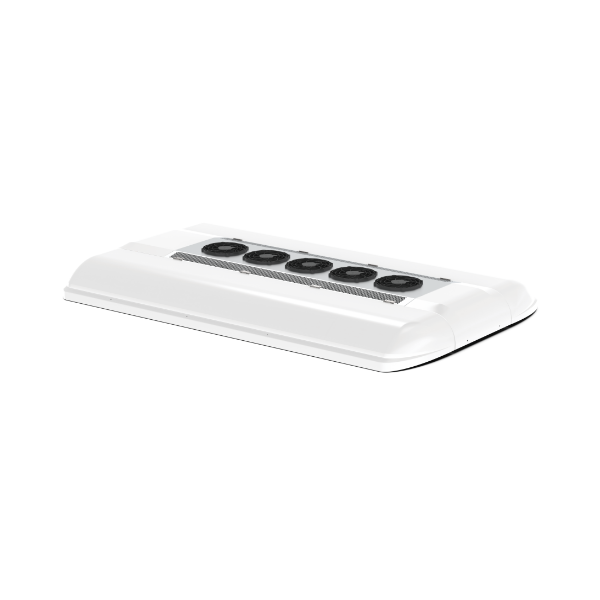
Cling’s EZDD-J/EZDS-J integrated roof heat-pump family combines passenger air conditioning with liquid-battery thermal management for electric, hybrid and fuel-cell buses. The official page explicitly describes controlled allocation of cooling between the cabin and battery circuits using electronic expansion valves and PID control. That allocation is the central enquiry issue: separate maximum rows do not show simultaneous performance, coolant conditions or which load has priority.
The EZDS-04-J reference lists 28 kW passenger cooling, 26 kW heating and 5/8 kW battery cooling while driving/charging, with R407C. The smallest EZDD-04-J has a different 3/5 kW battery row. The page’s shared test footnote says indoor 40°C/outdoor 35°C but supplies no separate battery coolant or heating rating schedule. Keep these conditioned-evidence limits visible and obtain an actual integrated selection before comparing with the passenger-only family.
This is an equipment family; its range does not identify one orderable configuration.
Swipe the table, or focus it and use arrow keys, to read the conditions and sources.
| Parameter | Published value | Conditions and evidence |
|---|---|---|
| Actual integrated architecture | Roof passenger HVAC plus liquid-battery thermal management | Official family description; exact coolant equipment/valve package not shown in a P&ID. Source |
| EZDS-04-J reference | 28 kW passenger cooling; 26 kW heating; battery 5/8 kW driving/charging | Source footnote indoor 40°C/outdoor 35°C; battery/heating conditions not defined. Source |
| Smallest model difference | EZDD-04-J: 17 kW cooling, 16 kW heating, battery 3/5 kW | Do not apply the 5/8 kW row to every family member. Source |
| Refrigerant and airflow | R407C; EZDS-04-J evaporator 4,000 m³/h, condenser 8,000 m³/h | Published table; charge, motor/input and air-distribution interfaces not provided. Source |
| Roof example | EZDS-04-J: 2,750 × 2,000 × 260 mm; 255 kg | Body reference for a suggested 7.5–9 m bus; not structural or load approval. Source |
| Comparative claims | 30% lower overall cost and 20% lower vehicle weight advertised | No matched baseline or complete vehicle/package scope reviewed; not adopted as project savings. Source |
Issue cabin cooling/heating loads and battery driving/charging heat rejection with their actual conditions. Request a simultaneous capacity map and priority sequence for cabin-only, battery-only and combined modes. A passenger 28 kW row and a battery 8 kW row cannot simply be added as a guaranteed simultaneous total.
The supplier states that cabin heating and battery cooling can coexist in low ambient. Obtain the temperature-dependent performance and valve sequence for that mode, including defrost and backup behaviour. The reviewed page does not give the outdoor threshold or show how passenger comfort is maintained during the battery’s peak charging demand.
Require coolant type, inlet/outlet limits, flow, pressure loss, allowable pressure and the included pump/treatment/expansion equipment. Obtain an order-specific P&ID and match it to the battery OEM’s permitted circuit. A liquid-battery application statement is not an approved OEM interface.
Agree sensor positions, coolant-leak/freeze response, isolation and service filling/venting. Confirm what remains active while charging with the vehicle otherwise off. The source’s battery kW rows omit those coolant conditions and cannot close a battery-system selection on their own.
The integrated J-series table does not state high/low-voltage ranges or current/input. Request them for the selected model and operating modes; do not borrow the passenger-only table’s 400–750 V/24 V entries automatically. Define vehicle power permissions, charging supply and protection/interlocks.
Obtain the exact controller signals, communication protocol, setpoints and failure priorities. The page names two-/four-way electronic expansion valves and PID, but not an issued wiring/register file. Specify alarm, communication-loss and restart tests against the actual vehicle control architecture.
The promoted cost and vehicle-weight percentages lack a matched baseline. Compare actual included equipment, refrigerant/coolant piping, controllers, electrical components and installation labour between an integrated package and separate cabin/battery units. Use current order masses and quotations instead of applying a headline saving to the whole bus.
The EZDS-04-J body is listed at 255 kg, while other sizes differ. Approve roof loads, openings, air distribution, coolant routing and service access using an issued drawing. Similar-looking roof photographs do not establish identical plumbing or mounting across the passenger-only and integrated families.
Obtain the current exact model, conditioned thermal/coolant/electrical schedule, P&ID and controls. The supplier warns that web tables can lag actual configurations; retain the approved revision in the purchase file rather than relying on a short family label.
Agree tests for charging cooling, driving cooling, cabin heating/cooling, simultaneous demands, defrost and relevant fault responses. Include filling/leak checks, service instructions and destination approval evidence. Price, stock, firm delivery and independent integrated energy savings remain unknown.
Cabin thermal duty and air/power/roof interfaces.
Additional battery coolant duty, simultaneous capacity and control priorities.
OEM-approved coolant/electrical interfaces and tested operating modes.
Compiled by HVACDeck Editorial. Source review identifies what the publication states; it is not an independent performance test or certification.
Editorial method and corrections · Report a detail with this page URL
Send the manufacturer your required duty, installation conditions and the unresolved items identified in this brief.
Cling EFDR independent glycol cooling
Cling EDDR roof-mounted liquid battery cooling
Cling DFDD independent-drive vehicle cooling
Cling FFND/XFND internal bus cooling
